
Every home cook deserves a reliable surface that makes meal prep safer, easier, and more enjoyable. If you’ve been settling for a flimsy plastic board that slides around your counter, it’s time to upgrade to something built to last. A butcher block cutting board is one of the most worthwhile investments you can make for your kitchen, combining durability, beauty, and functionality in a single tool.
But with so many options on the market, choosing the right one can feel overwhelming, especially if you’re new to the world of quality kitchen gear. What wood is best? How thick should it be? Does size really matter? These are all valid questions, and you deserve clear, straightforward answers.
In this guide, we’ve done the research for you. You’ll discover the top butcher block cutting boards available today, what features to look for before buying, and practical tips to help you maintain your board for years to come. Whether you’re just starting to build your kitchen essentials or ready to replace an old worn-out board, this list has everything you need to make a confident choice.
Quick Picks: Best Butcher Block Cutting Boards by Tier
Not every cook needs the same board, and the right choice depends on your budget, skill level, and how often you reach for a knife. Here is a quick breakdown of the four best tiers to help you find your match fast.
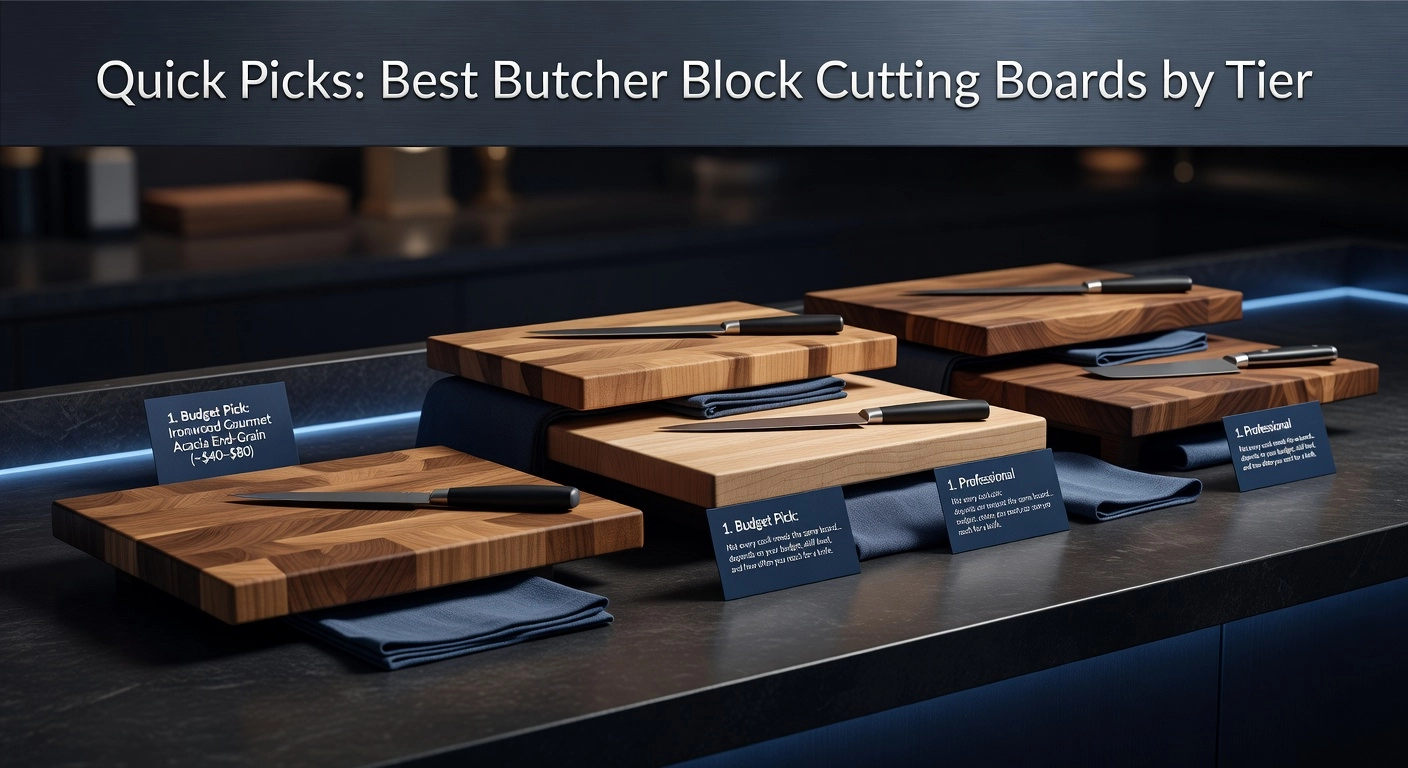
1. Budget Pick: Ironwood Gourmet Acacia End-Grain (~$40–$80) The Ironwood Gourmet acacia end-grain board is the go-to recommendation for first-time wood board buyers. Wirecutter names it a top budget wood option, praising its end-grain construction for being gentler on knife edges than most boards in its price range. It is lighter and easier to handle than premium maple boards, making it practical for smaller kitchens. Best for: beginners testing the benefits of wood before committing to a higher investment.
2. Best Overall: Jones Cutting Boards Maple End-Grain (~$175–$185) Wirecutter’s top overall pick, this handcrafted Pennsylvania-made board hits the sweet spot between performance, size, and price. Tight joints, smooth finishing, and self-healing end-grain fibers make it a reliable daily workhorse. Best for: most home cooks who want excellent knife feel and long-term durability.
3. Premium Pick: The Boardsmith Maple End-Grain (~$230+) Consistently ranked at the top by both Wirecutter and Serious Eats, The Boardsmith delivers superior craftsmanship, FSC-certified maple, and exceptional resistance to warping and gouging. Best for: enthusiasts wanting a heirloom-quality board built for decades of heavy use.
4. DIY/Build Pick: Rough Maple or Walnut Lumber Sourcing kiln-dried hardwood lumber from a local dealer gives you the lowest cost per square inch of any option here. With basic woodworking tools and a good glue-up plan, you can build a fully custom board. Best for: woodworking enthusiasts who want maximum value and full control over size and wood species.
End-Grain vs. Edge-Grain vs. Face-Grain: Which Construction Actually Matters
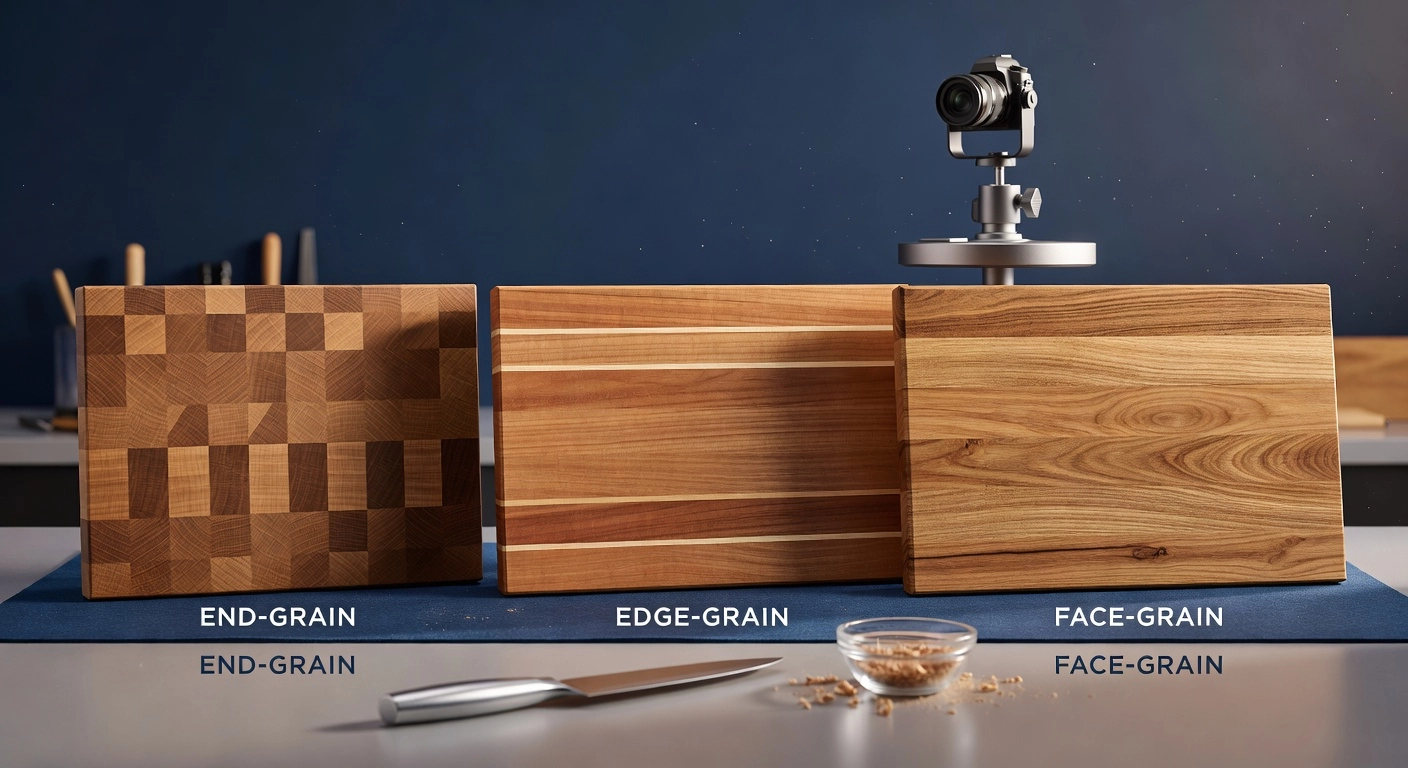
Understanding how a butcher block cutting board is built is one of the most important factors in choosing the right one. The three construction types look different, perform differently, and suit different kinds of cooks.
1. End-Grain: The Premium Choice for Knife Performance
End-grain boards are constructed by orienting wood blocks so the cut ends of the fibers face upward toward the cutting surface. Think of the wood fibers as a bundle of drinking straws standing on end. When you bring a knife down, the blade slips between those fibers rather than slicing across them. This fiber-friendly interaction is why end-grain boards are noticeably gentler on knife edges, helping blades stay sharper far longer than they would on plastic or other wood constructions. You also get shallower, less visible cut marks because the blade parts the fibers rather than severing them.
2. The Self-Healing Effect Explained
One of end-grain’s most impressive qualities is what happens after the knife lifts. The compressed fibers partially spring back toward their original position, closing the groove instead of leaving a permanent scar. Regular oiling amplifies this effect by keeping fibers supple and responsive. Over months of use, a well-maintained end-grain board actually looks better than a neglected one, with shallow marks fading rather than accumulating into deep, bacteria-trapping grooves. This self-healing behavior is a primary reason serious home cooks invest in end-grain boards despite the higher price, which can range from $175 to over $400 for large premium maple versions. You can learn more about end-grain vs. edge-grain construction differences directly from woodworking experts.
3. Edge-Grain: Durable, Practical, and Budget-Friendly
Edge-grain boards show the long side of the wood fibers running parallel across the cutting surface. This construction is denser and typically more resistant to warping than face-grain, and it comes in at a noticeably lower price point than end-grain. The boards are also lighter and easier to handle daily. Knives do cut across fibers here rather than between them, so there is slightly more dulling over time, but the difference is modest for most home cooks. Edge-grain boards comfortably outperform plastic in both knife care and aesthetics, making them an excellent choice for budget-conscious buyers who want real wood durability without the premium investment. For a side-by-side breakdown, this detailed edge-grain vs. end-grain guide covers the key practical differences well.
4. Face-Grain: Beautiful but Best Left for Serving
Face-grain boards display the wide, flat side of a plank, which produces the most visually dramatic grain patterns. They are genuinely stunning on a charcuterie spread or as a serving board for bread and cheese. However, for active prep work, they are the weakest of the three options. Knife cuts go directly across the surface fibers, producing deeper gouges that do not close up over time. Face-grain boards are also more prone to cupping and warping when exposed to moisture from washing. If you want a dedicated board for heavy chopping, face-grain is not the right tool for the job. Reserve it for light duties and presentation.
5. The Clear Verdict
For serious home cooks who prep daily and want a board that lasts decades, end-grain is the right construction. The fiber orientation, self-healing properties, and knife-edge preservation add up to a genuinely superior cutting surface. For buyers who want solid wood performance at a more accessible price, edge-grain delivers excellent durability and real advantages over plastic without the premium cost. This comprehensive comparison of all three grain types confirms what most professional testers agree on: construction type is not just a marketing distinction; it directly shapes how your board performs and how long it lasts.
Maple, Walnut, Cherry, Acacia, or Teak: Which Wood Should You Choose
Now that you understand how construction affects performance, the species of wood you choose adds another layer of quality, durability, and aesthetics to your butcher block cutting board. Each wood brings a distinct set of strengths, and knowing the differences will help you match the right material to your actual kitchen needs.
1. Hard Maple: The Gold Standard
Hard maple, specifically sugar maple with a Janka hardness rating of approximately 1,450 lbf, is the most recommended wood for cutting boards among professional testers and woodworking experts alike. Its tight, closed grain structure resists moisture absorption, prevents bacteria from settling into deep grooves, and holds up to daily heavy prep work without warping or cracking prematurely. One of maple’s most practical advantages is how evenly it absorbs mineral oil or butcher block conditioner during routine maintenance, which means your board stays protected from end to end. It is widely available across North America, domestically sourced under strict U.S. forestry regulations, and priced accessibly relative to its performance. For a beginner buying their first serious board, hard maple is consistently the safest, most reliable choice across all use cases.
2. Black Walnut: Premium Aesthetics With Knife-Friendly Softness
Black walnut sits at roughly 1,010 lbf on the Janka scale, making it noticeably softer than maple, but that softness is actually a selling point for cooks who use high-quality knives regularly. The wood is gentler on blade edges, meaning your knives stay sharper between honings. Visually, walnut is one of the most striking options available, offering deep chocolate-brown tones with flowing grain patterns that look exceptional as serving or display boards. It performs well in daily prep but may show surface wear slightly faster than maple and benefits from more frequent oiling. Walnut is the go-to recommendation for anyone who wants a board that is as beautiful on the countertop as it is functional during meal prep.
3. Cherry: Best for Serving Boards and Light Prep
Cherry wood registers around 950 lbf on the Janka scale, placing it as the softest domestic hardwood in this comparison. That softer density makes it exceptionally gentle on knife edges, which experienced cooks with premium blades often appreciate. Cherry’s most distinctive characteristic is its transformation over time; it develops a warm, reddish-amber patina through regular use and light exposure that becomes more attractive with age. However, because of its lower hardness, cherry is best reserved for lighter prep tasks, charcuterie boards, or serving presentations rather than daily heavy chopping. If you enjoy a board that doubles as a kitchen display piece, cherry delivers both function and visual warmth in one package.
4. Acacia: Budget-Friendly but Buyer Beware
Acacia is one of the hardest woods commonly found in cutting boards, with many samples measuring above 1,700 lbf on the Janka scale, and it offers solid moisture resistance at an attractive price point. Budget boards in the $40 to $80 range are often made from acacia, making it the most accessible entry point for new buyers. The challenge is that quality varies enormously depending on sourcing and manufacturing standards; lower-grade acacia boards are prone to warping, cracking, and splintering, and some boards labeled acacia may include mixed or inconsistent species. Look for boards made from plantation-sourced, FSC-certified acacia to get the best balance of eco-responsibility and durability. Approach acacia with realistic expectations: it can serve you well at a budget price, but it rarely matches the consistency and longevity of domestic maple or walnut.
5. Teak: Moisture Resistance With Trade-Offs
Teak falls between 1,000 and 1,155 lbf on the Janka scale and is uniquely valued for the natural oils and silica compounds present within the wood itself. Those compounds make teak naturally resistant to moisture, rot, and fungal growth, which is a meaningful advantage in humid kitchens or for boards used near sinks. However, the same silica content that protects the wood can accelerate knife dulling faster than maple or walnut, and teak sometimes requires different conditioning products since its natural oils can interfere with standard mineral oil absorption. Sustainability sourcing is especially critical with teak; always look for FSC-certified plantation-grown material, as wild-harvested teak carries significant environmental and legal concerns. Teak is a solid choice for moisture-heavy environments, but the knife trade-off is worth factoring in before you buy.
Top Butcher Block Cutting Boards Reviewed by Price Tier
With wood species and construction types now covered, it is time to see how those factors play out across real boards at different price points. Here is how the market breaks down across three tiers, with honest assessments of what you actually get for your money.
Budget Tier ($40–$80): Ironwood Gourmet Acacia End-Grain
For beginners testing the waters, Ironwood Gourmet’s acacia end-grain boards offer a low-risk entry point into butcher block ownership. They are widely available on Amazon and in kitchen retailers, which makes them easy to find and replace. The contrasting acacia grain patterns also give these boards genuine visual appeal for serving charcuterie or cheese alongside daily chopping tasks.
The trade-offs are real, though. Construction tends to run thin, often under 1.25 inches, which reduces stability and increases the risk of warping over time. Grain and sanding quality can vary noticeably between units, and base models typically skip juice grooves entirely. The foam adhesive pads on the bottom wear off faster than rubber feet found on pricier boards. Acacia is also imported and carries no FSC certification, which matters if sustainable sourcing is a priority for you.
Bottom line for this tier: A solid starter board for light use, but expect to replace it sooner than a thicker, certified-wood alternative.
Mid-Range Tier ($80–$175): Made In and Jones Cutting Boards
This tier is where performance starts pulling meaningfully ahead of price. Made In’s edge-grain maple butcher block delivers solid everyday durability, a reversible design with a juice groove on one side, and a clean modern aesthetic that holds up well under regular use. Serious Eats highlights it for its reliable construction and maple’s knife-friendly hardness.
Jones Cutting Boards represents the strongest value in this entire roundup. Their maple end-grain board, typically around 1.5 inches thick, is Wirecutter’s top-recommended wooden cutting board for good reason. It uses domestically sourced maple, offers optional features like juice grooves and rubber feet, and shows genuine self-healing properties from the end-grain construction. Expect low staining and minimal visible scarring even after months of daily knife work.
Both boards exceed 1.5 inches in thickness, which is the benchmark most expert reviewers use to separate serious boards from entry-level options. FSC-certified or domestically sourced wood is available at this tier, a step up from the unverified import supply chains common in budget acacia boards.
Premium Tier ($175–$400+): John Boos and Boardsmith
John Boos has been producing professional-grade maple butcher block boards since 1887, and that reputation is backed by genuine construction quality. Popular models offer reversible designs, solid 1.25 to 1.5-inch maple construction, and availability through major retailers including Williams Sonoma. Food and Wine named a Boos model best overall in recent testing for its combination of sturdiness and accessible pricing within this tier.
The Boardsmith sits at the top of nearly every expert ranking. As noted in Serious Eats’ in-depth Boardsmith review, these handmade boards feature FSC-certified domestic maple, construction at 2 inches thick or more, and sturdy feet that stay put. They are built to heirloom standards, meaning a well-maintained Boardsmith board can outlast decades of heavy kitchen use.
The Honest Truth About Diminishing Returns
Here is what every beginner should understand before spending $400 on a premium board: a $175 edge-grain or end-grain board from a reputable brand like Jones or Made In will consistently outperform a neglected $400 Boardsmith. Maintenance is the great equalizer. Regular oiling with food-grade mineral oil, proper hand-washing, and immediate drying after use matter far more than the price tag when it comes to long-term performance.
The experts at Food and Wine reinforce this point repeatedly: any wood board, regardless of tier, needs consistent care to deliver on its potential. If you are just starting out, buy the best board your budget allows at the mid-range level and commit to a simple oiling routine. That combination will serve you far better than an expensive board left to dry out on the counter.
The Features Worth Paying For on a Butcher Block Board
Knowing which construction and wood species to choose gets you most of the way there, but the specific features on a board determine whether it performs safely and lasts for years or ends up warped in a drawer. Here are the five features that genuinely justify spending more.
1. Thickness of 1.5 Inches or More
Boards at 1.5 inches thick or greater resist the warping and cupping that plague thinner options, especially when exposed to repeated wetting and drying cycles. Extra thickness also means more material to work with when the surface eventually needs sanding or resurfacing, extending the board’s usable life by years. For end-grain boards in particular, structural integrity depends heavily on this depth. According to thickness guidance from wholesale cutting board suppliers, 1.5 inches is the practical minimum for heavy-duty or frequent use, with larger boards benefiting from going even thicker.
2. Juice Grooves and Reversible Designs
Juice grooves earn their place if you regularly break down whole chickens, carve roasts, or prep juicy fruits. They contain liquids that would otherwise run across your counter. For vegetable-focused cooks, though, grooves reduce usable surface area and complicate scraping and cleaning. A reversible board solves this cleanly, with one grooved side for wet tasks and one flat side for everything else.
3. Rubber Feet or Non-Slip Grip Strips
This feature is skipped on most budget boards, and that is a genuine safety problem. A board that slides while you are using a sharp knife creates real injury risk. Rubber feet also lift the board slightly off the counter, improving airflow and reducing moisture buildup underneath.
4. FSC Certification or Domestic Hardwood Sourcing
FSC certification confirms that the wood was harvested through responsible forest management practices. It also tends to signal more consistent wood quality, with fewer defects and better moisture control during processing. Domestically sourced hardwoods like North American maple carry similar traceability advantages.
5. What to Avoid Outright
Skip any board under 1 inch thick, as the warp risk and short resurfacing lifespan make it a poor investment regardless of price. Avoid boards labeled simply as “hardwood” without specifying the species; vague labeling often indicates inconsistent or lower-grade material. Finally, ignore any dishwasher-safe marketing claim on a wood board. Heat, prolonged moisture, and harsh detergents will cause even well-made boards to crack, split, or delaminate over time. Hand-washing and immediate drying are non-negotiable for any butcher block cutting board worth owning.
How to Keep a Butcher Block Cutting Board Looking New for Decades
A quality butcher block cutting board is genuinely a lifetime investment, but only if you treat it right from day one. The five practices below cover everything a beginner needs to keep any wood board looking and performing like new for decades.
1. Choose the Right Product for the Job
Not all wood care products work the same way, and using the wrong one at the wrong stage shortens your board’s life. Food-grade mineral oil is the foundation of all wood board care. It soaks deep into the wood fibers, hydrating them from the inside out and preventing the drying and cracking that destroys boards prematurely. It does not form a hard surface layer, which means it needs to be reapplied regularly, but it is safe, affordable, and effective for raw or thirsty wood.
Butcher block conditioners take things a step further by combining mineral oil with waxes such as beeswax or carnauba wax. The oil still penetrates, but the wax component leaves a thin, water-resistant barrier on the surface that repels moisture, reduces staining, and adds a gentle sheen. These are the best choice for ongoing maintenance coats once your board is fully seasoned. Beeswax blends deliver the best of both worlds, offering deep hydration alongside stronger surface protection and a buffable finish. They are ideal for monthly upkeep and for boards you use for serving or display. One important rule applies across all three options: avoid cooking oils like olive oil or vegetable oil, as they go rancid inside the wood and create odor and hygiene problems.
2. Season a New Board Properly
A brand-new butcher block cutting board is essentially dry wood, and it will absorb oil aggressively until fully saturated. Apply food-grade mineral oil generously to all surfaces, including the bottom and all four sides, and let it soak in for several hours or overnight. Wipe off any excess, then repeat the process. You should complete five to seven applications over the first two weeks, allowing each coat to absorb fully before adding the next. You will know the board is fully saturated when the oil no longer soaks in quickly and sits on the surface instead. This initial seasoning schedule is the single most important thing you can do to extend your board’s life.
3. Stick to a Simple Monthly Routine
After the first seasoning, maintenance becomes straightforward. After each use, wipe the board with mild dish soap and warm water, then dry it immediately and thoroughly with a towel. Never let it soak in the sink and never put it in the dishwasher, as prolonged water exposure causes warping, cracking, and glue joint failure. Once a month, or whenever the surface looks dull and water absorbs instead of beading, apply a thin coat of conditioner or beeswax blend, let it sit for at least 20 minutes, then buff it dry with a clean cloth. According to Serious Eats, tying your oiling schedule to another regular kitchen task, like sharpening your knives, makes it easy to stay consistent.
4. Fix Surface Scratches Yourself
Light knife marks and surface scratches are completely normal and do not require professional help to fix. Clean and dry the board fully, then sand lightly along the wood grain using 220-grit sandpaper. Use a sanding block to keep pressure even and avoid digging in. After sanding, wipe away all dust with a slightly damp cloth, let the board dry completely, and immediately apply several generous coats of mineral oil or conditioner to restore full protection. The freshly sanded wood will absorb oil quickly, so do not skip the re-oiling step. This process restores most light to moderate surface damage and leaves the board looking nearly new.
5. Prevent Warping Before It Starts
Warping happens when one side of the board absorbs more moisture than the other, causing uneven expansion. The fix is simple: always oil both sides equally during every treatment, including the very first seasoning. Store the board vertically in a drying rack or flat on a dry, stable surface, and never lean it against a wall where air circulation is uneven. Keep it away from heat sources such as the stovetop, oven, and direct sunlight, and never let it sit in pooled water on the counter. These habits cost nothing and prevent the most common cause of early board failure.
Fixing Common Butcher Block Cutting Board Problems
Even well-maintained butcher block cutting boards run into problems eventually. The good news is that most common issues are fixable at home with basic tools and a little patience. Here are the five problems you are most likely to encounter and exactly how to address each one.
1. Board Warping From Uneven Moisture Exposure
Warping happens when one side of your board absorbs or loses moisture faster than the other, causing the wood to cup or bow. This is one of the most common complaints, especially with end-grain boards. To fix a minor warp, wet or apply mineral oil to the concave side (the side curving inward) to draw moisture back in, then place the board concave-side down on a flat surface and weight it down evenly. Leave it for several days, checking progress regularly. Once it flattens, re-oil all six sides evenly so neither face dries out faster than the other going forward.
2. Deep Knife Gouges That Resist Sanding
Surface scratches are normal and mostly cosmetic, but deep gouges can trap bacteria and compromise your cutting surface. When standard hand sanding cannot reach the damage, you need to resurface the board using a hand plane or belt sander, starting with a coarse grit around 80 and working up to 220 for a smooth finish. After leveling the surface, complete a full re-seasoning cycle: apply food-grade mineral oil generously to all surfaces, let it soak in overnight, wipe away the excess, and repeat the process for three to five days.
3. Water Stains and Dark Rings
Dark spots and rings are typically surface mold, mildew, or a reaction between wood tannins and metals left on the board. Sand the stained area lightly to remove the discoloration, then wipe the spot with a diluted white vinegar solution mixed at roughly equal parts vinegar and water. Let it sit for a few minutes, blot it clean, allow the board to dry completely, and then re-oil the entire surface. The vinegar neutralizes odor-causing bacteria while the fresh oil restores the protective barrier.
4. Dry, Cracking Wood
A board that looks gray, feels rough, and shows hairline cracks has been severely under-oiled. This is reversible if you catch it before the cracks become structural. Apply a generous coat of food-grade mineral oil to every surface, let it absorb for several hours or overnight, wipe away any excess, and repeat daily for three to five days. Most boards respond well to this treatment and regain flexibility. Surface and hairline cracks typically stabilize; cracks that run deep through the thickness of the board signal structural damage and may require replacement.
5. Glue Joint Separation in End-Grain Boards
Separated glue joints are uncommon in quality end-grain boards and usually indicate either a poor original glue-up or severe moisture damage from repeated soaking or dishwasher use. Small separations at the edge can sometimes be repaired by cleaning the joint, applying food-safe wood glue, clamping the board flat, and sanding smooth once dry. However, significant structural separation across the body of the board compromises both safety and hygiene. In that case, replacement is the practical answer. Investing in a board with proper construction and maintaining it consistently makes this problem unlikely to ever occur.
Should You Build a Butcher Block Cutting Board Instead of Buying One
If you have already priced out a premium end-grain maple butcher block cutting board, the sticker shock is real. Comparable retail boards run $175 to $400 or more, depending on size and maker. Building one yourself from rough maple lumber drops that cost to roughly $30 to $60 in materials, making the economics genuinely compelling for anyone with basic woodworking interest and a few weekends to spare.
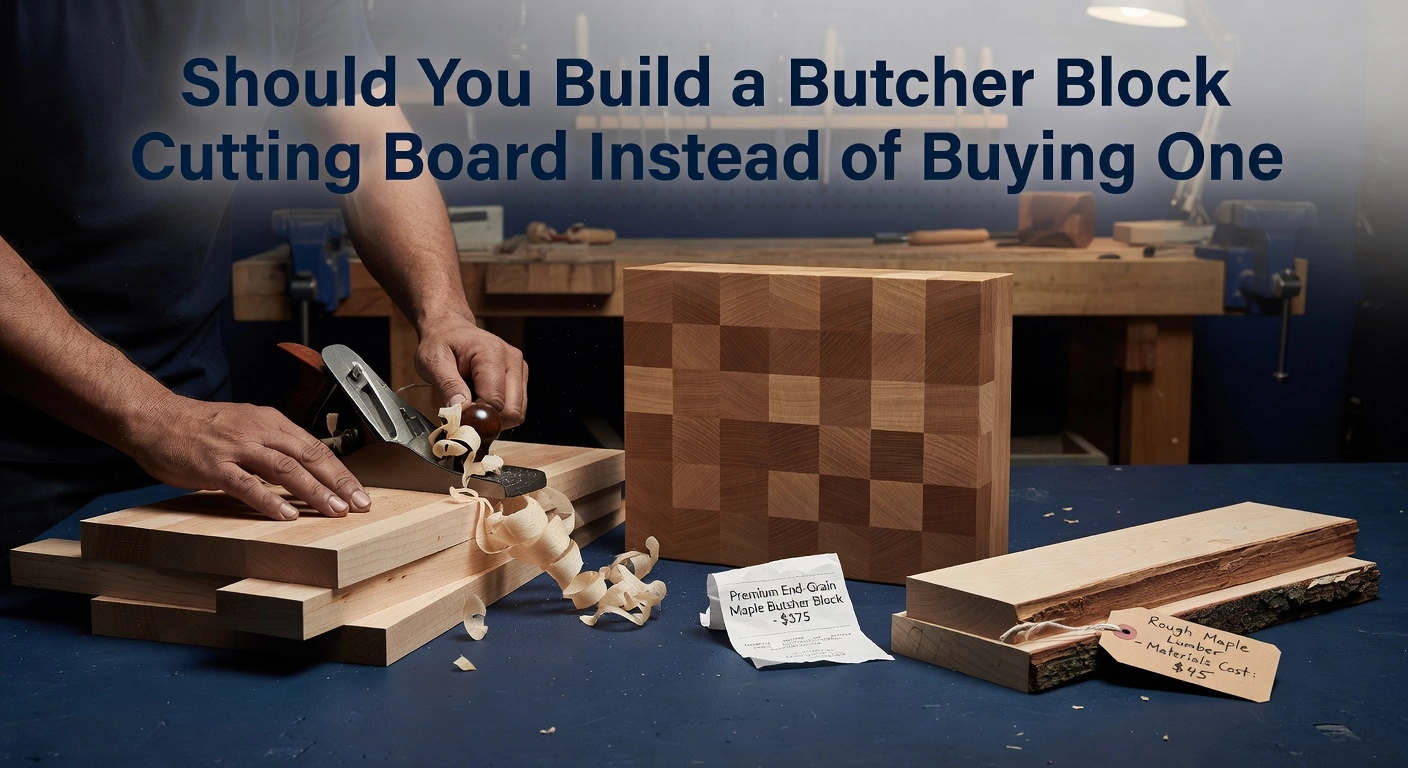
The tool list for a first build is shorter than most beginners expect. You need a table saw or miter saw for ripping and crosscutting strips, a set of parallel or pipe clamps, sandpaper or a random-orbit sander, and food-safe wood glue such as Titebond III. No CNC machine, no drum sander, and no specialty jigs are required to produce a functional, good-looking board on your first attempt. If you have access to a planer or jointer, milling becomes easier, but many successful beginner boards get built without them.
The core build process follows a logical sequence. Start by milling your maple lumber to a consistent thickness, then rip it into uniform strips. Glue those strips together edge-to-edge to form a panel. Once dry, crosscut that panel into new strips and rotate each one 90 degrees to expose the end grain, then glue up the final board. After the second glue-up cures, flatten the surface thoroughly before finishing with multiple coats of food-grade mineral oil. Skipping or rushing any of these steps is where most beginners run into trouble.
The three most common beginner mistakes are predictable and avoidable. Mismatched strip thicknesses create weak joints and an uneven surface that is nearly impossible to fix cleanly. Insufficient clamping pressure leaves gaps that fail over time with repeated washing. Skipping the flattening step after the final glue-up produces a board that rocks on the counter and looks unfinished. Taking time with each step eliminates all three problems.
WoodStuffHQ provides full step-by-step build guides complete with cut lists and measured drawings for readers ready to tackle their first end-grain board project from start to finish.
Butcher Block Cutting Board Questions Answered
These are the five questions beginners ask most often before committing to a butcher block cutting board, and the answers clear up a lot of common confusion.
How Long Does a Butcher Block Cutting Board Last?
A quality end-grain maple board can realistically last 20 to 30 years or longer with regular oiling and proper drying after each use. Many woodworkers and home cooks report boards still in active service after 35 years, and the key reason is that wood can be refinished. Light sanding removes deep grooves and surface stains, essentially resetting the board to near-original condition. Neglect is the main lifespan killer; a board left soaking in water or run through a dishwasher can warp and crack within a single use.
Are Wood Cutting Boards Actually Sanitary?
Yes, and the science backs this up. Research on hardwood surfaces shows that bacteria drawn into the wood grain do not multiply and instead die off over time. Studies have found recovery rates for pathogens like E. coli and Salmonella drop dramatically within minutes on wood surfaces, often by 99 percent or more after a few hours. Plastic boards, by contrast, develop knife grooves that trap and harbor bacteria in ways that are difficult to clean out. Prompt hand-washing with hot soapy water after each use keeps a wood board safe for everyday cooking.
Can You Put It in the Dishwasher?
No. High heat, prolonged moisture, and harsh detergents will warp, crack, and delaminate even an expensive board, sometimes in a single cycle. Hand-wash with mild soap, dry immediately with a towel, then stand the board upright to finish air-drying evenly on both sides.
How Often Should You Oil It?
Monthly is the right target for boards used regularly. The reliable test is simple: drip a few drops of water onto the surface. If the water beads up, the board is fine. If it spreads or absorbs into the wood, it is time to re-oil. New boards need several heavy applications during the first few weeks to fully saturate the wood before regular use begins.
What Is the Best Oil to Use?
Food-grade mineral oil is the standard recommendation across woodworking and culinary sources. It is colorless, odorless, non-toxic, and will not go rancid. Avoid olive oil, vegetable oil, or coconut oil entirely; these cooking oils break down inside the wood over time, causing unpleasant odors and potential spoilage. Pairing mineral oil with a beeswax-based board cream adds a protective top layer that extends the time between oil applications.
Choosing the Right Butcher Block Cutting Board for Your Kitchen
After exploring every tier, wood species, and feature covered in this guide, the decision comes down to four practical takeaways every beginner should carry into their purchase.
- A 1.5-inch thick end-grain maple board in the $120 to $175 range is the smart starting point for most home cooks. At that thickness, the board stays stable under daily use without becoming too heavy to handle. Maple offers closed grain pores, excellent hardness, and genuine self-healing properties that softer woods cannot match. That price window delivers real performance without the $230-plus premium you pay mostly for size and branding.
- Your maintenance routine matters more than your budget. Oil the board monthly with food-grade mineral oil, dry it immediately after every wash, and sand out scratches early before they deepen into harboring zones. Neglect ruins a $200 board faster than consistent care preserves a $130 one.
- Building your own board cuts material costs to roughly $30 to $60 while giving you custom dimensions and your preferred wood combination.
- WoodStuffHQ guides on oiling schedules, scratch repair, and full end-grain build plans give you the step-by-step detail needed to protect any board and build with confidence from day one.
Conclusion
Choosing the right butcher block cutting board does not have to be complicated. The key takeaways are simple: prioritize quality wood and construction, choose a size and thickness that fits your cooking style, and commit to regular oiling and maintenance to protect your investment. A well-chosen board will serve you faithfully for decades, not just years.
The difference between a great cutting board and a forgettable one shows up every single time you step into your kitchen. You deserve a surface that performs as hard as you do.
Now it is time to take action. Review the top picks in this guide, consider your budget and cooking habits, and make a confident choice. Your future self, the one effortlessly prepping beautiful meals, will thank you for it.