

So you’re staring at that empty corner of your living room, wondering whether to splash out on something stylish or roll up your sleeves and build it yourself. It’s a question more people are asking than you might think!
On one hand, places like Furniture Village offer a huge range of ready-made pieces that look great straight out of the box. On the other hand, the DIY route promises a personal touch and the satisfaction of saying “I made that.” But which option actually gives you more bang for your buck?
In this post, we’re breaking it all down in simple terms, perfect if you’re new to furnishing a home or just exploring your options. We’ll look at cost, quality, time, and effort so you can make a decision that works for your space and your budget. Whether you’re drawn to the convenience of browsing a showroom or you fancy getting creative with some wood and a few tools, by the end of this you’ll have a much clearer picture of which path suits you best. Let’s dive in!
What Furniture Village Actually Offers

If you’ve never heard of Furniture Village before, here’s the quick version: it’s the UK’s largest independent furniture retailer, with over 50 stores spread across the country and annual revenue sitting at around £348.9 million. That’s a serious operation, but what makes it interesting is that it doesn’t feel like a faceless corporation when you walk through the door.
The company was founded in 1989 by Peter Harrison and has stayed family-owned ever since, with the Harrison family still running things today. Headquarters are based in Slough, and the business became 100% family-owned following a 2022 transaction. That independent, family-run spirit shapes everything from how staff interact with customers to the standout 20-year structural guarantee offered on sofas, beds, dining, and bedroom furniture. Most retailers won’t come close to that level of coverage, which makes it a genuinely meaningful differentiator if you’re buying something you want to last.
In terms of what you can actually buy, the range covers lounge and living room furniture, bedroom pieces including beds and mattresses, dining furniture, and kitchen furniture, plus accessories like rugs and lighting. The in-store experience is intentionally low-pressure; staff are there to help, not to hustle you into a sale, and complimentary cookies are apparently part of the deal.
Growth hasn’t slowed down either. The brand recently opened its largest-ever flagship store in Glasgow, and it’s racked up multiple Ideal Home Awards across 2024 and 2025. According to recent sales figures, revenue grew nearly 10% year-on-year to £382.4 million in 2025, which signals a healthy, expanding business.
Customer feedback backs all of this up. Furniture Village holds a Trustpilot rating of 4.8 out of 5 stars across approximately 220,000 reviews, with consistent praise for delivery, helpful staff, and after-sales support. For a beginner trying to figure out where to start furniture shopping, that kind of track record offers some real reassurance.
How Much Does Furniture Village Actually Cost?
Let’s talk numbers, because this is usually where people want the straight answer before committing to a showroom visit.
Sofas tend to be the biggest spend for most shoppers. Entry-level three-seaters start around £800 to £1,200, particularly if you catch a sale or special buy promotion. Mid-range three-seaters and smaller corner sofas generally fall between £1,200 and £2,500, and if you’re eyeing a large premium corner sofa or a power recliner setup, expect to pay £2,500 to £3,500 or more. Dining sets can range from a few hundred pounds on clearance up to £2,700 for larger oak or industrial-style table-and-chair combinations. Bedroom furniture follows a similar pattern, with beds and frames starting modestly but full collections or premium pieces easily reaching £1,000 to £2,000 plus.

Compared to other well-known retailers, Furniture Village sits firmly in the mid-to-upper-mid tier. Budget options from IKEA typically start at £300 to £800 for sofas, while DFS often has entry-level pieces under £800. Furniture Village generally starts higher, but the argument is that you’re getting better materials and longer-lasting builds for that extra investment. Mid-market chains like Dunelm offer some overlap in the £400 to £1,400 range, but Furniture Village competes on guarantee strength and build quality rather than rock-bottom pricing.
Speaking of guarantees, the headline here is a free 20-year structural guarantee covering frames, springs, and joints on most sofas and bedroom furniture. Delivery runs roughly £39 to £119 depending on the item, and assembly is included on many larger pieces. You can check the full delivery details on their website before purchasing.
Where buyers get caught out is the extras. Fabric and leather protection packages, sometimes called Care+ plans, can add several hundred pounds. Delivery surcharges for remote areas or re-delivery after a missed slot can also sting. Extended warranty add-ons are worth reading carefully before signing.
Overall, Furniture Village positions itself as genuinely value-focused rather than luxury, and frequent sales back that up. But for most UK households, a sofa or dining set here still represents a serious four-figure spend that deserves careful planning.
What You Actually Get When You Build Your Own Furniture
When you buy a solid oak dining table from Furniture Village’s oak dining range, you’re choosing from a fixed selection of sizes, finishes, and styles that work for most people but aren’t built around your space. A comparable solid oak dining table there will typically run you somewhere between £1,000 and £2,700 depending on size and whether you’re adding chairs. That’s a significant spend for something you had zero say in designing.
Now compare that to building your own. A DIY solid oak dining table using a straightforward cut list and basic tools like a circular saw, drill, and sander typically costs somewhere between £120 and £450 in materials, including lumber, hardware, and your chosen finish. You’re not paying for showroom overheads, delivery logistics, or brand markup. What you’re paying for is the actual wood, and that’s it.
But the savings are only part of the story. When you build your own furniture, you choose the timber species from the start. Want white oak with a pronounced grain? Done. Prefer the warmth of walnut or the character of reclaimed pine? That’s your call entirely. You also control the exact dimensions, so a table that fits your dining room perfectly rather than almost perfectly is completely achievable. No retailer, however large, can offer that level of personal fit from their standard dining table collections.
This kind of personalisation is also riding a very real wave right now. In 2026, the artisanal and anti-flat-pack movement is pushing more homeowners toward handcrafted, real-wood projects. People are genuinely tired of furniture that chips, swells, or falls apart within a few years. Mass-produced pieces often rely on MDF or particleboard because it’s cheaper and easier to manufacture at scale. Solid wood, by contrast, can last decades with basic care like occasional oiling and simple cleaning, often becoming something you pass down rather than throw out.
The good news is that building your own no longer requires years of experience. WoodStuffHQ’s step-by-step furniture build guides include measured drawings and cut lists written specifically for beginners, so you can tackle a solid dining table or a simple cabinet without needing a workshop full of specialist tools. If you’ve got a weekend, a few basic tools, and the willingness to follow clear instructions, you’re genuinely capable of building something better than what you’d find flat-packed in a box.
Side by Side: Retail vs DIY Cost Breakdown
Numbers tell the clearest story, so let’s lay everything out side by side. The three pieces most people tackle first are a dining table, a storage unit, and a bed frame, and these happen to be three of the most popular categories on Furniture Village’s wooden dining tables range as well. Looking at those same pieces through a DIY lens reveals some pretty striking differences.
The Three-Piece Cost Comparison
For a solid oak dining table that seats six to eight people, Furniture Village-style retail pricing typically lands between £1,000 and £2,700 depending on finish, size, and whether it extends. DIY material costs for an equivalent solid hardwood build run roughly £300 to £800, with pine keeping you at the lower end and oak pushing toward the top. A solid wood storage unit or sideboard sits between £400 and £1,500 at retail; built yourself using plywood carcasses with hardwood faces and drawer fronts, you’re looking at £150 to £500 in materials. A bed frame in solid wood or quality plywood, which retails anywhere from £500 to £2,000 at showroom prices, can be built for £150 to £450 in materials using standard sheet goods and dimensional lumber.
These are material-only figures. Retail pricing wraps in design, finishing, delivery, and markup, plus things like Furniture Village’s well-regarded customer service and structural guarantee. DIY skips all of that overhead and puts the savings directly back in your pocket.
Tool Costs Are a One-Time Investment
Here is something beginners often overlook: you do not need a fully kitted workshop to build solid furniture. Most straightforward projects require only a circular saw for breaking down sheet goods and boards, a cordless drill for joinery and hardware, and sandpaper for finishing. A decent starter set of those three things costs roughly £100 to £300 total. That is a one-time spend that covers every project you build from here on out, not just the first one.
Time Pays for Itself Quickly
Yes, building your own furniture takes time. A beginner might spend eight to twenty hours on a first dining table build, working from a reliable cut list and step-by-step guide. But that time investment drops sharply on the second and third projects once you know how your tools behave and where to source materials. Across three or four builds, the hourly “cost” of learning becomes almost negligible compared to the money saved.
The Bottom Line on Cost
Across all three pieces and accounting for real-world material pricing, DIY consistently saves between 40 and 70 percent on material costs compared to buying solid-wood equivalent pieces at retail. The savings are strongest when you use your tool kit repeatedly and follow a tested plan rather than designing from scratch. Retail will always win on pure convenience, but if your goal is genuine solid wood at a fraction of the price, the numbers make a compelling case for picking up a drill.
Where Furniture Village Genuinely Has the Edge
Let’s be honest: DIY woodworking has real limits, and knowing where those limits are will save you a lot of frustration and money.
Upholstered sofas and armchairs sit firmly outside what most beginners can reasonably tackle at home. A good sofa isn’t just a wooden frame with cushions thrown on top. Inside a quality piece, you’ll find layered systems of sinuous springs or 8-way hand-tied coils, high-density foam in multiple grades, tensioned webbing, and precisely cut fabric that has to wrap corners without bunching or sagging. Getting any of that wrong means a sofa that loses its shape within months. Even experienced DIYers tend to step back from upholstery because the tools, materials, and learning curve are genuinely steep. You can find out why sofas sag even when professionally made, and that should give you a sense of how technically unforgiving the process is.
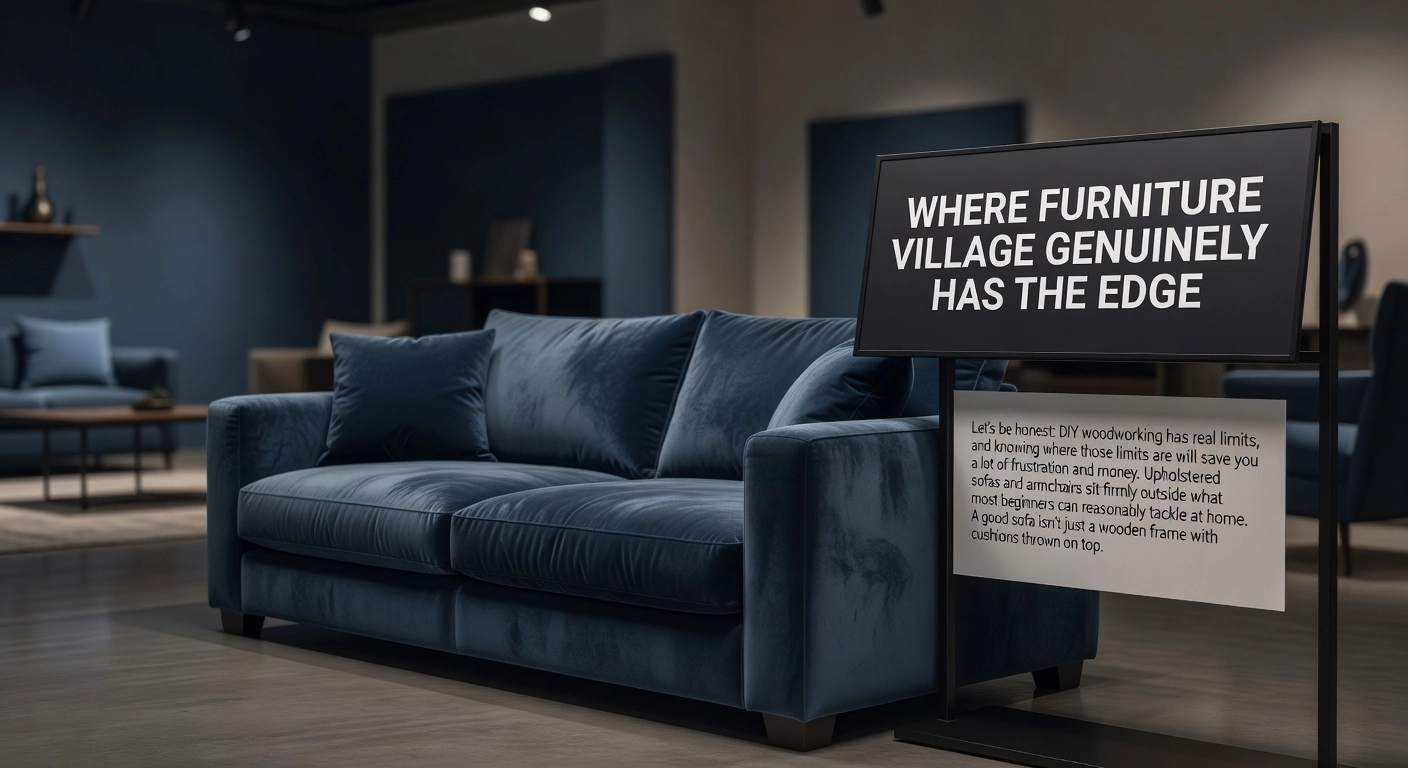
The 20-year structural guarantee is another point worth taking seriously. Furniture Village covers frames, springs, webbing, joints, and bed structures for two decades at no extra cost. If anything in that category fails, it’s their problem to fix, not yours. A dining table you build yourself carries no such safety net. For people who simply want furniture that works without any ongoing maintenance responsibility, that guarantee changes the value equation considerably.
The hybrid showroom and online model also solves a real problem with big purchases. Sitting in a sofa before you buy it, feeling the seat depth and cushion firmness, matters when you’re spending several hundred pounds. Browsing the full store network gives you that option without sacrificing the convenience of ordering online once you’ve decided.
For renters, flat-dwellers, or anyone working long hours, the practical reality is that DIY furniture requires storage space for timber, access to power tools, and blocks of free time. Not everyone has those things, and that’s completely valid. Retail exists for good reasons.
Finally, smart beds with AI-integrated sleep tracking and adaptive firmness are genuinely not something a home workshop can replicate. That category is growing fast in 2026, and if that technology matters to you, retail is the only realistic route.
Where Building Your Own Furniture Wins Outright
There are five areas where picking up a saw beats scrolling through a showroom website, and they’re all worth understanding before you make a decision.
Custom dimensions are the biggest practical win. Retail furniture is designed for the average room, which means it almost never fits your specific room perfectly. Got a chimney breast that creates a 47cm alcove? A ceiling that slopes down to 180cm along one wall? A bay window eating into your living room floor plan? Standard-sized units just don’t solve those problems. When you build your own, you work from your actual measurements, not a catalogue spec sheet. A simple storage unit built to fill an exact alcove looks intentional and architectural; the same space crammed with an off-the-shelf unit that’s two inches too narrow just looks like a compromise. For a deeper look at why custom dimensions justify the effort, the difference in liveable space alone often makes the project worthwhile.
The material gap is real and bigger than most people expect. A huge proportion of furniture sold at accessible price points uses veneered MDF or particleboard as the core. It looks like wood because it has a thin wood surface layer, but the structural material underneath is engineered board. When you build with solid timber sourced from a lumber yard, you’re working with the same material all the way through. That matters for longevity, for the way it ages, and critically for what happens when something goes wrong. Making sense of solid wood versus veneer construction helps you understand exactly what you’re buying or building.
Sustainability is much more transparent when you control the supply chain. Buying FSC-certified hardwood from a local timber merchant, or sourcing reclaimed wood from a salvage yard, gives you a clear line of sight on where your material came from. Research suggests reclaimed timber can require up to 13 times less energy to process than virgin wood, which is a meaningful environmental difference.
The 2026 design trends actually favour DIY skills. Live-edge slabs, mixed wood tones layering white oak with walnut, rounded organic shapes, and visible grain as a feature rather than something to hide; these are all achievable with basic tools and a decent slab selection. Mass production makes these styles expensive. A DIY approach makes them genuinely accessible.
Solid wood is also forgiving over time. A scratch on a veneered MDF surface can mean permanent damage because you can’t sand through a 0.6mm layer. On solid timber, the same scratch is a 20-minute fix. WoodStuffHQ covers exactly this kind of repair in plain language, from removing water rings to addressing deeper surface damage, giving you the confidence to buy or build real wood knowing you can maintain it yourself for decades.
Already Own Retail Furniture? Here Is How to Extend Its Life
Even if you’ve already invested in retail furniture, a little care goes a long way toward protecting that purchase. Wood pieces from any retailer pick up the same handful of problems over time: surface scratches from keys or pet claws, white water rings left by a cold glass, cabinet doors that feel sticky and grimy from kitchen grease, and wood that starts to look dull and dry after years without conditioning. None of these issues mean your furniture is finished. They just mean it needs some attention.
The good news is that most of these problems respond well to simple household products. A mild soap solution handles greasy cabinet doors better than you might expect. Mineral oil rubbed into dry or cracked wood brings back flexibility and colour. White water rings on a lacquered finish often disappear with a little gentle heat from a hairdryer or a dab of petroleum jelly left overnight. Scratches on real wood can be blended using oil or even a matching wax crayon. These fixes are low cost, low risk, and genuinely effective on most retail wood furniture finishes.
WoodStuffHQ has step-by-step guides covering all of these scenarios, from removing water stains and repairing surface scratches to degreasing kitchen cabinets and conditioning weathered wood. The guides are written for people who have never done this before, using simple tools and products you likely already own. You can also check out Furniture Village’s Natural Wood Care Kit as a ready-made starting option if you prefer a packaged solution.
What is worth noting is that learning these skills does more than extend the life of your current furniture. Understanding how wood reacts to moisture, heat, and different finishes builds real confidence. Many people start by fixing a scratch on a dining table and end up comfortable enough to take on a full DIY furniture build a year later. Restoration is a natural gateway into woodworking, and it costs almost nothing to start.
2026 Furniture Trends You Can Actually Build Yourself
Browsing through retailer catalogs is actually one of the best ways to spot what’s worth building yourself, and 2026 has some genuinely exciting trends that translate beautifully into beginner DIY projects.
Live-edge dining tables and shelving are the standout natural material trend right now. The look celebrates raw wood edges, thick slabs, and matte oil finishes rather than the polished, uniform surfaces you’d find in most retail showrooms. The good news for beginners is that these pieces are more approachable than they look. A pre-surfaced slab, screw-on metal legs, and a penetrating oil finish like Osmo or a comparable low-VOC alternative gets you most of the way there without advanced skills. A router sled handles flattening, basic sanding does the rest, and the natural character of the wood does the heavy lifting visually.
Mixed wood tones combining oak, walnut, and pine are equally popular right now, reflecting a broader shift toward layered, collected interiors rather than perfectly matched sets. White oak shelving alongside walnut cabinetry and pine accents creates warmth and depth that feels considered rather than flat. This is achievable with pocket screw joinery and basic finishing skills. The key is choosing complementary tones across the light-to-dark spectrum, then using oils or stains to bring them into conversation with each other.
Modular and space-saving builds are where DIY genuinely outperforms retail. You can design shelving units, expandable tables, or storage benches to fit your exact room layout rather than compromising with standard dimensions. Plywood, basic framing hardware, and simple joinery make this category very beginner-friendly.
Across all three trend areas, low-VOC and water-based finishes are the smart choice. Sustainable finishing options are driving faster growth within the broader global furniture market, which is projected at a 5 to 6 percent CAGR, and they also mean better air quality in your home during and after the project.
WoodStuffHQ’s cabinet door finishing guides and step-by-step build projects connect directly to each of these trends, giving you a practical starting point whether you’re tackling a live-edge shelf, a two-tone cabinet refresh, or a custom modular storage unit inspired by something you spotted in a showroom.
So Should You Buy from Furniture Village or Build Your Own?
The honest answer is that this doesn’t have to be a binary choice, and most homeowners get the best results by being selective rather than dogmatic about it.
Go with Furniture Village when you need upholstered pieces like sofas, recliners, or padded bed frames. Professional upholstery involves foam grading, spring systems, and fabric tensioning that genuinely requires specialist equipment. If you also lack tool storage, a dedicated workspace, or simply want a guaranteed out-of-box result with delivery and a warranty attached, retail makes complete sense. There’s no shame in buying smart.
Choose DIY when you want solid real wood, custom dimensions to fit an awkward alcove, or a piece you can sand back and refinish yourself in ten years. Solid wood tables and shelves built from quality lumber will outlast most retail particleboard equivalents by decades, and the long-term cost savings are significant once your basic toolkit is in place.
For many homeowners, the smartest move is a hybrid approach. Buy what you genuinely cannot build, and build what retail cannot match on fit, quality, or character.
If you’re new to woodworking, start small. A side table or floating shelf using WoodStuffHQ’s measured guides and cut lists is a low-risk way to build confidence before committing to a full dining set or bed frame.
And whether you buy retail or build yourself, bookmark WoodStuffHQ’s wood restoration guides. Fixing scratches, lifting water rings, and refreshing a dried-out finish are skills that apply equally to any wood piece regardless of where it came from.
Conclusion
So there you have it! Whether you go retail or DIY ultimately comes down to four key factors: your budget, your timeline, your skill level, and how much personalisation matters to you. Furniture Village and similar retailers win on convenience, quality assurance, and time saved. DIY wins on cost savings, creativity, and that unbeatable sense of pride when guests ask where you got something.
Neither option is universally better. The smartest approach is often a mix of both, splashing out on key statement pieces while building simpler items yourself.
Ready to make your move? Start by measuring your space, setting a firm budget, and honestly assessing your DIY confidence. From there, the right choice becomes surprisingly clear. Your perfect living space is closer than you think. Now go and create it!