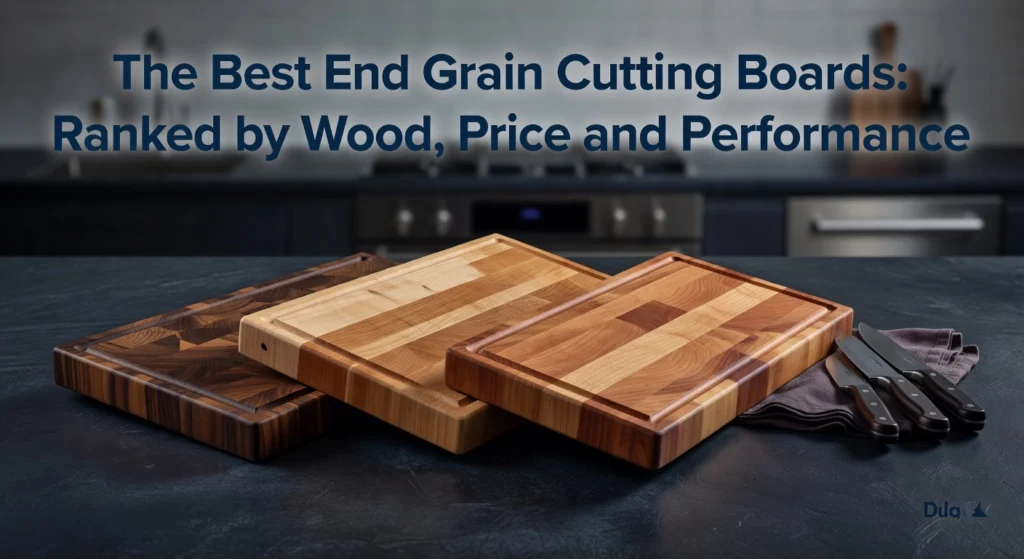

If you’ve spent any time in the kitchen, you already know that not all cutting boards are created equal. The end grain cutting board sits at the top of the hierarchy, and for good reason. Its unique construction, where the wood fibers run vertically to the surface, allows knife blades to slip between the fibers rather than cut across them. The result is a board that stays sharper longer, self-heals minor cuts, and can last decades with proper care.
But with dozens of options on the market, choosing the right one is harder than it looks. Wood species, construction quality, thickness, and price all play a significant role in how a board performs over time. Some boards justify their premium price tags, while others fall short despite impressive marketing.
In this guide, we break down the best end grain cutting boards available today, ranking them by wood type, price point, and real-world performance. Whether you’re upgrading from a basic board or investing in a professional-grade workhorse, you’ll find exactly what you need to make a confident, well-informed decision.
Why End Grain Cutting Boards Are Worth the Higher Price
The price gap between an end grain cutting board and a standard edge-grain alternative is immediately obvious. What’s less obvious is how quickly that gap closes when you factor in knife maintenance costs, board replacement frequency, and the daily performance difference in your kitchen.
The core advantage of end grain construction comes down to fiber orientation. When wood blocks are arranged so their ends face upward, a knife blade slips between the vertical fibers rather than cutting across them. The fibers part to accept the blade, then close back together after each stroke, a process woodworkers and chefs consistently describe as self-healing. The result is a surface that resists deep, permanent grooves and maintains a cleaner appearance over years of hard use. Edge-grain and end-grain boards handle this very differently, with edge-grain boards forcing the blade to sever fibers horizontally, leaving marks that accumulate and eventually become permanent.
That gentler cutting action translates directly to knife longevity. End grain boards can allow knives to retain their edge up to three times longer between sharpenings compared to harder or less forgiving surfaces. For anyone using quality chef’s knives, that difference is significant both in terms of time and the cost of professional sharpening services.
End grain boards also carry a meaningful hygiene advantage. Wood pores draw bacteria inward and away from the surface, where the organisms are deprived of the moisture they need to survive. Research has consistently shown near-complete bacterial die-off occurring within hours in properly maintained wooden boards, a property well-documented across end-grain and edge-grain wooden surfaces alike, though end grain’s exposed fiber ends may enhance this absorption effect.
The financial case becomes clearest when you examine lifespan. A quality end grain board, oiled regularly and hand-washed, routinely lasts 10 to 15 years or longer. At a price of $120 to $400 or more, that works out to roughly $10 to $30 per year of use. Compare that to edge-grain boards in the $40 to $150 range that typically last three to five years under similar use, or face-grain options that degrade quickly under repeated knife work and rarely survive more than one to two years as a primary prep surface. The premium is not a luxury markup; it reflects a fundamentally more labor-intensive construction involving precise block arrangement and gluing, combined with performance benefits that compound over years of daily cooking.
How to Choose the Right End Grain Board for Your Kitchen
Choosing the right end grain cutting board comes down to four personal variables: budget, knife quality, cooking frequency, and maintenance willingness. Budget-conscious buyers can find smaller acacia or mixed hardwood options in the $70 to $100 range, but these often use thinner construction and woods with higher silica content that can be harder on knife edges. Mid-tier boards in the $150 to $230 range, typically crafted from domestic hard maple, offer the best balance of performance and value. Premium and custom-built pieces above $230 represent genuine heirloom investments. If you cook daily with quality Japanese or high-carbon steel knives, the upgrade is well justified. If you reach for inexpensive serrated blades a few times a week, the benefits of end grain are largely wasted.
Thickness, Size, and Feature Trade-Offs
Board thickness is not a detail to overlook. A minimum of 1.5 inches is widely recommended by kitchen experts, with 2 inches or more considered ideal for serious use. Thicker boards resist warping and cupping caused by moisture fluctuations, since the additional mass buffers uneven absorption through the exposed fiber ends. They also provide more material for sanding and refinishing over the board’s lifespan, which can extend usable life by years. Boards thinner than 1.25 inches tend to bow under daily use, especially if drying is inconsistent.
Size selection depends heavily on how you plan to use the board. A 14 by 14 inch or 12 by 18 inch board handles everyday vegetable prep comfortably and fits most sinks for hand-washing. For prep-and-serve entertaining setups, larger boards in the 16 by 22 or 18 by 24 inch range double as striking charcuterie or carving platters. The current trend toward hybrid and reversible designs reflects this dual-purpose demand: one side grooved for catching juices during carving, the other flat for clean prep work. These larger formats add presence to an open kitchen but do add significant weight, sometimes 15 to 20 pounds for a thick maple board.
Feature trade-offs are worth thinking through carefully. Juice grooves are excellent for messy tasks like carving roasts or slicing tomatoes, but they reduce usable cutting area slightly and require more thorough cleaning. Rubber feet dramatically improve stability and elevate the board off wet counter surfaces, which matters especially for end grain construction since exposed fiber ends absorb standing moisture readily. Reversible designs sacrifice permanent feet on both sides but add flexibility. Custom sizing from artisan makers allows you to match your counter space and workflow precisely, at a higher cost than stock options. According to Serious Eats’ testing of wooden cutting boards, the combination of adequate thickness, non-slip stability, and quality hardwood construction consistently separates long-term performers from boards that fail within a few years.
Who Should and Should Not Buy
This is the most important filter of all. End grain boards reward cooks who hand-wash promptly, dry the board upright after each use, and apply food-safe mineral oil every one to three weeks. That routine is straightforward, but it is non-negotiable. Skipping it leads to cracking at the glue lines, warping, and surface degradation that no amount of refinishing can fully reverse. Wirecutter’s cutting board guidance consistently flags maintenance commitment as the primary reason some buyers should reconsider the purchase entirely.
If you rely on a dishwasher for kitchen cleanup or simply prefer a grab-and-go tool that requires no upkeep, a quality plastic board is the more practical choice. Similarly, those with very small kitchens, tight budgets, or minimal cooking needs will get more practical value from a lighter, less expensive option. End grain boards are the right investment for frequent cooks who value knife longevity, board aesthetics, and long-term durability, and who are genuinely prepared to care for a premium tool properly.
Maple vs. Walnut vs. Teak vs. Acacia: Which Wood Performs Best in End Grain
Wood species selection is the single most consequential decision you will make when buying or building an end grain cutting board, because it determines hardness, knife compatibility, maintenance demands, and long-term durability all at once.
Maple: The Undisputed Industry Standard
Hard maple sits at the top of nearly every expert recommendation list in 2026, and the reasons are straightforward. With a Janka hardness rating of approximately 1,450 lbf, it delivers exceptional resistance to denting and surface wear without crossing into the territory where knife edges suffer. Its closed-pore, tight grain structure resists staining and bacterial harboring better than more porous species when properly maintained with regular mineral oil applications. As a domestic North American hardwood, it benefits from stricter domestic forestry regulations, making it more sustainably accessible and consistently more affordable than imported premium alternatives. Serious Eats’ March 2026 evaluation of 19 wooden cutting boards repeatedly named maple end-grain boards as top performers for heavy home and professional use, cementing its status as the workhorse standard for serious cooks.
Walnut and Cherry: Premium Aesthetics With Performance Trade-Offs
Walnut occupies a distinct niche as the premium statement piece of the end-grain world. Its Janka rating falls between 1,010 and 1,150 lbf, meaning it is measurably softer than maple and correspondingly more forgiving on knife edges during heavy cutting sessions. The rich, dark chocolate tones and striking grain patterns make walnut boards genuinely beautiful objects in a kitchen, which drives pricing significantly higher than comparable maple boards. The trade-off is that walnut may show wear patterns slightly faster under high-volume daily use, though it performs exceptionally well for most home cooking environments. As a comparative analysis of maple, walnut, and cherry performance notes, walnut rewards buyers who prioritize visual appeal alongside solid cutting performance.
Cherry lands in a similar aesthetic category with a Janka rating around 950 lbf, making it the most knife-friendly of the three hardwoods. Its warm reddish-brown tone develops a desirable patina over time. However, that softer rating means cherry end-grain boards accumulate dents and deeper surface damage faster than maple under decades of intensive use, making it better suited to lighter-duty kitchens or as a secondary prep board.
Teak and Acacia: Specialty Woods With Specific Trade-Offs
Teak brings a genuinely unique property set to end-grain construction. Its natural oils provide inherent water resistance, reduce warping risk, and contribute documented antimicrobial properties, which means it requires less frequent oiling than maple or walnut. Its Janka hardness of roughly 1,000 to 1,080 lbf keeps it comfortably knife-friendly. For sustainability-conscious buyers, FSC (Forest Stewardship Council) certification is non-negotiable when purchasing teak, since it is typically imported and certification verifies responsible harvesting practices protecting forests, biodiversity, and worker welfare.
Acacia presents the most complex trade-off of any species in this comparison. Its Janka rating varies widely, from approximately 1,180 up to 1,750 lbf depending on the subspecies and sourcing region, and its notable silica content accelerates knife-edge dulling more than any other wood covered here. End-grain construction does mitigate the issue partially by allowing blades to slide between fibers rather than across them, but acacia still ranks as the hardest on knives in this group. Its lower price point makes it accessible, but buyers should treat it as a budget compromise rather than a performance-first choice, particularly if knife preservation is a priority.
Best Overall: The Boardsmith Maple End Grain Board
When independent testing organizations put end grain cutting boards through rigorous head-to-head evaluations, one board surfaces at the top with remarkable consistency. The Boardsmith maple end grain cutting board earned the best overall designation from Serious Eats after testing 19 wooden boards in 2026, secured the upgrade pick position from Wirecutter in their March 2026 update, and received the best splurge wooden board award from Food & Wine following their April 2026 evaluation of dozens of competing options. This is not a fluke result from a single review cycle. Serious Eats has consistently ranked it at or near the top for at least four consecutive years, which speaks to sustained real-world performance rather than a one-time laboratory result.
What Makes the Construction Stand Apart
The build quality separates this board from mass-produced competitors in ways that matter during daily use. The Boardsmith uses precision-glued, larger-than-average solid hardwood blocks arranged in a bricklay pattern, which distributes stress evenly across the surface and dramatically reduces the risk of warping or splitting at glue lines. At 2 inches thick as standard, it provides the kind of stability and weight that keeps the board planted during aggressive chopping. The knife contact with adhesive across both faces is roughly equivalent to a single grain of salt, which means your blade is working almost entirely against wood fiber rather than hardened glue. The FSC-certified domestic maple used throughout is food-safe, responsibly sourced, and hand-finished with mineral oil and board butter before shipping.
Price, Value, and Who This Board Is Actually For
The standard 12×18 inch Butcher size starts at approximately $230, which is a meaningful premium over other well-regarded end grain boards. That price reflects made-to-order craftsmanship from a small Texas family business, superior materials, and construction details that translate directly into decades of useful life with proper care. This board is genuinely worth the investment for serious home cooks, culinary professionals, or anyone seeking heirloom-quality kitchen equipment that also functions as an attractive serving piece. It is not the right choice for occasional users, budget-constrained buyers, or anyone unwilling to commit to regular oiling every one to three weeks.
Sizing, Customization, and Where to Buy
Available sizes range from the compact 9×12 inch Sidekick up through 16×22 and 18×24 inch options for high-volume prep or entertaining use. Rubber feet are installed by default for stability and airflow. Customization options include a perimeter juice groove (starting around $25), finger grooves, and engraving. Purchase directly through The Boardsmith’s product page for the full range of custom configurations, or through select retailers for standard sizes. Expect a lead time of one to two weeks for fabrication and shipping, detailed care instructions included with the board, and natural wood variation in grain and tone. Food & Wine’s wooden board testing specifically highlights the board’s dual function as both a serious prep surface and a presentation piece, which adds practical value that partially offsets the premium price point.
Best for Aesthetics: Brooklyn Butcher Blocks Cherry End Grain Board
When performance matters but visual impact matters just as much, the Brooklyn Butcher Blocks cherry end grain cutting board earns its place as the top aesthetic choice in the premium segment. This is not a board that sacrifices function for beauty. It delivers genuine end-grain performance, including self-healing fiber construction and knife-friendly surface contact, while presenting a visual character that maple simply cannot replicate.
Cherry vs. Maple: The Visual Difference
Cherry wood brings warm reddish-brown tones that deepen and enrich with age and regular oiling. Where maple reads as light and neutral, cherry reads as inviting and refined. The end-grain checkerboard pattern amplifies this effect, creating an organic, structured visual that complements both modern and traditional kitchen aesthetics. Serious Eats’ 2026 testing specifically noted the Brooklyn cherry board’s neat seams and consistent piece sizing, contributing to a polished, display-worthy appearance that sets it apart on a kitchen counter.
Performance Trade-offs vs. The Boardsmith Maple
Against The Boardsmith maple board reviewed in the previous section, the Brooklyn cherry presents honest trade-offs worth understanding. Maple carries a Janka hardness rating around 1,450, making it more resistant to denting and deep surface wear under heavy daily prep. Cherry, rated closer to 850 to 950, is softer, which actually benefits high-quality knife edges since the blade meets less resistance. In practical testing, the Brooklyn cherry board showed strong resistance to deep scratches even after rigorous use, though it may develop superficial surface marks faster than maple under very high-volume chopping. The Boardsmith also edges ahead on finish quality, with its surface described as exceptionally smooth; the Brooklyn cherry is well-constructed but finishes at a slightly less refined tactile level.
Pricing and Ideal Buyer
Pricing sits firmly within the premium $120 to $400+ range that defines handcrafted end grain boards. A 12×18-inch Brooklyn cherry board lists around $200 to $311 depending on current pricing, with larger entertaining sizes approaching $360. That investment makes the most sense for a specific type of buyer: home entertainers who double their cutting boards as serving surfaces, gift givers seeking an heirloom-quality presentation piece, and design-conscious home cooks who want their kitchen tools to reflect personal style. If your priority is maximum durability under daily restaurant-level prep, The Boardsmith maple remains the stronger call. But if the board will be seen as much as it is used, cherry delivers an aesthetic return that maple cannot match.
Best Sustainable Option: Teakhaus FSC-Certified Teak End Grain Board
For buyers who treat sustainability as a non-negotiable rather than a tiebreaker, the Teakhaus FSC-certified teak end grain board occupies a category of its own. The Forest Stewardship Council (FSC) is a globally recognized nonprofit that certifies forests meeting rigorous standards across three pillars: environmental protection (biodiversity, soil, and watershed preservation), social responsibility (fair wages, safe labor conditions, and respect for Indigenous land rights), and long-term economic viability. That certification creates a traceable chain of custody from plantation to finished product, which is precisely why the FSC logo carries more weight than vague “responsibly sourced” claims that have become common marketing language. In 2026, with updated FSC US standards effective as of April emphasizing climate resilience and adaptive forest management, choosing an FSC-certified board means backing verified practices rather than taking a brand’s word for it. Teakhaus even received a 2025 FSC Leadership Award, reinforcing its standing as a genuinely accountable manufacturer rather than an opportunistic one.
Teak’s performance advantages over maple and walnut are rooted in its natural chemistry. The wood contains high concentrations of natural oils, including tectoquinone compounds, that create an inherent moisture barrier at the cellular level. Compared to hard maple, which relies on its tight grain structure to resist water but lacks intrinsic oils, teak handles prolonged exposure to moisture considerably better and is less prone to warping or checking over time. Walnut, while knife-friendly and visually striking, is more porous and absorbs liquids more readily than teak. On the antimicrobial front, teak’s natural oils actively inhibit bacterial growth, which complements the self-healing fiber structure that end grain construction already provides.
That same oil content translates directly into a more forgiving maintenance routine. America’s Test Kitchen notes that Teakhaus boards require oil less frequently than comparable maple or walnut options, and long-term users report boards remaining smooth and stable after 12-plus years of heavy kitchen use. Where a maple end grain board demands oiling every one to three weeks to prevent cracking, teak’s natural saturation reduces that urgency meaningfully. Standard care still applies: hand-wash promptly, towel-dry thoroughly, and keep it away from the dishwasher. But the margin for error is wider.
On price, Teakhaus occupies a genuinely accessible middle position. Large models in the 20 to 24-inch range typically fall between $140 and $200, depending on configuration and current promotions. That sits notably below Boardsmith’s handcrafted maple boards, which start around $230 for a 12×18-inch butcher size, and Brooklyn Butcher Blocks’ comparable end grain offerings, which run roughly $220 to $280 for similar dimensions. For buyers who want end grain performance and verified sustainability without the boutique premium, Teakhaus represents strong value per square inch.
One legitimate limitation deserves transparency. Sustainably sourced teak is harder to verify outside FSC-certified brands. Independent reviewers consistently flag that non-certified teak products may trace back to less regulated harvests, so the FSC label is not optional context here; it is the entire purchase rationale. If you encounter teak boards without explicit FSC certification, the sustainability argument collapses entirely. Stick with certified sources, and this board delivers on every promise it makes.
Best Mid-Range Value: John Boos and J.K. Adams End Grain Boards
John Boos carries a pedigree that no other mass-market cutting board brand can match. Founded in 1887 in Effingham, Illinois, the company spent over a century supplying professional butcher blocks to commercial kitchens before expanding into residential lines. That heritage translates directly into credibility: when a home cook picks up a Boos board at Williams Sonoma, Crate & Barrel, or Amazon, they are buying into a lineage of professional-grade construction with the return policy and accessibility of a major retailer behind it. That combination of institutional trust and broad distribution is something smaller artisan makers simply cannot replicate.
John Boos Mid-Range End Grain: What You Actually Get
John Boos mid-range end grain boards in maple or cherry typically measure 1.5 to 2.25 inches thick, feature checkerboard glue patterns, and offer reversible surfaces on most models. Construction quality is solid; editors at several major publications have reported owning Boos boards with five or more years of daily use showing only superficial wear. Compared to premium options like the Boardsmith, the differences are measurable rather than dramatic. Premium boards often use larger individual wood blocks, a bricklayer glue pattern that distributes stress more effectively, heavier weight for superior stability, and more refined pre-finishing from the factory. Boos boards may carry more visible seam lines and occasionally lack built-in feet or juice grooves on entry-level configurations, but under consistent oiling every one to three weeks and proper hand-drying, they deliver excellent longevity for the majority of home cooks.
J.K. Adams: Handcrafted at a Reachable Price
J.K. Adams, based in Vermont, occupies a compelling niche as a handcrafted American alternative. Its professional-grade end grain boards in maple, walnut, and cherry are built thick, gentle on knife edges, and stable enough for both heavy prep work and countertop serving. Pricing lands slightly below top-tier artisan options while still delivering the self-healing fiber structure that defines quality end grain construction.
The $120 to $250 Segment: Honest Trade-offs
Buyers in this price range gain professional knife friendliness, durable hardwood construction, and genuine aesthetic appeal that doubles as a serving piece. What they give up versus spending $300 or more is primarily a matter of refinement: fewer custom options, marginally less thickness, and slightly less meticulous finishing. Williams Sonoma’s own end grain line and Made In’s butcher block offerings round out this tier with polished retail presentation and dependable performance, making them practical choices for buyers who prioritize both function and countertop aesthetics without crossing into heirloom pricing territory.
Best Budget Pick: Ironwood Gourmet and Acacia Options Under $80
Not every cook needs a $300 heirloom board on their counter. For occasional home cooks, those new to the end-grain category, or buyers working within a tight budget, sub-$80 acacia options represent a legitimate and functional entry point rather than a compromise forced by circumstance.
Ironwood Gourmet: The Budget Tier Standard-Bearer
Ironwood Gourmet dominates this price segment with consistent mentions across major testing publications. Their acacia end-grain boards, including the Charleston series and Large End Grain Prep Station models, typically measure around 14″ x 14″ x 1.25″ and retail between $55 and $79 depending on size and retailer. Performance assessments are genuinely positive for the price point: these boards handle everyday prep tasks well, including vegetables, cheese, and simple proteins. Testing has shown minimal knife dulling after extended use sessions, and the natural contrasting acacia grain pattern gives them an attractive appearance that doubles as a serving board. Comparable acacia end-grain boards from similar price-tier brands share the same general construction approach and price range, though Ironwood earns more consistent expert recognition for quality control and reliability.
Trade-Offs You Need to Understand
The compromises at this price tier are specific and worth knowing before you buy. Construction thickness runs 1.13 to 1.25 inches, noticeably thinner than the 1.5 to 2-inch standard on premium boards. That reduced mass translates to less stability under heavy daily use and a narrower margin for error if maintenance gets neglected.
Acacia’s higher natural silica content is the more significant performance factor. While still gentler on knife edges than plastic or bamboo, acacia works against your blades more than maple or walnut does. Expect slightly more frequent sharpening compared to what a premium maple board would require.
Maintenance Expectations at This Price Point
Budget acacia boards demand more attentive care than premium alternatives. Oil with food-grade mineral oil every two to three weeks under moderate use, and inspect glue seams regularly for early signs of separation, particularly during seasonal humidity shifts. Store the board flat and hand-wash promptly after every use. With consistent maintenance, these boards realistically last five to eight years. Without it, drying and seam issues accelerate significantly faster than they would on a thicker, higher-quality maple board.
This tier suits occasional home cooks preparing meals a few times per week, buyers with smaller kitchens who need a compact option, or anyone wanting to experience end-grain’s knife-preserving and self-healing advantages before committing to a premium investment. If your cutting sessions are daily and heavy, the step up to a thicker maple end-grain board will pay for itself through longevity and reduced knife maintenance alone.
End Grain Cutting Board Price Tiers: What You Get at Each Level
The end grain cutting board market breaks cleanly into three price tiers, and understanding what separates them helps you spend confidently rather than guessing at a price point.
Under $80: Budget Acacia and Entry Hardwoods
Boards in this range are typically mass-produced using acacia or basic imported hardwoods. Construction quality reflects the price: block counts tend to be lower, individual pieces are larger and less uniform, and glue joint precision varies noticeably from board to board. Thickness usually falls between 1.0 and 1.5 inches, which works adequately for light prep but leaves less material for future resurfacing. Finishing is functional rather than refined, typically a single pass of food-safe mineral oil applied at the factory. Warranties are rare, and repair or reconditioning support is essentially nonexistent. Best buyer profile: occasional home cooks, beginners exploring end grain for the first time, or anyone with genuine budget constraints. Expect solid service for two to five years with disciplined hand-washing and regular oiling.
$80 to $250: Mid-Range Maple and Established Brands
This tier represents the performance sweet spot for most serious home cooks. Hard maple dominates here, offering a tighter grain structure, superior density, and more consistent glue surfaces than acacia. Block counts increase significantly, individual pieces are smaller and more uniform, and glue joint precision improves enough that boards resist warping and maintain flatness over years of heavy use. Thickness reliably reaches 1.5 to 2 inches, multi-coat mineral oil and beeswax finishing is standard, and reputable makers in this range typically back their boards with one-year to limited lifetime warranties, sometimes including reconditioning services. The global cutting board market is projected at approximately $2.25 billion in 2026, and this mid-range tier drives much of that volume. Best buyer profile: dedicated home cooks and families who want genuine longevity. With proper care, these boards realistically last 10 to 20 years.
$250 to $400 and Above: Premium and Custom Makers
Premium boards from specialist makers feature meticulously selected small blocks, near-perfect glue joint alignment, and thickness that frequently reaches 1.75 to 3 inches. Multi-stage finishing is standard, and lifetime repair or reconditioning programs are common. Despite representing a smaller share of total unit sales, premium end grain boards capture a disproportionate share of profit margins in the wood board category, a trend supported by sustained 6.4% annual market growth projected through 2033. Independent makers on Etsy and direct custom woodworkers sit primarily within this tier and the upper mid-range, offering genuine differentiation: one-of-a-kind wood combinations, custom dimensions, personalized patterns, and direct communication with the craftsperson. Lead times run longer and quality varies between sellers, but the best independent makers deliver craftsmanship that rivals established premium brands at competitive pricing. Best buyer profile: professional cooks, serious enthusiasts, or anyone investing in a board they expect to pass down. The per-use cost over a decade is remarkably low.
End Grain Board Care: What You Must Do to Protect Your Investment
Your end grain cutting board will last 10 to 15 years or longer, but only if you treat its specific vulnerabilities with the same seriousness you bring to knife selection and wood species choice. Neglect the care fundamentals, and a $200 to $400 board can warp, crack, or delaminate within months.
Never put an end grain board in the dishwasher. This is the single most important rule. The high heat, prolonged steam exposure, and harsh detergent cycles force the wood to expand and contract unevenly. Because end grain boards are assembled from dozens of precisely glued wooden blocks, that uneven stress concentrates directly at the glue lines, and those joints will fail. Hand-wash promptly using hot water, mild dish soap, and a sponge or nylon brush. Rinse quickly, never submerge the board, and stand it upright to dry on both sides simultaneously. Drying flat on one face traps moisture beneath the board and creates the differential pressure that causes cupping.
Oiling Frequency and Why End Grain Demands More
End grain boards need oiling every one to three weeks, compared to roughly once a month for edge-grain boards. The reason is structural. End grain construction exposes the open pores at the tips of wood fibers rather than the smoother lateral surfaces. Those open pores absorb oil and moisture far more aggressively, which means the board dries out faster between applications. A quick test confirms when oiling is overdue: sprinkle a few drops of water on the surface. If the water beads up, protection is adequate. If it soaks in within seconds, oil immediately.
For the oiling process itself, use food-grade mineral oil (USP grade), which is odorless, tasteless, and will not go rancid. Avoid olive oil, vegetable oil, or any cooking fat; these turn rancid inside the wood and create bacterial risks. Apply a generous amount with a clean cloth, flooding all surfaces including edges and the underside. Allow full absorption overnight before use, then wipe away any excess. A board butter blend combining beeswax and mineral oil adds an extra water-repellent layer and is particularly effective on end grain surfaces as a finishing step after oil has penetrated.
Deep Cleaning and Odor Control After Raw Meat Use
After cutting raw meat, poultry, or seafood, wash the board immediately with hot water and dish soap, scrubbing both faces. For odor removal without soaking the board, work a paste of kosher salt and lemon juice into the surface, allow it to sit for approximately one hour, then scrape it off and rinse quickly. A diluted white vinegar solution (roughly one part vinegar to three parts water) sprayed on and air-dried also neutralizes odors effectively. Avoid bleach entirely; it strips the wood’s natural oils and can cause discoloration and premature drying. Always allow the board to stand upright until completely dry before storing it.
For readers who want detailed step-by-step guidance beyond these fundamentals, WoodStuffHQ’s dedicated board oiling guide and cutting board restoration guide cover every stage of the process in full, including how to revive a board that has already begun to show dryness or surface damage.
End Grain vs. Edge Grain vs. Plastic: Which Should You Actually Buy
The structural difference between end-grain and edge-grain boards comes down to fiber orientation. End-grain boards stand wood fibers vertically, exposing the cut ends at the surface. When your knife strikes the board, the blade slides between fibers rather than slicing across them. Those fibers spring back after each cut, producing the self-healing effect that keeps end-grain surfaces looking cleaner over years of heavy use. Edge-grain boards orient fibers horizontally, running parallel to the cutting surface. Every knife stroke cuts across those fibers, creating permanent grooves faster and dulling edges more quickly. End-grain boards typically run $120 to $400 or more; comparable edge-grain boards land between $40 and $150, making the structural trade-off a direct reflection of price difference.
The plastic board debate deserves a direct answer. Plastic boards are non-porous and dishwasher-safe, which makes them appear more hygienic on the surface. The problem is knife use. Repeated cutting creates grooves that trap food particles and bacteria in channels that scrubbing cannot reliably reach. Wood behaves differently because bacteria drawn into the pores via capillary action die off rather than multiply. Research published in the Journal of Food Protection found bacteria populations on wooden surfaces reduced by at least 98%, often exceeding 99.9%, while plastic boards held overnight allowed bacterial multiplication in those grooves. Properly maintained hardwood boards are comparably or more hygienic in home kitchen conditions, a conclusion supported by subsequent studies on maple and other common cutting board hardwoods.
Bamboo surfaces frequently in this conversation as an eco-friendly, budget-conscious alternative worth clarifying. Bamboo is technically a grass, not a hardwood, and its dense cellular structure contains high concentrations of silica. That silica content makes bamboo significantly harder on knife edges than maple, walnut, or cherry. Some comparative dulling tests rank bamboo meaningfully worse than hardwoods for blade preservation, with edges degrading noticeably faster through regular use. Bamboo is better than plastic for knife care, but it cannot match quality hardwood end-grain boards where edge longevity matters.
The practical recommendation matrix breaks down cleanly:
- End-grain hardwood: For serious home cooks who use quality knives daily and are willing to oil the board every one to three weeks
- Edge-grain hardwood: For budget-conscious buyers or lighter, occasional kitchen use where half the price for comparable functionality makes sense
- Plastic: For dishwasher convenience or dedicated raw meat prep boards only, not for primary cutting work
For a full side-by-side breakdown covering knife friendliness, durability, maintenance demands, weight, and long-term value, WoodStuffHQ’s complete end-grain vs. edge-grain comparison goes deeper into each performance category with structured testing analysis.
Choosing the Right End Grain Board: Final Recommendations
An end grain cutting board is a 10 to 15 year investment that pays dividends in three areas: knife longevity, surface durability, and kitchen aesthetics. No other single kitchen tool protects your blades, handles daily abuse, and improves with age the way a well-made end grain board does.
For final recommendations by category: The Boardsmith maple board remains the best overall choice for serious cooks who want heirloom-quality construction. Brooklyn Butcher Blocks leads on visual impact, especially in walnut and cherry. Teakhaus is the clear pick for sustainability-focused buyers who want FSC-certified sourcing without sacrificing performance. John Boos delivers reliable mid-range value with proven craftsmanship. Ironwood Gourmet offers an accessible entry point for budget-conscious buyers exploring end grain for the first time.
Before purchasing any of these boards, internalize the care requirements: no dishwasher, hand-wash and dry upright after each use, and oil every one to three weeks. Skipping these steps shortens lifespan significantly.
For deeper guidance, WoodStuffHQ’s related guides on oiling schedules, wood species selection, and the end grain versus edge grain comparison cover everything needed to maintain your board correctly. Choose one board, commit to the routine, and the difference becomes obvious within weeks.