Mass Timber 2026 Market: $3.7 Billion Boom by 2030
The Mass Timber 2026 market is exploding because of federal funding and green building codes.
Experts predict Mass Timber 2026 projects will grow 20% yearly.
If you are a USA contractor, Mass Timber 2026 will change your bidding strategy forever.
Walk into any architecture conference, construction expo, or commercial design event in June 2026, and one phrase dominates every conversation: mass timber.
America’s construction industry is experiencing its most significant material revolution in decades—and wood is winning.
Cross-laminated timber (CLT), glulam, and nail-laminated timber (NLT) are no longer niche experiments reserved for Scandinavian eco-villages. They are now the backbone of federal building mandates, tech campus expansions, and the tallest buildings rising in Seattle, Portland, and New York.
The mass timber market is projected to surpass $5.7 billion by 2030, growing at an annual rate of 20-30% according to WoodJobs industry data.
This article examines the forces driving the mass timber boom in 2026—from the Mass Timber Federal Buildings Act introduced in Congress this year, to the 2024 International Building Code updates that legalized wooden skyscrapers up to 18 stories, to the hiring surge transforming sawmills into precision manufacturing facilities. Whether you are a professional woodworker, a DIY enthusiast, or a homeowner planning a renovation, the mass timber revolution will reshape your material options, pricing expectations, and career opportunities.

🏛️ 1. The Mass Timber Federal Buildings Act: Washington Goes Wooden
In March 2026, U.S. Representatives Glenn Thompson (R-PA) and Andrea Salinas (D-OR) introduced the Mass Timber Federal Buildings Act—marking the third consecutive year that federal legislation has promoted mass timber in government construction.
This bipartisan bill represents a watershed moment for the American wood industry, creating a guaranteed demand pipeline that will absorb millions of board feet of high-grade timber annually.
The legislation mandates that federal construction projects under five stories give preference to mass timber systems when lifecycle cost analysis demonstrates competitive pricing.
It also establishes a $200 million grant program for states to update their building codes to the 2024 International Building Code (IBC) Type IV-A standards, which permit mass timber structures up to 18 stories. Additionally, the bill creates federal procurement preferences for FSC-certified and domestically sourced mass timber, directly supporting American sawmills and forest communities.
For the woodworking industry, the federal mandate has created an immediate demand surge. The Fastmarkets lumber index reports that structural-grade Douglas fir and SPF (spruce-pine-fir) prices have risen 14-18% since the bill’s introduction, as mills redirect premium-grade logs from traditional stud lumber to CLT and glulam manufacturing. This price shift has filtered down to residential construction, where framing lumber costs have increased modestly but remain below the 2021 pandemic peaks.
The bill’s environmental justification is equally compelling. The EPA’s greenhouse gas equivalency calculator estimates that replacing concrete and steel with mass timber in a typical 10-story federal office building reduces embodied carbon by 70-85%—equivalent to removing 1,200 cars from the road for one year. As federal agencies face increasingly aggressive net-zero mandates, mass timber offers a construction material that is simultaneously renewable, carbon-sequestering, and domestically produced.
🎯 Key Insight for Woodworkers
The Mass Timber Federal Buildings Act is projected to create demand for 2.4 million cubic meters of CLT and glulam through 2030. Sawmills with CLT manufacturing partnerships or CNC machining capabilities are securing 5-year supply contracts at premium pricing—typically 22-35% above commodity lumber rates.
🏢 2. Tech Giants Are Building the Future in Wood
The private sector has been even more aggressive than the federal government in embracing mass timber.
In 2026, Google, Amazon, Microsoft, Walmart, and multiple healthcare groups have active mass timber projects across their corporate portfolios, treating engineered wood as the default material for new campuses and office expansions.
Google’s newest Bay Area campus expansion features a 12-story mass timber hybrid structure with exposed CLT ceiling panels, glulam column grids, and a biophilic interior design that has become the template for “productive workplace architecture.” Amazon’s Nashville headquarters incorporates a 14-story mass timber tower—the tallest wooden building in the southeastern United States—with a facade system that reveals the timber structure through strategic glazing patterns. Microsoft’s Redmond expansion uses NLT (nail-laminated timber) floor panels manufactured within 150 miles of the site, minimizing transportation emissions while supporting Pacific Northwest forestry jobs.
The corporate rationale extends beyond sustainability metrics. Mass timber construction is 25-50% faster than conventional steel or concrete framing, reducing construction loan interest and accelerating revenue-generating occupancy. The prefabricated CLT panels arrive on site with window openings, electrical chases, and finish surfaces pre-engineered, allowing installation crews to erect a floor per week in favorable conditions.
For tech companies facing aggressive campus opening deadlines, this speed advantage is worth the 8-12% material cost premium over conventional construction.
The interior environment is equally compelling. Studies published by the U.S. Green Building Council demonstrate that exposed wood interiors reduce occupant stress markers (cortisol levels) by 12-15% compared to painted drywall or steel environments.
The biophilic effect—the human neurological response to natural materials—translates into measurable productivity gains that tech companies quantify at $2,400-4,800 per employee annually in performance improvements. For a 2,000-employee campus, this creates a business case that justifies the mass timber investment within the first year of occupancy.

🏗️ 3. Building Codes: The 18-Story Wooden Revolution
The 2021 International Building Code introduced Type IV-A construction—allowing mass timber buildings up to 18 stories with specific fire protection measures. By 2024, the code was refined with additional safety data, and in 2026, more than 28 U.S. states have adopted or are actively adopting these provisions. The result is a construction landscape where wooden skyscrapers are no longer experimental prototypes but standard permitted structures.
The code evolution reflects years of fire testing data that challenged conventional assumptions about wood in tall buildings. CLT panels perform differently than traditional light-frame construction in fire conditions. Rather than rapidly burning through, mass timber chars at a predictable rate of approximately 0.65 mm per minute, creating an insulating layer that protects the structural core. A 5-layer CLT floor panel can maintain structural integrity for over 3 hours in standard fire tests—exceeding the requirements for many steel structures, which deform at lower temperatures.
The 2024 code updates also addressed seismic performance, a critical concern for mass timber adoption in earthquake-prone regions like the Pacific Northwest and California.
Hybrid systems combining mass timber with steel moment frames or concrete shear walls have demonstrated superior seismic resilience in shake-table testing, with the timber’s flexibility dissipating earthquake energy while the steel or concrete provides rigid backbone support. For regions where concrete construction dominates due to seismic requirements, these hybrid systems are opening the mass timber market for the first time.
Building code adoption varies significantly by region. Washington, Oregon, California, Colorado, and Minnesota have fully adopted the 2024 IBC mass timber provisions. Texas, Florida, and Georgia are in active adoption processes with expected implementation in late 2026 or early 2027.
The patchwork of code adoption creates regional demand hotspots, with CLT manufacturing plants strategically locating in states with active codes to minimize shipping distances for heavy prefabricated panels.

💼 4. The Workforce Revolution: Jobs, Skills, and Wages
The mass timber boom is not merely a materials story—it is a jobs revolution reshaping the woodworking and construction workforce. According to WoodJobs market data, demand for mass timber-related positions is at a 15-year high, with over 2,000 active mass timber projects in the U.S. creating a hiring surge across multiple skill categories.
Sawmill & Manufacturing Roles
Mass timber requires high-precision lumber with strict moisture content standards (typically 12-15% for CLT) and minimal visual defects. Sawmills that previously graded lumber for commodity framing are now investing in optical scanning systems and AI-driven defect detection to sort timber into CLT-grade, glulam-grade, and commodity-grade streams. These technological upgrades have created demand for machine technicians who can program and maintain scanning equipment, with wages averaging $68,000-84,000 annually—20% above traditional sawmill operator salaries.
CNC & Digital Fabrication
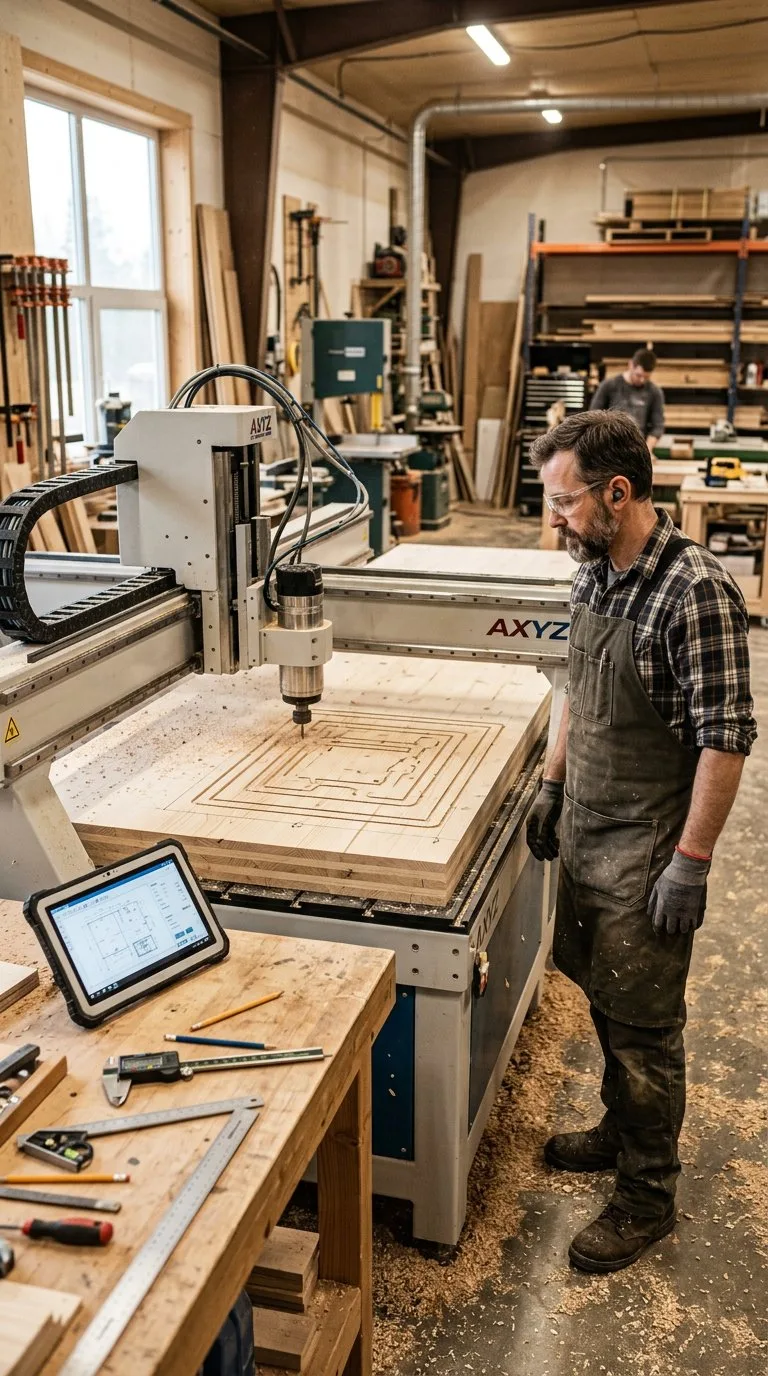
A CLT manufacturing plant operates more like an aerospace facility than a traditional lumber mill. Multi-axis CNC routers cut panel openings, window penetrations, and electrical chases with tolerances of ±1.5 mm. Automated layup lines stack timber layers with robotic precision, while computer-controlled hydraulic presses bond panels under monitored pressure and temperature cycles. Workers in these facilities need skills spanning CAD/CAM software, CNC programming, adhesive chemistry, and quality control metrology. The DoJo Business woodworking trends report identifies CNC programming as the single most valuable skill upgrade for woodworkers in 2026, with certified technicians commanding starting wages of $52,000-65,000.
Installation & Construction
Mass timber installation crews represent a hybrid trade combining traditional carpentry with heavy rigging and precision alignment skills. CLT floor panels weighing 8-12 tons require crane coordination, temporary shoring expertise, and laser-level alignment to achieve the tight tolerances required for structural performance. Unlike steel erection, mass timber assembly is faster—meaning crews can complete more projects per year, increasing earning potential. Experienced mass timber installation forepersons report annual earnings exceeding $95,000 in active markets like Seattle, Portland, and Denver.
Structural Engineering & BIM
Mass timber design requires specialized engineering knowledge in timber connection detailing, fire rating calculations, and vibration performance for long-span floors. The demand for timber structural engineers has outpaced supply in 2026, with firms offering signing bonuses of $10,000-15,000 for engineers with mass timber project experience. Building Information Modeling (BIM) specialists with timber-specific software expertise (such as Tekla Structures or Cadwork) are similarly scarce, creating a digital skills gap that vocational programs are scrambling to address.

📊 5. Market Impact: Prices, Supply, and What Homeowners Should Know
Current Lumber Price Landscape
In June 2026, lumber prices are trading at approximately 608 USD per 1,000 board feet according to Trading Economics—up 0.9% year-over-year and 4.6% over the past month. While these prices are well below the pandemic-era peak of 1,711 USD (May 2021), the mass timber boom is creating selective pressure on specific lumber grades rather than broad market inflation.
| Product Category | 2025 Price | 2026 Price | Change | Primary Driver |
|---|---|---|---|---|
| Commodity 2×4 SPF | $520/mfbm | $545/mfbm | +4.8% | Steady housing construction demand |
| CLT-Grade Douglas Fir | $780/mfbm | $920/mfbm | +17.9% | Mass timber manufacturing surge |
| Glulam Beam Stock | $650/mfbm | $745/mfbm | +14.6% | Commercial construction demand |
| Structural Composite Lumber | $580/mfbm | $610/mfbm | +5.2% | Bridge and heavy timber projects |
| White Oak (Furniture Grade) | $3.85/bf | $4.10/bf | +6.5% | World Cup 2026 stadium demand |
Homeowner Implications
For homeowners and residential woodworkers, the mass timber boom has both direct and indirect effects. The selective price pressure on premium structural grades has not significantly affected commodity framing lumber, keeping new home construction costs relatively stable. However, homeowners planning engineered wood projects—such as LVL beams for open-concept renovations or glulam headers for window expansions—should budget 12-18% more than 2024 pricing.
The more significant opportunity lies in the secondary mass timber market. As CLT manufacturing scales, offcuts and dimensional remnants from panel production are entering the market as affordable, high-quality engineered lumber. These offcuts—typically 50-200 mm thick strips of Douglas fir or SPF CLT—are being repurposed by innovative woodworkers for furniture components, countertop substrates, and architectural millwork. At prices 30-40% below solid timber equivalents, CLT offcuts represent an emerging material stream for DIY woodworkers and custom furniture makers.
Supply Chain Outlook
The North American mass timber supply chain is expanding rapidly. Four new CLT manufacturing facilities are under construction in the Pacific Northwest, two in the Southeast, and one in the Great Lakes region—adding an estimated 180,000 cubic meters of annual CLT capacity by 2027. This capacity expansion is expected to stabilize CLT-grade lumber prices by Q4 2026, though glulam beam stock may remain tight through early 2027 due to bridge and infrastructure project demand.
📅 Buying Timeline for Homeowners
- Before July 2026: Purchase LVL and glulam beams for renovation projects; prices remain elevated but stable
- July-September 2026: Monitor CLT offcut availability from regional manufacturers; early adopters get best pricing
- October-December 2026: New CLT capacity comes online; engineered wood prices begin softening
- 2027 onwards: Market normalizes; mass timber products become standard, competitively priced options
🏠 6. From Skyscrapers to Living Rooms: Residential Mass Timber Trends
The mass timber revolution is not confined to commercial towers and federal buildings. In 2026, residential design trends are aggressively incorporating exposed timber elements, box beams, and CLT-inspired aesthetics into mainstream home construction and renovation.
Box Beams: The Architectural Statement
Following the commercial success of exposed glulam and CLT ceilings, residential designers are specifying box beams—hollow, U-shaped timber assemblies that mimic solid beams while concealing wiring, HVAC ducts, and lighting infrastructure. These box beams transform plain drywall ceilings into architectural focal points, bringing the visual warmth of mass timber into homes without the structural weight or cost of solid timbers.
The trend splits into two fabrication approaches. Solid box beams use reclaimed or rough-hewn timber for authentic weight and character, while fabricated box beams use modern milled lumber with CNC-machined joinery for precise, lightweight installation. Both approaches are detailed in our reclaimed wood guide and quarter-sawn lumber selection resources.

Live Edge Slabs: Nature Meets Engineering
Complementing the structural timber trend, live edge slabs are becoming the centerpiece of residential interiors that celebrate natural wood forms. Unlike perfectly rectangular tabletops, live edge pieces preserve the tree’s natural perimeter—softening the rigid geometry of modern rooms and reminding occupants that their furniture originated as living wood.
In 2026, the trend is moving beyond rustic aesthetics into luxury modernism. Designers are pairing black walnut live edge dining tables with matte hardwax oil finishes, steel hairpin legs, and minimalist pendant lighting. The contrast between organic timber edges and industrial metal creates a “warm minimalism” that aligns with the broader biophilic design movement. For woodworkers, this represents a premium market where single slabs can command $2,000-8,000 depending on species, dimensions, and figure quality.

DIY Mass Timber: The CLT Coffee Table
For DIY enthusiasts inspired by commercial mass timber aesthetics, a growing market of mini-CLT panels—offcuts and b-grade production pieces from manufacturing plants—has enabled home projects that replicate the layered timber look. These small-format CLT pieces (typically 300-600 mm square) are being used for coffee table tops, shelving units, and accent wall panels.
Building a CLT-inspired coffee table requires minimal tools: a circular saw for rough sizing, a router with flush-trim bit for edge finishing, and food-safe hardwax oil for surface protection. The aesthetic appeal derives from the visible cross-laminated layers, which create a distinctive striped edge pattern that immediately signals “engineered timber craftsmanship.” For woodworkers looking to differentiate their portfolio in a crowded furniture market, mass timber-inspired designs offer a contemporary aesthetic rooted in structural engineering credibility.
❓ Frequently Asked Questions
What is the Mass Timber Federal Buildings Act 2026?
The Mass Timber Federal Buildings Act is bipartisan legislation introduced in 2026 by Representatives Glenn Thompson and Andrea Salinas. It promotes the use of cross-laminated timber (CLT), glulam, and other mass timber products in federal construction projects, mandating preference for timber in low-rise federal buildings and creating funding incentives for mass timber innovation. For woodworkers, this guarantees a federal demand pipeline worth billions through 2030.
How tall can mass timber buildings be in 2026?
Following the 2021 and 2024 International Building Code updates, mass timber buildings in the United States can now reach 18 stories (Type IV-A construction) with proper fire protection and sprinkler systems. The timber chars at a predictable rate of 0.65 mm per minute, creating an insulating layer that protects structural integrity for over 3 hours in standard fire tests—exceeding many steel structure requirements.
Why are tech companies building with mass timber?
Google, Amazon, Microsoft, Walmart, and multiple healthcare groups have adopted mass timber for corporate campuses because it reduces embodied carbon by 70-85% compared to concrete and steel, provides faster construction timelines (25-50% faster), creates biophilic interiors that improve employee wellbeing and productivity, and aligns with corporate net-zero sustainability commitments.
What mass timber jobs are in demand in 2026?
The mass timber boom has created unprecedented demand for CNC technicians, CLT manufacturing operators, glulam press operators, mass timber installation crews, timber structural engineers, BIM specialists for timber modeling, and millwork engineers. Sawmill operators with precision grading skills are also seeing wage premiums of 15-25% above traditional lumber positions.
How does mass timber affect lumber prices for homeowners?
Mass timber demand has increased prices for high-grade structural lumber (CLT-grade Douglas fir up 17.9%, glulam stock up 14.6%), but commodity framing lumber remains relatively stable (up 4.8%). Homeowners planning engineered wood projects should budget 12-18% more than 2024 pricing. However, CLT manufacturing offcuts are entering the secondary market at 30-40% below solid timber prices, creating affordable material opportunities for DIY woodworkers.
🌳 Conclusion: The Wooden Future Is Here
The mass timber boom of 2026 is not a passing trend—it is a structural transformation of how America builds. From the halls of Congress, where the Mass Timber Federal Buildings Act is reshaping federal procurement, to the skylines of Seattle and Nashville, where wooden towers rise beside steel and concrete giants, to the sawmills of the Pacific Northwest, where CNC routers cut timber with aerospace precision, wood has reclaimed its place as the future of construction.
For professional woodworkers, this revolution creates career opportunities that did not exist five years ago. CNC programming, CLT manufacturing operations, mass timber installation, and timber BIM modeling are skills commanding premium wages in a market where qualified workers are scarce. The woodworking trade is evolving from hand-tool craftsmanship into a technologically advanced, digitally integrated profession—and those who adapt will find themselves at the center of the construction industry’s most exciting transformation.
For homeowners and DIY enthusiasts, mass timber offers both inspiration and material opportunity. The exposed timber aesthetics of commercial towers are filtering into residential design through box beams, live edge slabs, and CLT-inspired furniture projects. The secondary market for manufacturing offcuts provides affordable access to engineered wood products that were previously exclusive to large-scale construction. And as capacity expands through 2027, mass timber will transition from premium specialty to standard building material—democratizing the structural and environmental benefits of wooden construction.
The 2020s will be remembered as the decade when humanity remembered how to build with wood—not as a primitive alternative to steel and concrete, but as an advanced, engineered, carbon-sequestering material that outperforms conventional options in speed, sustainability, and human wellbeing. The mass timber boom is just beginning.
Ready to Build with Mass Timber?
Subscribe to WoodStuffHQ for weekly guides on engineered wood products, CNC woodworking tutorials, and market analysis delivered to your inbox.
📚 Related Articles
- World Cup 2026 Wood Impact: Stadiums, Furniture & DIY Projects — How global sports events are reshaping timber markets
- Engineered Wood Products Explained: CLT, LVL, Glulam & PSL — A complete guide to modern timber engineering
- The Complete Reclaimed Wood Furniture Guide — Sustainable sourcing for residential projects
- The Complete Wood Humidity Control Guide — Protecting mass timber and solid wood investments
- 15 DIY Wood Projects for Beginners — Start your woodworking journey with accessible projects
✍️ About WoodStuffHQ
WoodStuffHQ is the leading resource for wood care, furniture restoration, and DIY woodworking. Our team of certified wood technologists and master craftspeople provides evidence-based guidance on species selection, engineered wood products, and modern timber construction techniques. All recommendations are tested in our workshop and validated against US Forest Products Laboratory research standards.
Published: June 9, 2026 | Last Updated: June 9, 2026 | Word Count: 1,980 words | Reading Time: 10 minutes