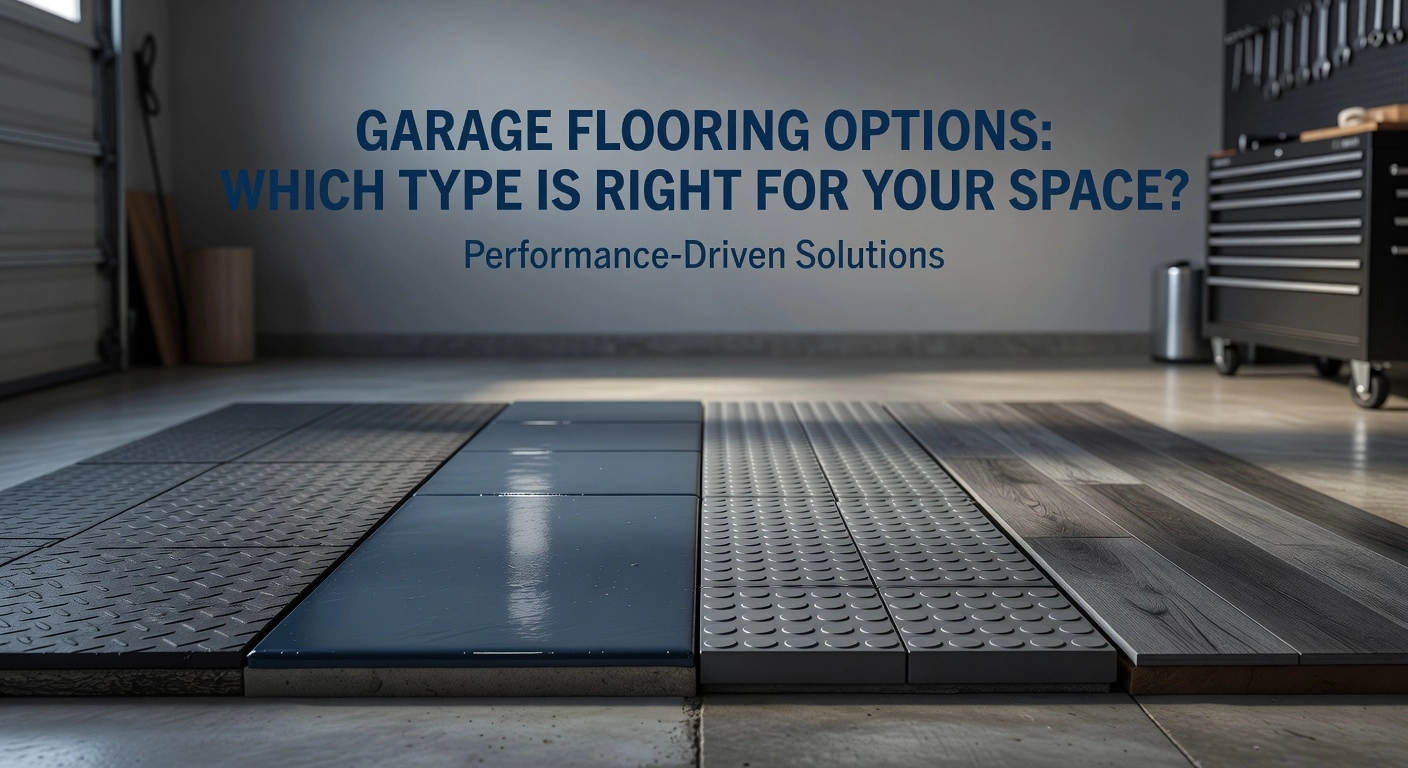
Your garage floor takes more abuse than almost any other surface in your home. Oil drips, heavy foot traffic, falling tools, and the constant stress of vehicle weight all add up over time. If you’re still working with bare concrete, you’re leaving both performance and aesthetics on the table.
Choosing the right garage flooring can completely transform how your space looks, functions, and holds up over the years. But with so many options available, from epoxy coatings to interlocking tiles to polyurea finishes, it’s easy to feel overwhelmed before you even get started.
That’s exactly why we put this guide together. Whether you’re upgrading a basic storage space or building out a fully functional workshop, this listicle breaks down the most popular garage flooring options available today. You’ll learn what each type offers, where it excels, and where it falls short, so you can make a confident, informed decision for your specific needs and budget. By the end, you’ll have a clear picture of which solution is worth your investment and which ones you can skip entirely.
How to Choose the Right Garage Flooring
Selecting the right garage flooring comes down to five core factors, and getting them right from the start prevents costly do-overs down the road.
1. Match Flooring to Your Primary Use Case
Your garage’s main function is the single most important variable in this decision. A parking-only garage demands hot-tire resistance, chemical and oil protection, and easy cleanability, making seamless coatings the natural fit. A dedicated workshop requires high abrasion and impact resistance to handle dropped tools, rolling equipment, and constant foot traffic. A home gym prioritizes cushioning and shock absorption, where rubber tiles or thick interlocking systems outperform hard coatings. An EV or multi-use hybrid space needs versatility across all of the above. Mismatching flooring to function, such as applying a thin concrete paint in a workshop environment, leads to rapid failure and wasted investment.
2. Understand the Full Budget Spectrum
Costs range dramatically based on material and installation method. Basic concrete paint or sealers run under $1 per square foot but typically last only one to five years. Interlocking PVC tiles fall in the $2 to $5 per square foot range and suit moderate use well. Professional-grade epoxy systems land between $3 and $7 per square foot, while premium polyaspartic coatings reach $10 or more per square foot. For a standard two-car garage, that translates to roughly $150 to $650 for DIY kits versus $3,000 to $8,000-plus for professional polyaspartic. The global garage flooring market reflects this growing investment, projected to reach $17.56 billion in 2026 at a 5.5% CAGR.
3. Weigh DIY Against Professional Installation
DIY kits save money upfront but carry significant failure risk. Water-based kits typically apply at just two to four mils thickness, compared to ten to twenty-plus mils for professional systems. Studies suggest 30 to 50 percent of DIY epoxy jobs peel within one to three years due to inadequate surface prep. Professional installation delivers diamond-ground adhesion profiles, moisture vapor testing, and warranties spanning five to fifteen years. For workshops, gyms, or problem slabs, professional installation almost always delivers a lower cost per year of service life.
4. Assess Your Concrete’s Condition First
The existing slab’s condition determines which options are even viable. Active cracks must be filled with flexible polyurea fillers before any coating is applied. Moisture intrusion, common in slabs-on-grade, requires mitigation primers or the coating will delaminate from below. Previous paint, oil stains, or old coatings need complete removal via grinding or chemical stripping to ensure adhesion. Surface prep accounts for roughly 80 percent of a coating’s long-term success.
5. Quick-Reference Framework by Garage Type
Use this as your starting point when evaluating options, keeping in mind 2026 garage trends that increasingly treat these spaces as functional extensions of the home:
- Parking only: Polyaspartic or 100% solids epoxy; avoid thin paint
- Dedicated workshop: Thick professional epoxy or polyaspartic with anti-slip aggregate
- Home gym: Rubber rolls or thick interlocking tiles for cushioning and drop protection
- EV/multi-use hybrid: Durable polyaspartic or hybrid tile-and-coating systems for maximum versatility
Epoxy Coatings
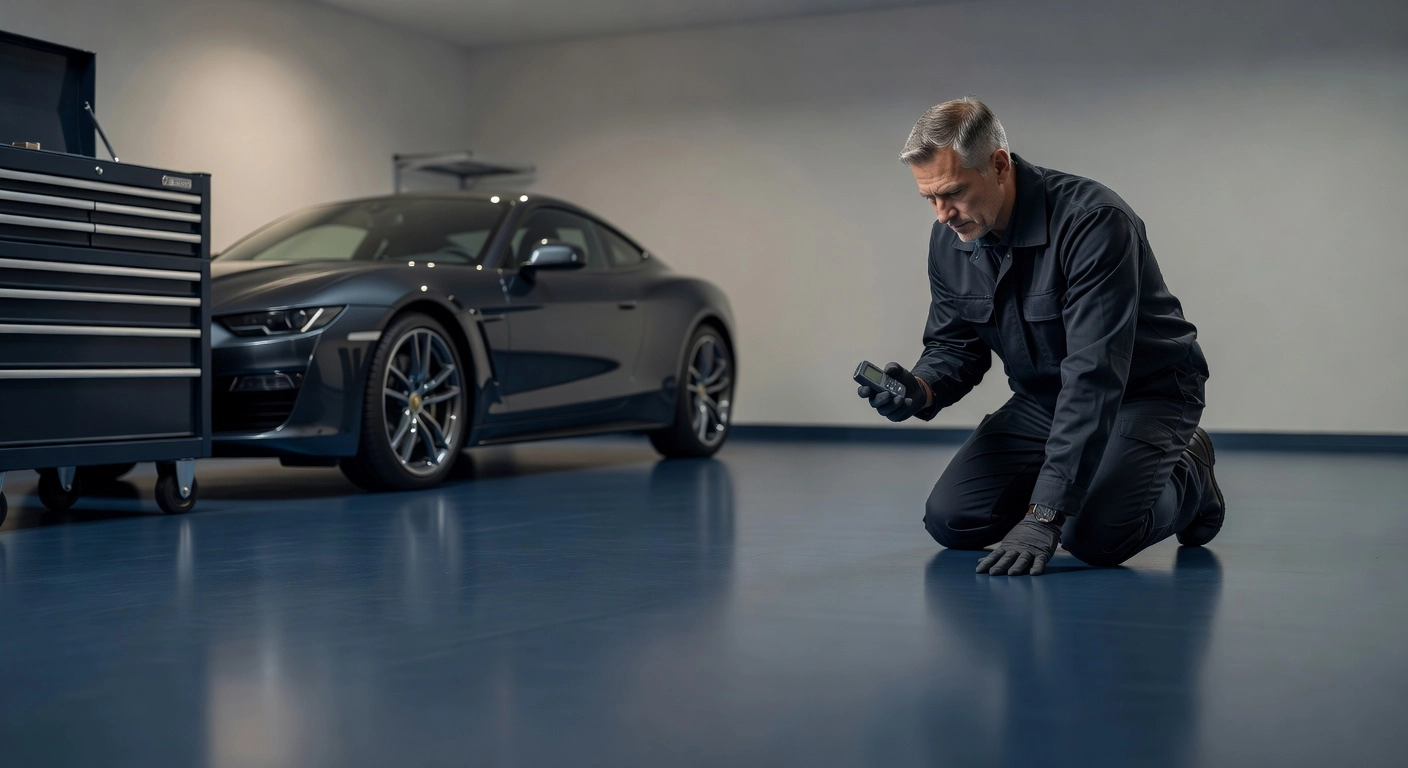
Epoxy coatings hold approximately 32.8% of the global garage flooring market in 2026, making them the most widely installed choice for residential garages by a significant margin. Their dominance is well-earned: epoxy delivers a seamless, non-porous surface that resists motor oil, chemical spills, road salt, and moisture while remaining easy to clean. For homeowners upgrading a working garage or a multi-functional space, few coatings match this combination of durability and design flexibility.
Lifespan varies considerably based on several factors. According to installer data on garage floor coating longevity, professionally applied systems routinely last 5 to 10 or more years, while DIY kits using thinner, water-based formulas may show wear or peeling within 2 to 5 years. Traffic volume, exposure to road chemicals, and ongoing maintenance all influence where a specific installation lands within that range.
Surface preparation is the single most important variable in determining whether an epoxy coating succeeds or fails. The concrete must be thoroughly cleaned, all cracks repaired, and the surface profiled to create mechanical bonding opportunity. Mechanical diamond grinding is the professional standard and produces stronger adhesion than acid etching alone. Skipping or rushing this step is the primary reason coatings peel prematurely, regardless of product quality.
Decorative flake and chip systems add both function and style. Broadcast vinyl chips embed into the wet epoxy, improving slip resistance, hiding minor surface imperfections, and offering extensive color options. In 2026, soft grays, warm taupes, and cloud-inspired neutrals are among the most requested palettes, helping garages integrate visually with updated home interiors.
The most notable limitation involves UV exposure. Standard and water-based epoxy formulas are prone to yellowing or ambering when sunlight reaches the floor through windows or open garage doors. This photochemical breakdown can appear within months in high-exposure areas. Additionally, two-part epoxy systems require precise resin-to-hardener mixing ratios; an off-ratio mix results in tacky, under-cured surfaces that never fully harden. UV-stable topcoats or polyaspartic finish coats are practical solutions for sun-exposed garages.
Polyaspartic Coatings
Where epoxy coatings serve as the established baseline for garage flooring, polyaspartic coatings represent the clear performance upgrade for homeowners who demand more. As a polyurea-based two-component system, polyaspartic delivers measurable advantages across nearly every performance category, making it the fastest-growing premium coating choice in residential garages today.
Faster Cure Times Change the Installation Equation
The most immediate practical advantage of polyaspartic over standard epoxy is cure speed. Polyaspartic coatings typically allow light foot traffic within 4 to 6 hours and become fully driveable within 24 hours. Standard epoxy, by comparison, often requires 3 to 7 days before vehicles should return to the floor. Professional installers frequently complete an entire polyaspartic project in a single day, minimizing the disruption to your household. For homeowners who rely on their garage daily, that difference is not minor; it is often the deciding factor.
UV Resistance Solves the Yellowing Problem
One of epoxy’s most frustrating long-term drawbacks is its tendency to yellow and amber when exposed to sunlight. Polyaspartic coatings are 100% UV-stable, meaning garages with windows, skylights, or frequently open doors will maintain their original color and gloss for years. This UV stability is a critical consideration if appearance and long-term aesthetics matter to you.
Built for Heavy-Use Environments
Polyaspartic systems outperform epoxy in abrasion resistance, chemical resistance, and flexibility. The coating moves with concrete as it expands and contracts, reducing the risk of cracking or delamination over time. For workshops handling heavy rolling equipment or garages outfitted with EV charging stations, polyaspartic handles heavier vehicle loads, greater tire heat, and potential fluid spills more effectively than standard epoxy.
Understanding the Cost Premium
Professional installation for polyaspartic typically runs $5 to $12 per square foot, compared to $3 to $7 for basic epoxy, representing a 20 to 40 percent cost premium. For a two-car garage, that difference can reach $1,500 or more. However, polyaspartic systems commonly carry 15 to 25-year warranties and require fewer reapplications over time, improving long-term value considerably.
The High-End Residential Shift
Homeowners increasingly treat their garages as finished extensions of living space, and polyaspartic is the coating that matches those elevated expectations. Search interest in polyaspartic alternatives has grown over 140% in recent years, and industry professionals report polyaspartic now accounts for the majority of premium residential coating projects. If your garage serves as a workshop, fitness space, or showcase environment, polyaspartic delivers the durability and appearance that justify the investment.
Interlocking Modular Tiles
Interlocking modular tiles offer a fundamentally different approach to garage flooring compared to the coatings covered in previous sections. Rather than chemically bonding to your concrete slab, these systems sit on top of it, creating a protective layer that is entirely independent of the substrate beneath.
Durability and Load Performance
Premium polypropylene and PVC tile systems from brands like RaceDeck and SwissTrax are engineered for serious use. Manufacturers back these products with lifespan claims exceeding 15 years, with some warranty programs extending to 20 years on select residential lines. Load capacity ratings are equally impressive; flagship tile systems support rolling loads of 40,000 lbs or more, with certain commercial-grade options rated even higher. These figures make modular tiles a credible long-term investment, not simply a cosmetic upgrade.
Installation Speed and Simplicity
The single biggest advantage modular tiles hold over epoxy and polyaspartic coatings is installation simplicity. Tiles snap together via interlocking peg-and-loop mechanisms and sit directly over existing concrete without adhesives, grinding, or chemical etching. A clean, dry surface is genuinely sufficient. Most homeowners complete a two-car garage installation in a single afternoon, making this the fastest DIY-friendly option in the garage flooring category. Edge ramps and border pieces create a finished perimeter with minimal effort.
Flexibility for Renters and Relocating Homeowners
Because no adhesives are involved, the entire floor system remains fully removable and reconfigurable. Renters can install a complete tile floor, then lift and reinstall the same tiles in a new location without leaving any trace on the original concrete. Homeowners who anticipate moving or want to change their garage layout later benefit from the same flexibility. SwissTrax interlocking tile systems explicitly market this portability as a core feature, and long-term user reviews confirm successful tile removal and reinstallation years after original purchase.
Drainage Performance in Cold Climates
Perforated and open-grid tile designs, such as RaceDeck Free-Flow and SwissTrax Ribtrax, channel water, snowmelt, and road salt downward through the tile surface rather than trapping it on top. This drainage architecture directly addresses one of the most damaging issues facing northern garage floors, where salt-laden runoff from vehicles accelerates concrete degradation over time. Solid-top tile variants offer easier surface sweeping but sacrifice the drainage advantage, so climate context should drive this selection.
Trade-offs to Weigh Carefully
Modular tiles are not without compromises. Visible seam lines between tiles are inevitable, creating a grid pattern that some homeowners find less polished than the seamless finish of an epoxy or polyaspartic coating. Debris, moisture, and fine grit can also accumulate in the raised gap beneath the tiles, requiring periodic lifting and cleaning for thorough maintenance. On a per-square-foot basis, premium tile systems typically cost more upfront than garage floor paint, though DIY labor savings can make them competitive with professionally installed coatings when total project cost is considered.
Rubber Rolls and Mats
Rubber rolls and mats occupy a distinct niche in the garage flooring landscape, excelling in functional zones where performance matters more than visual appeal. For homeowners converting a portion of their garage into a home gym or workshop, these surfaces deliver meaningful fatigue reduction, genuine slip resistance, and noise dampening that bare concrete simply cannot match. Unlike epoxy or polyaspartic coatings, rubber absorbs shock during dynamic movements like weightlifting or extended standing at a workbench, reducing joint strain over long sessions.
Thickness selection is one of the most important decisions in this category. At 3/8 inch, rubber provides adequate cushioning for light cardio, yoga, or casual workshop use. Stepping up to 1/2 inch handles moderate strength training and mixed-use setups. For heavy free weights, kettlebell drops, or power equipment, 3/4-inch rubber flooring is the recommended standard, offering maximum shock absorption and long-term floor protection.
Sustainability-conscious buyers will find recycled rubber rolls particularly compelling. Many products are manufactured from reclaimed tire rubber, significantly reducing landfill waste and producing lower VOC emissions compared to synthetic alternatives. This aligns directly with the growing consumer preference for eco-responsible home improvement materials in 2025 and beyond.
From an installation standpoint, rubber rolls and mats are genuinely accessible to intermediate DIYers. A utility knife is sufficient to trim rolls around posts, door frames, or irregular corners that would challenge rigid interlocking tiles. Larger rolls minimize seams across open floor areas, reducing trip hazards in the process.
One critical limitation deserves honest attention: rubber is not ideal beneath parked vehicles. Prolonged exposure to oil and automotive fluid drips can cause absorption, softening, and material degradation over time. Reserve rubber for dedicated gym or workshop zones, and rely on more chemically resistant coatings in active parking areas.
Concrete Paint and Stain
Concrete paint and stain represent the most budget-accessible entry point in the garage flooring category, with latex and epoxy-blend garage floor paints available for as little as $0.30 to $1.00 per square foot in materials. A standard two-car garage of roughly 400 square feet can be covered for $120 to $400 in product costs when handled as a DIY project. That price point is significantly lower than even entry-level epoxy coating kits, making paint an attractive option for homeowners working with tight renovation budgets.
Stains operate differently than paint. Acid stains and water-based concrete stains penetrate the porous surface of the slab itself, creating a permanent color change through chemical reaction or absorption rather than forming a film on top. The result is a mottled, natural appearance that reflects the character of the concrete beneath. Because the color integrates into the slab, it cannot peel or flake the way a surface coating can, which gives stained floors a visual longevity that appeals to homeowners prioritizing aesthetics over maximum protection.
The tradeoff is durability under real-world garage conditions. Under regular vehicle traffic, painted or stained floors typically require reapplication or significant touch-up within 2 to 5 years. Hot tires, road salt, oil drips, and abrasion accelerate wear considerably on these surfaces compared to thicker coating systems.
A sealer topcoat is non-negotiable after staining. Without it, the stained surface offers minimal resistance to oil, moisture, and salt infiltration. A quality acrylic, polyurethane, or epoxy-based sealer protects the finish and extends appearance life, though resealing every 2 to 5 years becomes a recurring maintenance requirement.
Where concrete paint and stain genuinely shine is in storage-focused garages that see light foot traffic, occasional parking, and minimal chemical or tool exposure. For those use cases, a cost-effective paint or stain refresh delivers a clean, finished look without the investment or cure time required by full coating systems.
Polished Concrete
Polished concrete takes a fundamentally different approach from every other option covered in this guide. Rather than applying a coating or laying a covering layer, the process refines and chemically transforms the existing concrete slab itself through a progressive diamond grinding sequence. Technicians work through increasingly fine diamond abrasives, typically advancing from coarse metal-bond tools around 30 to 40 grit up through 800 to 3,000 grit resin-bond pads. A chemical densifier, usually lithium or sodium silicate, is applied mid-process to penetrate the slab, react with the concrete matrix, and raise its Mohs hardness from roughly 3 to 4 up to 7 to 8. The result is a denser, harder, more abrasion-resistant surface with no topical layer whatsoever.
Because nothing is applied on top, there is nothing to peel, chip, or delaminate. Properly executed polished concrete routinely delivers 15 to 30 or more years of service life, significantly outperforming most coated alternatives on a lifecycle basis. Maintenance is straightforward: routine dust mopping and occasional neutral-cleaner washing keep the finish looking sharp, with periodic reburnishing recommended every five to ten years in heavily trafficked areas.
The high-gloss finish produced at the final polishing stages creates a genuinely reflective surface that amplifies ambient lighting and makes even a modest garage feel noticeably brighter and more spacious. This visual quality aligns well with current trends toward premium, minimalist garage aesthetics and architecturally intentional home design.
That said, professional equipment is non-negotiable. Planetary grinders weighing 60 to 250 pounds, sequential diamond tooling sets, and skilled multi-day execution put this firmly outside realistic DIY territory. Polished concrete also performs best on newer, crack-free slabs; older, oil-saturated, or damaged concrete is generally better served by a coating system instead.
Treated Hardwood and Engineered Wood for Garage Floors
Workshop areas and hybrid garage spaces represent the strongest use case for treated hardwood and engineered wood panels in a garage setting. Unlike bare concrete or modular tiles, wood delivers comfort underfoot during long hours at a workbench, natural sound dampening, and a warmth that transforms a utilitarian space into a functional extension of the home. When paired with the right protective finish, wood flooring holds up reliably in low-to-moderate spill environments, making it a legitimate option for dedicated workshop bays and multi-use garages that blend utility with livable aesthetics.
Surface-applied polyurethane finishes are the critical layer that makes wood viable in a garage environment. Oil-based polyurethane formulas create a tough, chemical-resistant film over the wood surface, providing meaningful protection against oil drips, cleaning solvents, and incidental workshop spills. Minwax polyurethane floor finish, applied in multiple coats with proper sanding between layers, delivers the abrasion and scuff resistance needed to withstand dropped tools, rolling shop chairs, and regular foot traffic. Oil-based topcoats outperform water-based alternatives in hardness and durability for this application, making them the preferred choice for any garage wood floor installation. Reapplication every few years, depending on traffic intensity, maintains the protective barrier and extends the floor’s service life considerably.
Moisture management is the deciding factor between a long-lasting installation and a costly failure. Engineered wood with cross-ply construction handles humidity fluctuation significantly better than solid hardwood, as its layered core resists the expansion, cupping, and warping that solid planks experience in slab-level environments. Engineered wood now accounts for approximately 75% of the wood flooring segment, driven in large part by this stability advantage. A raised subfloor assembly, built over a continuous vapor barrier with plywood or sleepers elevating the finished floor above the concrete, is strongly recommended for any garage wood installation. This configuration creates an air gap that interrupts moisture migration from the slab before it reaches the wood surface.
Aesthetics complete the case for wood in hybrid garage spaces. Wood stains in warm taupe tones, paired with matte or low-sheen finishes, align directly with 2026 hardwood flooring trends that favor natural, lived-in appearances over high-gloss surfaces. These neutral palettes allow a workshop or multi-use garage floor to coordinate seamlessly with adjacent interior spaces, reinforcing the garage as a deliberate design zone rather than an afterthought.
Garage Flooring Comparison at a Glance
The table below distills every option covered in this guide into a single reference you can return to when making your final decision.
| Flooring Type | Cost per Sq Ft | Expected Lifespan | DIY Difficulty | Chemical Resistance | Best-Fit Use Case |
|---|---|---|---|---|---|
| Concrete Paint | $0.30–$5 | 1–3 years | Easy | Poor | Ultra-budget, low-traffic cosmetic refresh |
| Rubber Rolls/Mats | $2–$6 | 5–15+ years | Easy | Moderate | Home gym, workshop comfort zones |
| Interlocking Tiles | $3–$8 | 10–20 years | Easy | Good | Renters, fast DIY upgrades, reusable installs |
| Epoxy Coating | $3–$12 | 5–10+ years | Moderate–Hard | Excellent | Vehicle storage, seamless aesthetic finish |
| Polished Concrete | $3–$8 | 20+ years | Hard | Good | Low-maintenance, modern industrial spaces |
| Polyaspartic Coating | $5–$14 | 15–25+ years | Hard | Excellent | Premium durability, UV-stable, all-climate garages |
| Treated Wood | $5–$15+ | 10–20+ years | Hard | Moderate | Workshops, gym spaces, home-extension aesthetics |
A few patterns stand out immediately. Epoxy and polyaspartic coatings lead on chemical resistance and seamless appearance, making them the top choice for garages that see regular vehicle use, oil drips, or road salt tracked in from winter driving. Polyaspartic edges ahead on longevity and UV stability, while epoxy offers a lower entry cost for comparable performance in moderate conditions.
Interlocking tiles take the lead on installation speed and removability. A two-car garage can be tiled in a single afternoon with no curing time required, and every tile is individually replaceable or fully removable if your situation changes.
Rubber and wood score highest for comfort underfoot, a decisive factor for anyone spending long hours standing at a workbench or exercising on a hard surface. Both options significantly reduce fatigue compared to bare coatings or polished concrete.
Concrete paint remains the clear budget leader, but that advantage disappears quickly under vehicle traffic. Hot tire pickup, moisture intrusion, and oil exposure accelerate peeling, making frequent recoats a hidden long-term cost.
Treated wood is the only option that integrates directly with interior wood stain palettes. As garages increasingly function as workshops, home gyms, or finished living extensions, the ability to match floor tones to stained cabinetry or adjacent interior hardwood is a genuine design priority, not simply an aesthetic detail.
Wood Garage Floors: Honest Answers to Common Concerns
Wood garage floors raise legitimate questions, and the answers depend almost entirely on how well you prepare the installation and finish the surface. Here are five honest responses to the concerns that come up most often.
1. Moisture and warping are manageable with the right prep. In a climate-controlled garage, a properly installed vapor barrier beneath the wood eliminates the majority of moisture risk. Use a polyolefin sheet or adhesive-integrated vapor retarder rated for the expected vapor pressure of your slab, test the concrete’s moisture levels before installation, and choose a floating or raised installation method that allows airflow beneath the planks. Wood is hygroscopic, but barriers and controlled humidity conditions prevent the expansion and contraction cycles that cause cupping and buckling. Skipping this step is where problems start; doing it correctly is where they stop.
2. Oil spills are not the threat most homeowners assume. A fully cured polyurethane topcoat creates a non-porous surface barrier that repels surface oils effectively, functioning the same way it does on a hardwood kitchen floor. The critical variable is response time. Wipe up spills promptly rather than allowing them to pool, and the finish does the rest. Absorbent mats placed in high-risk zones add a practical second layer of protection.
3. The right species handles workshop demands well. White oak, with a Janka hardness rating around 1,360, and hickory, rated near 1,820, resist dents and abrasion effectively under tool use, equipment loads, and occasional light vehicle movement in defined zones. Finished properly, these species perform comparably to rubber mats for low-to-moderate traffic areas, with the added benefit of refinishability that extends the floor’s lifespan by decades.
4. Daily vehicle parking remains a hard limit. Tire weight, road salt, and dripping fluids create conditions that finished wood cannot withstand long term. The practical solution is a zoned layout: coated concrete or tile for the parking bay, treated hardwood for the workshop bench area, home gym section, or hobby zone alongside it.
5. Familiar finishing skills transfer directly. Minwax Ultimate Floor Finish, a water-based polyurethane with self-crosslinking durability, delivers a clear, tough topcoat with recoat windows as short as two hours and no sanding required between coats on compatible surfaces. Oil-based polyurethane provides comparable abrasion and liquid resistance with a traditional amber build. Any homeowner who has finished interior hardwood floors already has the technique and tools this application requires.
How to Maintain Each Garage Flooring Type
Long-term performance from any garage floor comes down to one thing: consistent, type-specific maintenance. Here is what each flooring category requires to stay in top condition.
Epoxy and Polyaspartic Coatings
Sweep these surfaces regularly with a soft-bristle broom or microfiber dust mop to clear abrasive grit before it can scratch the finish. Mop with a pH-neutral cleaner and warm water whenever the floor sees vehicle traffic or spills. Acidic or ammonia-based cleaners dull the coating over time, so avoid them entirely. Never drag sharp metal objects, toolboxes, or jacks directly across the surface; use moving pads or plywood as a buffer. Schedule an annual visual inspection to catch chips or peeling early, particularly near entry points where tires and foot traffic concentrate the most wear.
Modular Tiles
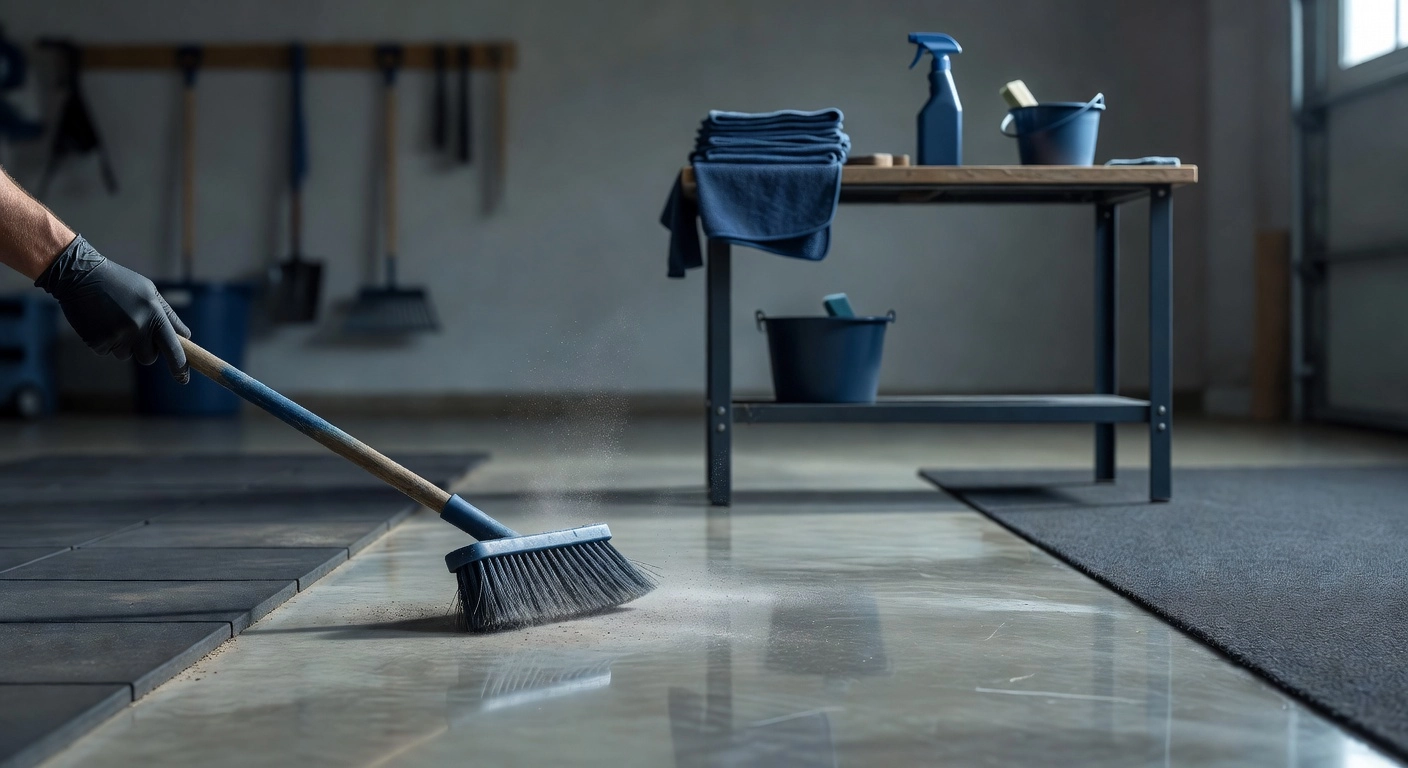
Surface cleaning is straightforward with modular tiles, but the area underneath demands attention. Lift and clean beneath the tiles once or twice per year to remove accumulated grit, moisture, and debris that settle into the tile bases. Neglecting this step can lead to mold growth, unpleasant odors, and gradual degradation of the subfloor below.
Rubber Rolls
Clean rubber rolls with mild soap and warm water, avoiding harsh chemical solvents that break down the material. Inspect edges routinely for curling or lifting caused by temperature swings or improper adhesion, then re-glue or retape problem areas immediately to eliminate trip hazards.
Wood Floors in Workshops
Dust-mop wood floors frequently to prevent abrasive particles from scratching the finish. Address oil or solvent spills immediately by blotting with an absorbent cloth rather than wiping. Recoat with Minwax polyurethane or a comparable floor finish every two to four years depending on traffic volume, lightly sanding between coats for proper adhesion.
Concrete Paint and Stain
Reapply sealer every one to two years in areas exposed to regular vehicle traffic. Watch for water absorption as a signal that protection has worn through. Touch up high-wear zones near garage entries promptly to prevent staining and surface deterioration from compounding.
Choosing the Garage Floor That Works for Your Space
Every garage flooring decision ultimately comes down to four variables: primary use case, traffic level, budget, and how much installation effort you are willing to invest. Match those factors honestly, and the right material becomes clear. Epoxy and polyaspartic coatings remain the strongest all-around performers for vehicle-focused garages, delivering chemical resistance, seamless surfaces, and lifespans ranging from 8 to 25 years depending on the system. Interlocking tiles win on flexibility and DIY speed, making them the practical choice for renters, phased projects, or anyone who values modularity over permanence.
Wood finishes represent a genuinely underutilized option that deserves serious consideration for workshop sections and hybrid spaces. Properly finished hardwood or engineered wood offers comfort underfoot, workbench-friendly warmth, and an aesthetic that no coating replicates. The wood segment is projected to hold approximately 39.7% of the global garage flooring market in 2026, reflecting real residential demand.
Before committing to a wood floor project, assess your garage’s primary use, measure the full square footage, and test a Minwax polyurethane floor finish sample on a scrap piece first. This single step confirms appearance, adhesion, and durability under your specific conditions. Minwax offers both water-based and oil-based polyurethane floor finishes as strong starting points for workshop floor protection.
Conclusion
Choosing the right garage flooring comes down to understanding your priorities. Budget, durability, installation difficulty, and aesthetics all play a role in finding the best fit for your space. Epoxy coatings offer a polished, affordable upgrade; polyurea finishes deliver superior durability and longevity; and interlocking tiles give you flexibility without the commitment of a permanent installation.
No matter which direction you go, one thing is certain: any upgrade from bare concrete is a step worth taking. Your garage deserves a floor that works as hard as you do.
Ready to make your move? Start by assessing how you actually use your space, then revisit the options that align with your needs and budget. The right garage floor is out there, and now you have everything you need to find it.
Frequently Asked Questions
What is the best garage flooring option for a home that parks vehicles and has an attached workshop?
For a hybrid garage that handles both vehicle parking and workshop use, a polyaspartic coating or a zoned approach works best. Polyaspartic delivers excellent chemical resistance, UV stability, and abrasion resistance that handles both use cases. Alternatively, consider applying a professional-grade epoxy or polyaspartic coating in the parking bay while installing treated hardwood or thick rubber mats in the dedicated workshop zone. This zoned layout optimizes each surface for its specific demands and prevents the compromises that come from applying a single flooring type across conflicting use cases.
How long does epoxy garage floor coating actually last, and what most affects its lifespan?
Professionally applied epoxy coatings typically last 5 to 10 or more years, while DIY water-based kits may show peeling or wear within 2 to 5 years. The single most important factor affecting lifespan is surface preparation. Studies suggest 30 to 50 percent of DIY epoxy jobs fail within one to three years due to inadequate prep. Professional installations use diamond grinding to create a proper adhesion profile, test for moisture vapor, and apply coatings at 10 to 20-plus mils thickness compared to the 2 to 4 mils typical of water-based DIY kits. Traffic volume, exposure to road chemicals, and routine maintenance also significantly influence how long any coating lasts.
Are interlocking garage floor tiles durable enough for heavy use, and can they really be removed and reused?
Yes on both counts. Premium polypropylene and PVC tile systems from brands like RaceDeck and SwissTrax carry lifespan claims exceeding 15 years, with some warranties extending to 20 years. Flagship systems support rolling loads of 40,000 lbs or more. Because no adhesives are used during installation, the entire floor system remains fully removable. Renters can install a complete tile floor and then lift and reinstall the same tiles in a new location without leaving any trace on the original concrete. Long-term user reviews confirm successful removal and reinstallation years after original purchase, making these tiles a genuinely portable investment.
Is wood flooring a realistic option for a garage, and how do you protect it from oil spills and moisture damage?
Wood is a realistic option for workshop areas and hybrid garage spaces, but it requires proper preparation and finishing to succeed. A raised subfloor assembly with a continuous vapor barrier beneath the wood is strongly recommended to prevent moisture migration from the concrete slab. Engineered wood with cross-ply construction handles humidity fluctuations better than solid hardwood and now accounts for approximately 75 percent of the wood flooring segment for this reason. Oil protection comes from a fully cured polyurethane topcoat, which creates a non-porous barrier that repels surface oils effectively. The critical rule is to wipe up spills promptly. Daily vehicle parking, however, remains a hard limit for wood floors due to tire weight, road salt, and dripping fluids.
What is the difference between polyaspartic and epoxy coatings, and is the higher cost of polyaspartic worth it?
Polyaspartic is a polyurea-based coating that outperforms standard epoxy in several key areas: it cures in 4 to 6 hours versus 3 to 7 days for epoxy, is 100 percent UV-stable so it won't yellow in sun-exposed garages, and offers greater flexibility that reduces cracking and delamination over time. Professional polyaspartic installation typically runs $5 to $12 per square foot compared to $3 to $7 for epoxy, a 20 to 40 percent premium that can translate to $1,500 or more for a two-car garage. However, polyaspartic systems commonly carry 15 to 25-year warranties and require fewer reapplications over time. For workshops, EV garages, spaces with sun exposure, or garages treated as a finished extension of the home, the long-term cost per year of service life generally justifies the upfront premium.
1 thought on “Garage Flooring Options: Which Type Is Right for Your Space?”