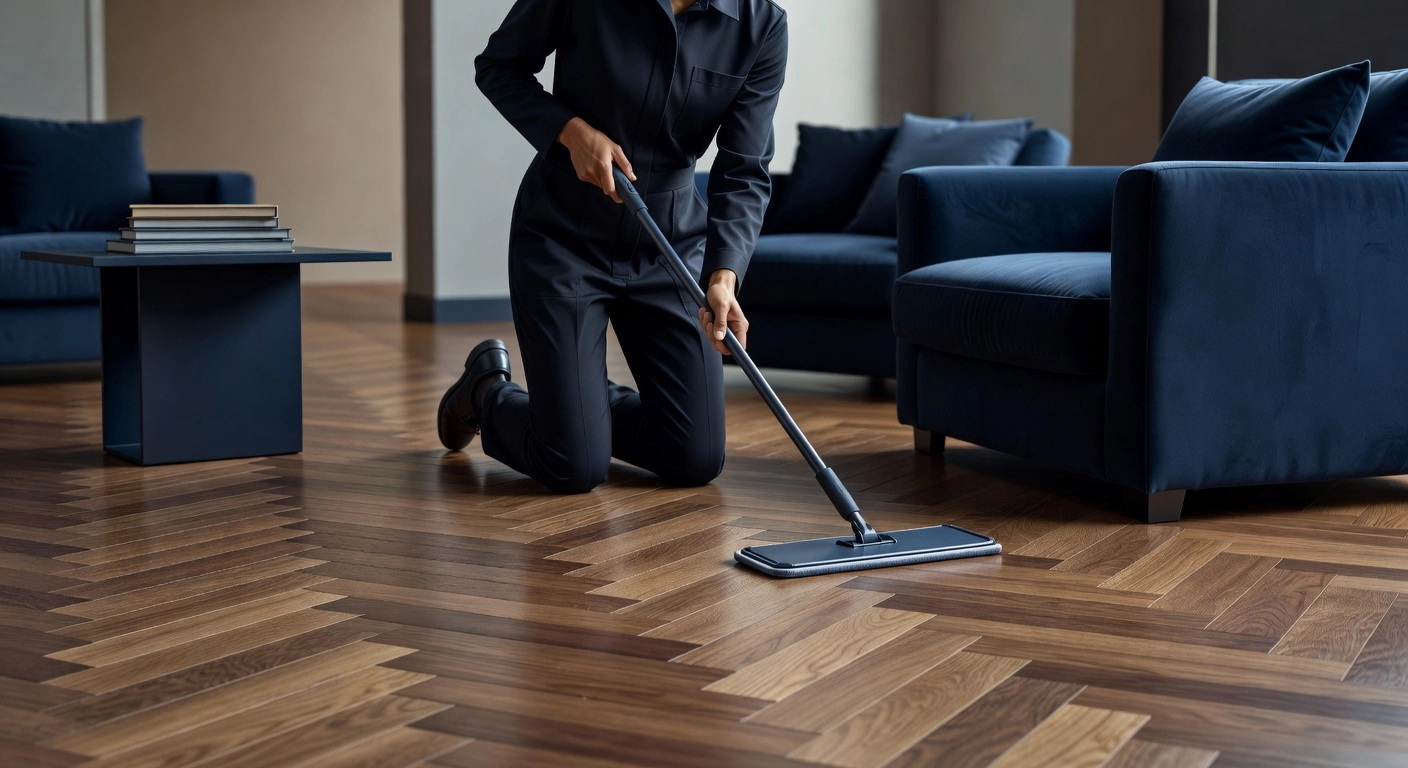
Few flooring choices command attention quite like herringbone flooring. The interlocking zigzag pattern has graced the halls of European palaces for centuries, and today it remains one of the most sought-after design choices for homeowners who want to blend timeless elegance with modern sophistication. But owning this distinctive flooring comes with a responsibility that many people underestimate.
Caring for herringbone floors requires more than the occasional sweep and mop. The angled, interlocking planks create unique challenges when it comes to cleaning, maintenance, and long-term preservation. Get it wrong, and you risk warping, discoloration, or premature wear that can diminish both the beauty and value of your investment.
In this complete guide, you will learn exactly how to protect and maintain your herringbone floors using proven techniques and the right products. From daily cleaning routines to seasonal deep maintenance, refinishing considerations, and damage prevention strategies, this tutorial covers everything an informed homeowner needs to know. Whether your floors are solid hardwood, engineered wood, or tile, the practical steps outlined here will help keep them looking exceptional for decades to come.
What Is Herringbone Flooring?
Herringbone flooring is defined by rectangular planks arranged in a staggered zigzag pattern, with each plank placed at 90-degree angles to its neighbors. The result mimics the lateral bones branching from a fish spine, which is precisely where the name originates. Unlike random or straight-lay installations, every plank in a herringbone floor connects end-to-side in a deliberate, interlocking sequence that creates visual rhythm and depth across the entire surface.
Herringbone vs. Chevron vs. Parquet
Understanding what herringbone is requires knowing what it is not. Chevron flooring uses planks with angled end cuts, typically at 45 or 60 degrees, so the tips meet point-to-point and form continuous, unbroken V-shapes. This gives chevron a sleeker, more graphic, and directional appearance. Herringbone, by contrast, uses standard square-cut planks, and the joints stagger rather than align, producing a broken zigzag that feels more layered, textured, and organically traditional. Broader parquet designs encompass a wide family of geometric wood arrangements, including basketweave, Versailles panels, and decorative inlays; herringbone and chevron are simply the most popular subsets within that family.
Heritage Roots and the 2026 “Quiet Luxury” Revival
The pattern traces its origins to Roman road construction, where interlocking bricks provided structural stability on crushed-stone bases. By the 16th century, European craftsmen had translated the technique into interior wood floors, with one of the earliest documented examples installed at the Château de Fontainebleau in 1539. French and European nobility adopted it as a hallmark of refined craftsmanship throughout the 1600s. In 2026, that heritage is fueling a major design resurgence. Both Forbes and The Spruce have identified herringbone as a leading trend, describing it as emblematic of “quiet luxury,” a design philosophy that values understated elegance, craftsmanship, and longevity over trend-driven flash.
Materials and Modern Installation Preferences
Four primary materials dominate herringbone production today. Solid hardwood offers authenticity and multiple refinishing cycles but demands precise moisture management. Engineered wood, featuring a real wood veneer bonded over a stable multi-layer core, has become the gold standard for modern herringbone installs due to its dimensional stability and compatibility with underfloor heating. Luxury vinyl plank (LVP/SPC) formats deliver waterproof performance and click-lock installation, making the pattern accessible for kitchens, bathrooms, and high-traffic commercial spaces. Laminate provides a budget-conscious entry point, though it is better suited to low-moisture environments. Engineered wood and LVP together dominate current installations for their balance of performance, cost, and practicality.
Why the Zigzag Layout Changes How You Care for the Floor
The interlocking geometry is not purely decorative; it fundamentally alters how the floor behaves and how it must be maintained. The overlapping joint structure distributes load more evenly across the surface, which can reduce individual plank movement in high-traffic zones compared to straight-lay floors. However, those same angled joints create more crevices where dust, grit, and debris can accumulate, meaning routine cleaning requires closer attention along the seam lines. Repairs also carry greater complexity; replacing a single damaged plank in a straight-lay floor is relatively straightforward, but the interlocking nature of herringbone means that disturbing one plank affects its neighbors. Refinishing and staining require equally careful technique to avoid lap marks across the directional grain changes, a distinction that makes product selection and application method especially important for long-term results.
Assessing Your Herringbone Floor Before Any Care Work
Before applying any product or beginning a care routine, you need to know exactly what you are working with. Herringbone flooring appears across multiple material categories, and the wrong approach on the wrong floor type can cause irreversible damage.
Identifying Your Floor Material
Start with two simple field tests. For the scratch test, use a coin or key to lightly drag across an inconspicuous area, such as inside a closet. Real wood, whether solid or engineered veneer, will show a faint scratch mark. Laminate and vinyl resist this easily due to their synthetic wear layers. For the moisture test, place a few drops of water on the surface and observe for 60 seconds. Solid hardwood absorbs quickly, visibly darkening the grain. Engineered wood resists somewhat longer. Laminate may swell at seams with prolonged exposure, while vinyl shows virtually no absorption at all.
Solid hardwood consists of a single piece of wood throughout its thickness and can typically be sanded four to seven times across its lifespan. Engineered wood features a real wood veneer over a plywood core and supports only one to three sanding cycles depending on veneer thickness. Laminate and luxury vinyl plank cannot be sanded or refinished at all. Identifying your material determines every decision that follows.
Factory-Finished vs. Site-Finished
This distinction changes your care approach entirely. Factory-finished floors arrive pre-coated with UV-cured aluminum oxide finishes applied under controlled conditions, producing a highly durable but fixed surface. You cannot easily sand through a factory finish to change stain color, and recoating adhesion can be challenging without proper preparation.
Site-finished floors are installed raw, then sanded, stained, and coated on location. This method creates seamless visual continuity across the herringbone pattern, with no pre-beveled edges interrupting the zigzag geometry. More importantly, site-finished solid hardwood is the primary candidate for Minwax staining and finishing work, because the entire system, from bare wood through stain to protective topcoat, can be customized and renewed on-site.
Reading Your Finish Condition
Examine sheen consistency across the floor. Dull patches in high-traffic corridors or near doorways indicate finish wear. Perform a water bead test: water should bead on a healthy finish and absorb where the protective layer has degraded. Surface scratches that catch light but do not penetrate the wood require only a recoat. Deep gouges that expose raw wood fibers or create a tactile ridge under your fingernail signal the need for sanding. Cupping, where plank edges sit higher than the center, points to moisture imbalance in the subfloor and must be resolved before any finishing work begins.
Decision Framework
Use this straightforward framework to guide your next step. If the finish is dull but the wood is structurally sound with only light surface scratches, a screen-and-recoat is appropriate; it is faster, less disruptive, and costs significantly less than full refinishing. If deep scratches, uneven wear, or a desired color change are involved, full sanding and refinishing is the correct path, provided sufficient wood thickness remains. Replacement becomes necessary when structural moisture damage, warping, buckling, or exhausted veneer thickness makes refinishing impossible.
According to 2026 flooring trend data, restoration is increasingly favored over replacement for both sustainability and cost reasons, making proper assessment even more valuable. Site-finished solid hardwood herringbone represents the ideal candidate for full refinishing work, offering the most longevity and the greatest creative flexibility when paired with quality stains and protective finishes.
How to Stain Herringbone Hardwood Floors Without Lap Marks
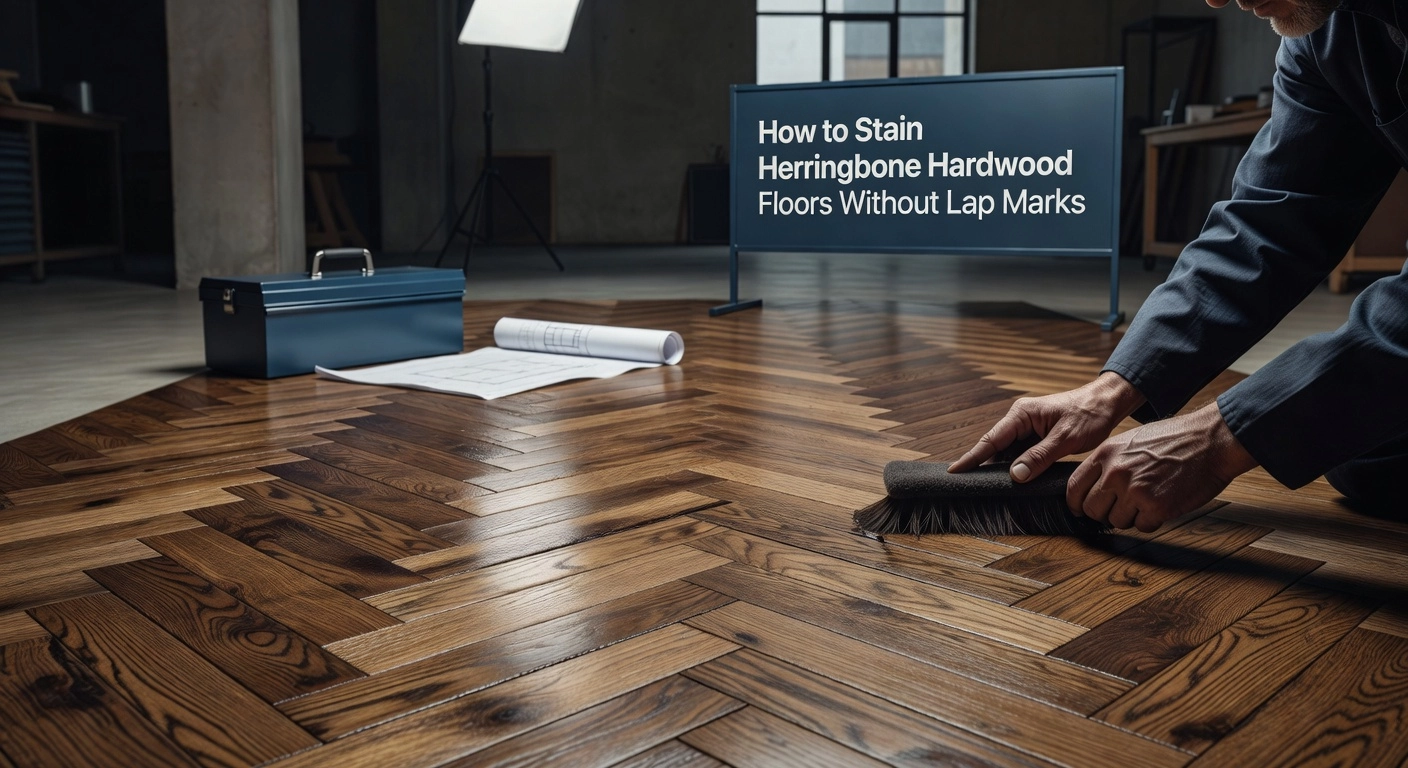
Herringbone’s signature zigzag geometry creates a staining challenge that straight-plank floors simply do not face. Because each plank is laid at alternating 90-degree angles, roughly half the surface area has grain running diagonally against any single sanding direction. This produces inconsistent scratch patterns, variable pore exposure, and differential absorption rates across the floor. Where one set of planks accepts stain deeply, the adjacent set may repel it or absorb far less, creating the blotchy, uneven patches and visible overlap lines known as lap marks. Understanding this root cause is what separates a professional-grade result from a floor that looks permanently streaked.
Why Pre-Conditioning Changes Everything
Applying Minwax Pre-Stain Wood Conditioner before any color touches the floor is the single most important step you can take on a herringbone surface. The conditioner penetrates open wood pores and partially fills the more absorbent areas, particularly end-grain zones that appear wherever planks are cut at angles. By equalizing absorption rates across the alternating grain directions, it prevents the rapid, uncontrolled uptake that causes blotching. On oak, which is the most common species used for herringbone hardwood floors, pore structure already varies considerably; the angled layout amplifies those differences significantly. Apply the conditioner by brushing or wiping it liberally in the direction of each plank’s individual grain, allow it to penetrate for 5 to 15 minutes, wipe away the excess, and apply your stain within two hours before the conditioning effect dissipates.
Step-by-Step Staining Walkthrough
Surface preparation is non-negotiable. Sand through progressive grits, beginning around 40 to 60 grit to remove old finish or level imperfections, and finishing at 120 to 150 grit for a smooth, even surface. Use a professional buffer or orbital sander and complete multiple screening passes; lap marks and blotching on herringbone frequently trace back to uneven sanding rather than stain application errors. After sanding, vacuum thoroughly and wipe the entire floor with a tack cloth to remove every trace of dust.
Sanding sequence on herringbone requires working with the dominant diagonal direction as much as possible, then completing additional passes to address the opposing plank orientation. There is no single grain direction to follow across the whole floor, so even preparation across both sets of angles is the goal, not perfection in one direction.
Conditioning and stain application follow immediately after dust removal. Once the conditioner is applied and wiped, load your applicator, whether a brush, lamb’s wool pad, or clean rag, with Minwax Wood Finish stain. Work with the herringbone layout by following the diagonal run of each plank rather than pushing the stain perpendicular to the pattern. This directional discipline minimizes streaking at plank transitions and keeps color absorption consistent across both grain orientations.
Managing Wet Edges Across the Zigzag
Lap marks form when a stain edge dries before you return to blend it. On a herringbone floor, the zigzag boundary between sections creates multiple such edges simultaneously. Counter this by working in small, clearly defined sections, perhaps four to six rows of the pattern at a time, and maintaining a wet line at every edge. Overlap slightly into the previously stained area while it is still tacky, blending wet-on-wet rather than wet-on-dry. Plan your workflow before opening any product so you never stop mid-section. Avoid working under direct sunlight or near heating vents, as accelerated drying is one of the leading causes of lap marks on complex patterns.
2026 Color Guidance and Minwax Shade Matches
The dominant 2026 palette for herringbone hardwood floors centers on light oak naturals, greige tones, and mid-range warm browns, all of which complement the pattern’s organic movement without overwhelming it. Minwax Natural or similarly light honey tones capture the airy, Scandinavian-influenced look trending alongside herringbone’s resurgence. For greige, Classic Gray offers a versatile neutral that reads differently depending on ambient light. Mid-tone warm browns align closely with Special Walnut, which Minwax named its 2026 Color of the Year, as well as Provincial and Golden Oak. Always test your selected shade on an inconspicuous section of the actual floor, both with and without conditioner, before committing to the full surface.
Drying, Timing, and Environmental Factors
Allow each stain coat to dry fully before applying the next, typically 8 to 24 hours depending on product formulation, ambient temperature, and humidity. Ideal conditions sit between 65 and 75 degrees Fahrenheit with 40 to 60 percent relative humidity. High humidity extends open time and creates a wider window for lap marks to develop if sections are not blended quickly. Low humidity or elevated heat accelerates skinning at the edges, making wet-line maintenance harder. On herringbone specifically, these environmental variables amplify the inconsistencies already introduced by alternating grain directions. Condition your workspace with climate control, and schedule staining during stable weather windows rather than on humid summer days or in the middle of winter heating season.
Choosing and Applying the Right Finish for Herringbone Floors
Finish selection carries more weight on herringbone floors than on any straight-plank installation, and the geometry explains why. The dense network of angled joints running across a herringbone layout creates dozens of seams where finish can pool, migrate unevenly, or reveal inconsistencies that would go unnoticed on a simpler pattern. Every directional shift in the zigzag also changes how light interacts with the wood grain, meaning sheen level becomes a visible, structural element of the design rather than just a surface property. Vulnerabilities are similarly amplified: moisture can infiltrate tight joint intersections, and scratches read more prominently against the dynamic visual movement of the pattern. Getting the finish right is not a finishing detail; it is a foundational decision.
Why Matte and Satin Outperform High-Gloss on Herringbone
The case for low-sheen finishes on herringbone floors is both practical and aesthetic. Matte and satin sheens conceal scratches, scuffs, dust, and footprints far more effectively than high-gloss because they scatter rather than reflect light, preventing imperfections from catching the eye. On a herringbone floor, which already draws attention through its pattern, a high-gloss surface compounds visual noise by adding glare across every angled joint and grain change. Satin finishes, typically measuring between 30 and 50 on a gloss scale, strike the ideal balance: enough reflection to add warmth and depth without overpowering the geometric character of the layout. In 2026, this preference aligns directly with the dominant quiet luxury aesthetic trend, which pairs organic, understated surfaces with refined architectural patterning. Herringbone in a matte or satin finish reads as intentional and elevated rather than flashy.
Applying Minwax Floor Finish Across a Herringbone Layout
Applying Minwax floor finish to a herringbone surface demands technique adapted specifically to the pattern’s overlapping angles. Begin by thoroughly stirring the product rather than shaking it, which introduces air bubbles that compromise the finish surface. Use a synthetic pad or lambswool applicator and work in thin, even passes, always following the grain direction of the individual plank beneath your applicator. The critical rule is never stopping mid-board; halting your stroke partway along a plank creates a visible lap line that the diagonal joints will amplify. Work in sections that align with one of the two dominant directional families in the herringbone pattern, completing each section before moving to the adjacent one. Keep a consistently wet edge across every joint to prevent the finish from setting unevenly at seam lines. In tight corners and along borders where planks meet at sharp angles, switch to a brush or smaller applicator and feather the product out carefully to avoid the buildup that accumulates when excess finish pools at intersections.
Recoating Protocol and Cure Time Guidance
Most herringbone installations benefit from two to three coats of finish, with bare wood or deeper protection goals warranting the full three. If you apply the next coat within two hours and no longer than 24 hours after the previous one, you can proceed without abrading. If that window has passed, lightly scuff the surface with 220 to 320 grit sandpaper or a maroon abrasion pad, remove every trace of dust with a tack cloth, and then recoat. Do not sand through to bare wood; you need adhesion, not removal.
Understanding the difference between dry-to-touch, light-use, and full-cure timelines is essential, particularly on herringbone where concentrated foot traffic at entry points can damage a soft finish. Under ideal conditions (approximately 77 degrees Fahrenheit and 50 percent relative humidity with good ventilation), Minwax floor finish is typically dry to the touch within two hours. Light foot traffic is generally safe after 24 hours. Full cure, meaning maximum hardness and durability, requires seven days before placing rugs or furniture and can take up to 30 days for complete polymerization depending on temperature, humidity, and coat thickness. Introducing heavy traffic before full cure causes dents, scuffing, imprinting, and clouding as the finish remains chemically soft and vulnerable.
Common Herringbone-Specific Application Errors
Several mistakes arise specifically from herringbone’s geometry and are worth anticipating before you start. Streaking along diagonal joints is the most common, caused by poor wet-edge maintenance, stopping the applicator mid-pass, or the flattening agents in matte and satin formulas distributing unevenly when the applicator changes direction abruptly. Buildup and puddling at corners where planks intersect at angles results from overloading the applicator or failing to feather thin coats through those tight zones. Finish inconsistency near borders and transition areas occurs when frequent direction changes break your rhythm and produce uneven coverage across the outermost rows of the pattern. All three errors share the same root cause: departing from a disciplined, directional, thin-coat technique. Maintaining consistent applicator pressure, respecting the grain direction of each plank, and resisting the urge to go back over areas that appear slightly dry will prevent the most damaging and difficult-to-correct results on your herringbone floor.
Ongoing Maintenance Routine for Herringbone Floors
Daily and Weekly Cleaning Habits
The geometry of herringbone flooring demands a more deliberate cleaning approach than straight-plank installations. With each plank angled at 90 degrees to its neighbor, the floor’s surface features a dense network of seams running in multiple directions simultaneously. Dust, grit, and fine debris settle into these joints readily, and without consistent removal, abrasive particles grind against the finish with every footstep. Use a dry microfiber dust mop or a vacuum fitted with a hard-floor attachment (no beater bar) daily in high-traffic zones and two to three times weekly elsewhere. The critical technique is to follow the plank direction or trace the “V” shapes of the pattern rather than sweeping across the grain, which pushes debris deeper into angled joints rather than collecting it.
Weekly damp mopping should use a well-wrung microfiber mop and a pH-neutral cleaner formulated for your floor type. The mop should feel barely damp to the touch, not wet. Excess moisture is significantly more damaging on herringbone than on straight-plank floors because the elevated number of angled seams multiplies the entry points for water. Moisture penetrating those joints causes edge swelling, warping, subfloor adhesive breakdown, and in glue-down installations, widespread lifting. Wipe spills immediately and never allow standing water to remain. For a deeper understanding of how to clean and maintain herringbone flooring, following manufacturer-specific guidance for your material type is always the safest baseline.
Products and Practices to Avoid
Steam mops are incompatible with herringbone floors in virtually every material category. The pressurized heat and moisture combination forces water into seams at an accelerated rate, causing delamination in engineered boards, adhesive failure in glue-down installations, and finish degradation across the entire surface. Beyond steam, harsh alkaline cleaners, bleach, ammonia-based solutions, oil soaps, and wax-based products all compromise the protective finish over time. Oil soaps in particular leave a residue that builds up within the pattern’s many joints, attracts dirt, and gradually softens the finish bond. Vinegar solutions, even diluted, are acidic enough to dull polyurethane and water-based finishes with repeated use. These restrictions are detailed further in the right way to clean herringbone patterned floors, which reinforces pH-neutral cleaners as the consistent standard.
Managing Scratches and Scuffs on Matte Finishes
Matte and satin finishes, now dominant on herringbone installations, diffuse light in a way that obscures minor surface scuffs better than gloss. However, they still require prompt attention when damage occurs. For light scuffs that have not broken through the finish layer, a touch-up pen or wood-tone marker matched precisely to the floor color provides adequate cosmetic correction. When dullness appears across traffic lanes but the finish remains structurally intact with no bare wood visible, a professional screen-and-recoat adds a fresh protective layer without heavy sanding. This maintenance coat approach is appropriate every three to five years in active households and effectively resets the surface appearance. Deep gouges or scratches that expose raw wood require professional sanding; attempting DIY filler repairs on a patterned layout risks uneven texture that becomes more visible across the herringbone geometry than it would on straight planks.
Seasonal Humidity Management
Wood movement caused by humidity fluctuations creates proportionally greater stress on herringbone floors than on straight-plank installations. Because each joint runs at an angle rather than parallel, expansion and contraction forces pull seams in competing directions, increasing the likelihood of visible gaps in winter, cupping in humid summers, and subfloor adhesion failure over repeated seasonal cycles. Maintaining indoor relative humidity between 30 and 50 percent year-round is the standard recommendation for most hardwood and engineered installations. Run a whole-home humidifier during dry heating seasons and a dehumidifier or air conditioning during humid summer months. A basic hygrometer placed near the floor level gives accurate readings and allows early intervention before damage accumulates.
Recognizing Finish Failure: Maintenance Coat vs. Full Refinish
A maintenance coat is the correct response when the floor looks dull or slightly worn but the protective finish layer remains intact. The tactile test is straightforward: run a clean finger across the surface in a traffic area. A finish that beads water, feels smooth, and shows no roughness or exposed grain is still protective and suitable for a screen-and-recoat. A full refinish becomes necessary when water no longer beads, when bare wood or gray oxidation is visible, when the surface feels rough or raises splinters, or when deep staining has penetrated below the finish. On herringbone floors specifically, watch for boards that feel loose or shift slightly underfoot, as this signals adhesive failure that requires professional assessment before any finishing work begins. Engineered boards carry a limited number of sandable layers (typically one to two refinishes over the floor’s lifespan), so accurate diagnosis before committing to a full sand is essential for preserving long-term value.
Caring for Engineered Wood and Vinyl Herringbone Floors
Not all herringbone floors are created equal, and the care approach that protects one material can actively damage another. Understanding where engineered wood and vinyl sit relative to solid hardwood is the foundation of any smart maintenance plan.
Material Differences That Drive Care Decisions
Solid hardwood offers the most refinishing potential, typically 6 to 8 full sanding cycles over its lifetime, but it carries the lowest moisture tolerance of the three. Engineered wood adds dimensional stability through its layered plywood or HDF core, making it better suited to areas with moderate humidity fluctuations. Vinyl herringbone, including LVP and LVT formats, contains no real wood at all; its synthetic construction delivers full waterproof performance but eliminates any possibility of traditional sanding or staining. The wear layer tells the story for engineered floors: a veneer of 2 mm or less typically limits you to a single screen-and-recoat, while a 3 to 4 mm wear layer can support two to three full refinishing cycles. Each pass of a drum sander removes roughly 0.5 to 1 mm of material, so measuring wear layer depth before committing to any sanding work is essential.
Minwax Products for Engineered Herringbone Surfaces
When an engineered herringbone floor shows dullness or light surface wear but still has wear layer left to preserve, a refresher coat is the smarter choice over full sanding. Minwax Hardwood Floor Reviver applies directly over clean, unwaxed polyurethane-finished surfaces with no sanding required. It rebuilds the protective layer, restores clarity, and extends the floor’s useful life, buying valuable time before a full refinish cycle becomes necessary. For routine cleaning between refresher applications, Minwax Hardwood Floor Cleaner removes residue without leaving a dulling film that would compromise adhesion on future coats.
Vinyl Herringbone: Why Staining and Refinishing Do Not Apply
Vinyl’s decorative layer is a printed image, not real wood grain. Stain has nothing to bond with, and sanding would simply destroy the visual layer entirely. Maintenance for vinyl herringbone centers entirely on protection and gentle cleaning: daily sweeping or vacuuming without a beater bar, followed by damp mopping with a pH-neutral cleaner using a well-wrung microfiber mop. Steam mops and excessive water should be avoided, as moisture can compromise seams or adhesive bonds over time.
High-Moisture Area Protocols
Kitchens and entryways are where vinyl herringbone flooring trends for 2026 are gaining the most traction, largely because its waterproof core handles the punishment those spaces deliver. Wipe spills immediately rather than letting them sit at seam edges. Use entry mats to capture grit before foot traffic grinds it into the wear layer. Maintain indoor humidity between 35 and 55 percent, and place felt pads under all furniture to prevent concentrated pressure points. These simple habits, combined with consistent cleaning, routinely extend vinyl herringbone life well beyond 15 years in demanding environments, keeping the pattern sharp and the surface intact without any refinishing investment.
Herringbone Floors in Commercial and High-Traffic Spaces
Commercial operators have discovered what residential designers have long known: herringbone flooring transforms a space from ordinary to architecturally compelling within a single glance. Airbnb hosts, salon owners, and cafe operators are increasingly installing herringbone specifically because the pattern photographs exceptionally well, creating visual depth and movement that elevates listing images and draws bookings. In competitive short-term rental markets, a herringbone floor can justify higher nightly rates by signaling quality and intentional design before a guest ever steps through the door. Salons and cafes benefit from the same effect at street level, where the pattern communicates a premium, design-led experience that influences customer perception from the moment they enter. You can explore how herringbone is shaping 2026 commercial interiors to understand the breadth of adoption across hospitality and retail sectors.
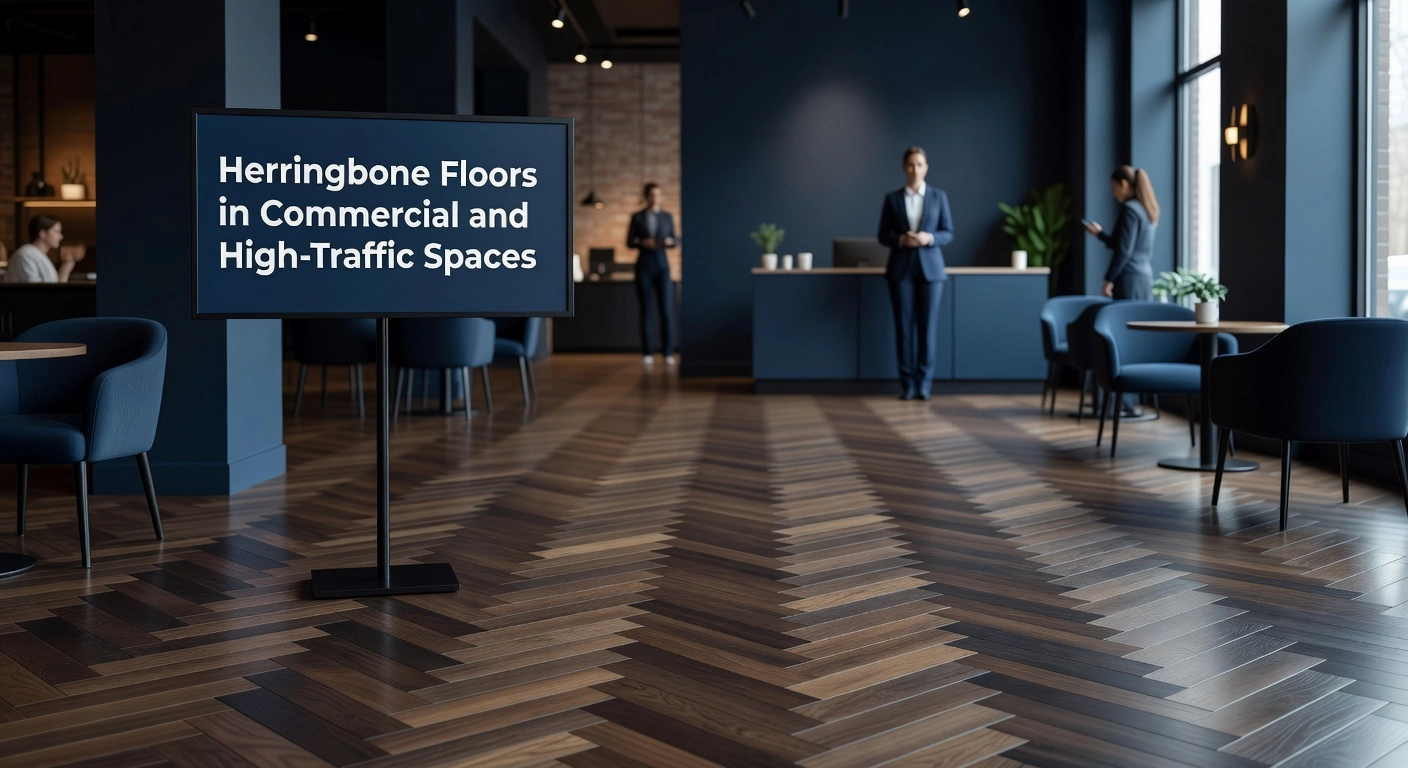
The finish requirements in these environments go well beyond what standard residential products are designed to handle. High-traffic herringbone accumulates stress at every angled joint and seam intersection, points where heel strikes, rolling furniture, and abrasive foot traffic concentrate force more intensely than on straight-plank floors. A commercial-grade or harder finish, whether a robust aluminum oxide coating on engineered wood or a thick SPC wear layer on vinyl herringbone, provides the scratch resistance, scuff resistance, and surface integrity needed to maintain the pattern’s visual clarity under constant use. Matte and satin sheens remain the practical choice here; they conceal everyday marks while supporting the refined aesthetic that motivated the installation in the first place.
Maintenance schedules also require a fundamentally different philosophy in commercial settings. Rather than reactive care triggered by visible damage, commercial herringbone demands a defined, proactive calendar. Weekly visual inspections should cover seam alignment, finish condition, and debris accumulation in the pattern’s crevices. Scuffs and surface marks warrant immediate spot treatment rather than deferred attention, because deterioration in high-traffic environments accelerates rapidly once a finish layer is compromised. Recoating should follow a scheduled interval tied to traffic volume rather than waiting for obvious wear, typically every six to twelve months in heavily used corridors or open-plan zones.
Protecting concentrated wear areas requires targeted physical interventions as well. In entry zones, quality matting systems extending at least ten to twelve feet inside the threshold intercept grit and moisture before they reach the angled joints. Under tables, chairs, and service equipment, felt pads and furniture glides prevent the localized scratching that accumulates quickly on herringbone’s shorter plank faces. In corridors where foot traffic follows a consistent path, protective runners reduce direct contact with the most vulnerable sections of the pattern, and periodic rotation of any moveable barriers distributes wear more evenly across the full installation.
Pro Tips and Common Mistakes When Working With Herringbone
Staining Mistakes That Herringbone Amplifies
Four staining errors cause the most damage on herringbone surfaces specifically. First, skipping pre-stain wood conditioner on blotch-prone species like maple or pine leads to splotchy absorption that the diagonal pattern makes impossible to hide. Second, applying stain against the grain direction on portions of the floor creates streaks and uneven penetration; because herringbone splits grain orientation across two directions, you must adjust your technique for each plank group rather than working the entire floor in a single pass. Third, tackling too large a section at once causes the leading edge to dry before you can blend it, leaving hard lines across the zigzag joints. Fourth, failing to maintain a wet edge across diagonal joints is the primary driver of lap marks on herringbone. Work in narrow, manageable strips and keep edges active throughout. Minwax® Pre-Stain Wood Conditioner applied before color helps regulate absorption and reduces the margin for error on complex grain patterns.
Finishing Errors That Show Immediately
Finishing mistakes on herringbone floors announce themselves at the first angle of light. Applying topcoat too thickly across the complex joint network traps air bubbles and creates uneven sheen that follows every zigzag line. Rushing between coats is equally damaging; inadequate dry time causes adhesion failure, peeling, and a tacky surface that collects debris. Edge planks where the pattern meets straight-cut walls are the most frequently missed areas; inconsistent sanding or skipped finish passes leave visible sheen variations along the perimeter. Apply thin coats, follow manufacturer dry-time guidance precisely, and treat every border plank with the same care as the field.
When to Call a Professional
Some projects exceed DIY scope regardless of skill level. Deep structural damage, extensive cupping from moisture intrusion, or a layout requiring intricate border sanding all indicate that professional intervention will cost less in the long run than correcting DIY errors. Herringbone’s geometry makes every flaw visible, and complex patterns demand multi-directional sanding equipment and technique that most homeowners do not have access to.
Investment Value Through Proper Care
Well-finished and consistently maintained herringbone floors deliver documented ROI, often returning 75 to 85 percent of project cost at resale while adding measurable appeal in rental listings. Solid hardwood refinished on schedule can last well beyond 50 years; engineered formats typically perform 20 to 40 years with proper maintenance. Every coat of quality finish and each consistent cleaning session extends that timeline.
Quick Reference Checklist
Do:
- Sand progressively through grits using multi-directional screening and remove all dust before any product application
- Apply pre-stain conditioner on blotch-prone species and test color on an inconspicuous section
- Work in small sections, maintain a wet edge at all diagonal joints, and apply finish in thin, even coats
Don’t:
- Skip prep or attempt to stain against the grain on any portion of the floor
- Apply stain or finish across oversized sections without a clear angle and border strategy
- Rush dry times or neglect edge planks where the herringbone pattern meets the wall
Your Herringbone Floor Deserves the Right Care From Day One
Herringbone flooring demands more from every care decision than a straight-plank floor ever will. The angled joints accumulate grit faster, the multiple grain directions complicate stain absorption, and visible wear patterns emerge more prominently across the geometric layout. Standard routines built for linear installations simply fall short when applied to herringbone’s interlocking zigzag structure.
Four pillars address these challenges directly: pre-conditioning to equalize absorption across varying grain directions, directional staining to prevent lap marks in the angled layout, matte finish selection to conceal everyday scratches while honoring the quiet luxury aesthetic, and consistent maintenance to protect the pattern over years of use. Each pillar reinforces the others, and skipping any one weakens the entire approach.
For site-finished solid hardwood herringbone projects, Minwax Pre-Stain Wood Conditioner, Minwax stain colors, and Minwax floor finish form the core product trio. These products work together to deliver even color penetration, rich grain enhancement, and durable protection suited specifically to hardwood floors.
Before applying anything, identify whether your floor is solid hardwood, engineered wood, or vinyl. Each material requires a different care path, and mismatched techniques cause preventable damage.
Explore the full Minwax product lineup, use the Minwax color selector to preview stain options for your space, and consult a flooring professional if your project scope or floor type is uncertain. The right care, started on day one, preserves both the beauty and the long-term value of your investment.
Conclusion
Herringbone floors are a long-term investment that reward attentive, consistent care. To protect that investment, remember these essential principles: clean regularly with the right tools and products, address spills and damage immediately before they escalate, schedule seasonal deep maintenance to preserve the finish, and refinish on time to prevent irreversible wear.
The effort you put in today directly determines how stunning your floors look a decade from now. These are not floors that ask for much, but they do ask for the right approach.
Start by establishing a simple daily and weekly cleaning routine, then build from there. If you are unsure where to begin, consult a flooring professional for a personalised maintenance plan.
Your herringbone floors have the potential to last generations. Treat them well, and they will continue to be the most breathtaking feature in your home for years to come.
Frequently Asked Questions
What makes herringbone floors harder to maintain than straight-plank floors?
Herringbone floors are more demanding to maintain because the interlocking zigzag pattern creates a dense network of angled seams running in multiple directions simultaneously. These joints accumulate dust, grit, and debris faster than straight-plank floors, requiring more deliberate cleaning techniques. The alternating 90-degree grain directions also complicate staining and finishing, as each plank group absorbs products differently, increasing the risk of lap marks, blotchy color, and uneven sheen if standard techniques are applied without adjustment.
How do I prevent lap marks when staining a herringbone hardwood floor?
Preventing lap marks on herringbone floors starts with applying Minwax Pre-Stain Wood Conditioner before any color is introduced. This equalizes absorption rates across the alternating grain directions and reduces blotching. When applying stain, work in small sections of four to six rows at a time, always follow the grain direction of each individual plank rather than pushing across the pattern, and maintain a consistently wet edge at every diagonal joint. Avoid working in direct sunlight or near heat vents, as accelerated drying is the primary cause of hard lines forming across the zigzag layout.
What finish sheen level works best for herringbone floors, and why?
Matte and satin finishes are the best choices for herringbone floors for both practical and aesthetic reasons. These low-sheen options scatter light rather than reflecting it, which effectively conceals everyday scratches, scuffs, footprints, and dust that would be highly visible on a high-gloss surface. On herringbone specifically, a glossy finish adds visual noise by creating glare across every angled joint and grain change, overwhelming the pattern's natural elegance. Satin finishes, typically measuring between 30 and 50 on a gloss scale, add warmth and depth while aligning with the 2026 quiet luxury design trend that herringbone currently represents.
Can engineered wood and vinyl herringbone floors be stained or refinished like solid hardwood?
Engineered wood herringbone can be refinished, but only a limited number of times depending on the veneer thickness. A wear layer of 2 mm or less typically allows only one screen-and-recoat, while a 3 to 4 mm veneer can support two to three full sanding cycles. Each drum sander pass removes roughly 0.5 to 1 mm of material, so measuring wear layer depth before sanding is essential. Vinyl herringbone, including LVP and LVT formats, cannot be stained or refinished at all because its decorative layer is a printed image rather than real wood grain. Maintenance for vinyl centers entirely on gentle cleaning with pH-neutral products and immediate spill removal.
How often should herringbone floors be professionally refinished, and what signs indicate it is time?
The timing for refinishing depends on traffic levels and finish condition rather than a fixed calendar. In active households, a screen-and-recoat is typically appropriate every three to five years when the floor appears dull but the protective layer remains structurally intact. A full refinish becomes necessary when water no longer beads on the surface, when bare wood or gray oxidation is visible, when the surface feels rough or raises splinters, or when deep scratches have penetrated below the finish layer. On herringbone floors specifically, boards that feel loose or shift slightly underfoot signal adhesive failure requiring professional assessment before any finishing work begins. Solid hardwood refinished on schedule can last well beyond 50 years.
3 thoughts on “The Complete Guide to Caring for Herringbone Floors”