
Whether you’re building a boat, a dockside deck, or any project that faces constant moisture, choosing the wrong wood can lead to warping, delamination, and costly repairs. That’s where marine plywood becomes your most important material decision.
Marine plywood is not just regular plywood with a fancy label. It is a specially engineered wood product built to withstand harsh, wet environments where ordinary plywood would quickly fall apart. Understanding what makes it different, how to select the right grade, and how to maintain it properly can mean the difference between a project that lasts decades and one that deteriorates within a season.
In this tutorial, you will learn exactly what marine plywood is and how it differs from standard plywood, how to read grades and choose the right type for your specific project, and how to seal, maintain, and extend its lifespan. No prior woodworking experience is required. By the end, you will have the foundational knowledge to shop with confidence, ask the right questions at the lumber yard, and give your project the best possible start.
What Is Marine Plywood?
Marine plywood is a premium exterior-grade engineered wood panel specifically designed to perform in high-moisture and wet environments. Unlike standard plywood, it is constructed from five or more thin plies of high-quality hardwood veneer, such as Okoume, Meranti, or Douglas Fir, arranged in a cross-laminated pattern where each layer’s grain runs perpendicular to the next.
This alternating structure gives the panel exceptional dimensional stability, strength, and resistance to warping that commodity panels simply cannot match. According to The Spruce’s guide to marine-grade plywood, this construction method is what makes marine plywood a trusted choice for demanding applications like boat building, docks, and coastal outdoor structures.
The adhesive bonding those plies together is equally important. Marine plywood uses a fully waterproof phenolic resin glue, sometimes called WBP (Weather and Boil Proof) adhesive, which creates a permanent structural bond under heat and pressure. This glue line resists breakdown, fungal attack, and delamination even after prolonged exposure to standing water or high humidity.
It is this waterproof glue, rather than the wood itself, that forms the foundation of the panel’s moisture-fighting performance.
That said, marine plywood is highly moisture-resistant, not fully waterproof on its own. Without proper sealing using marine varnish, epoxy, or paint, the panel can still absorb water over time and begin to swell or degrade. Finishing and edge protection are essential for long-term durability.
Marine plywood also carries a strict APA EXTERIOR exposure rating and adheres to tight manufacturing tolerances, including B-grade or better veneers and maximum core voids of just 1/8 inch. These standards separate it from cheaper commodity panels like CDX, which permit larger voids and lower-grade glue. This comparison of marine versus exterior plywood highlights why those tolerances matter in real-world wet conditions.
With the global marine plywood market projected to reach $15.62 billion in 2026, demand from DIY enthusiasts and construction professionals alike continues to grow rapidly, making this an increasingly relevant material to understand.
How Marine Plywood Is Made
Understanding the manufacturing process behind marine plywood explains exactly why it outperforms standard panels in demanding, moisture-heavy environments. Every step in production is held to a higher standard, and those differences compound into a dramatically more durable final product.
Layered Construction and Alternating Grain
Marine plywood is built from a minimum of five individual wood veneers, each rotary-peeled from carefully selected hardwood or softwood logs such as Douglas-fir, Western larch, Okoume, or Meranti. Each veneer is dried to a low moisture content, typically below 8%, before assembly.
The layers are stacked so that the wood grain of each ply runs perpendicular to the one above and below it, a technique called cross-graining. This alternating structure distributes stress evenly across the panel, resists splitting when fasteners are driven through it, and significantly reduces the swelling and shrinking that causes warping. An odd number of plies is always used to keep the panel balanced and stable. Thicker sheets may use seven, nine, or more layers for additional strength.
The Void Standard
One of the most important distinctions in marine plywood production is the strict limit on core voids. According to the APA marine grade plywood specification, maximum allowable core gaps are limited to just 1/8 inch. Standard plywood can contain interior gaps up to one inch wide, creating hidden weak points where moisture collects and decay begins. By eliminating those pockets, marine plywood removes the primary entry points for rot and structural failure.
Adhesives and Veneer Grade Requirements
The glue used in marine plywood is a phenolic resin adhesive, classified as Type I and rated for full exterior and submerged exposure. These waterproof bonds withstand prolonged humidity, boiling water tests, and even continuous immersion without delaminating.
Interior plywood relies on urea-formaldehyde glues that break down under sustained moisture. All plies in certified marine plywood must also meet a B-grade veneer minimum, meaning no open knotholes, consistent thickness, and smooth, repaired face surfaces. Standard exterior panels regularly use C-grade or D-grade inner veneers with far more permissible defects.
Together, void-free cores and waterproof phenolic bonds prevent moisture infiltration, eliminate rot pockets, and maintain structural integrity across years of wet-environment service. You can review additional guidance from the APA to understand how these specifications translate into real-world performance requirements.
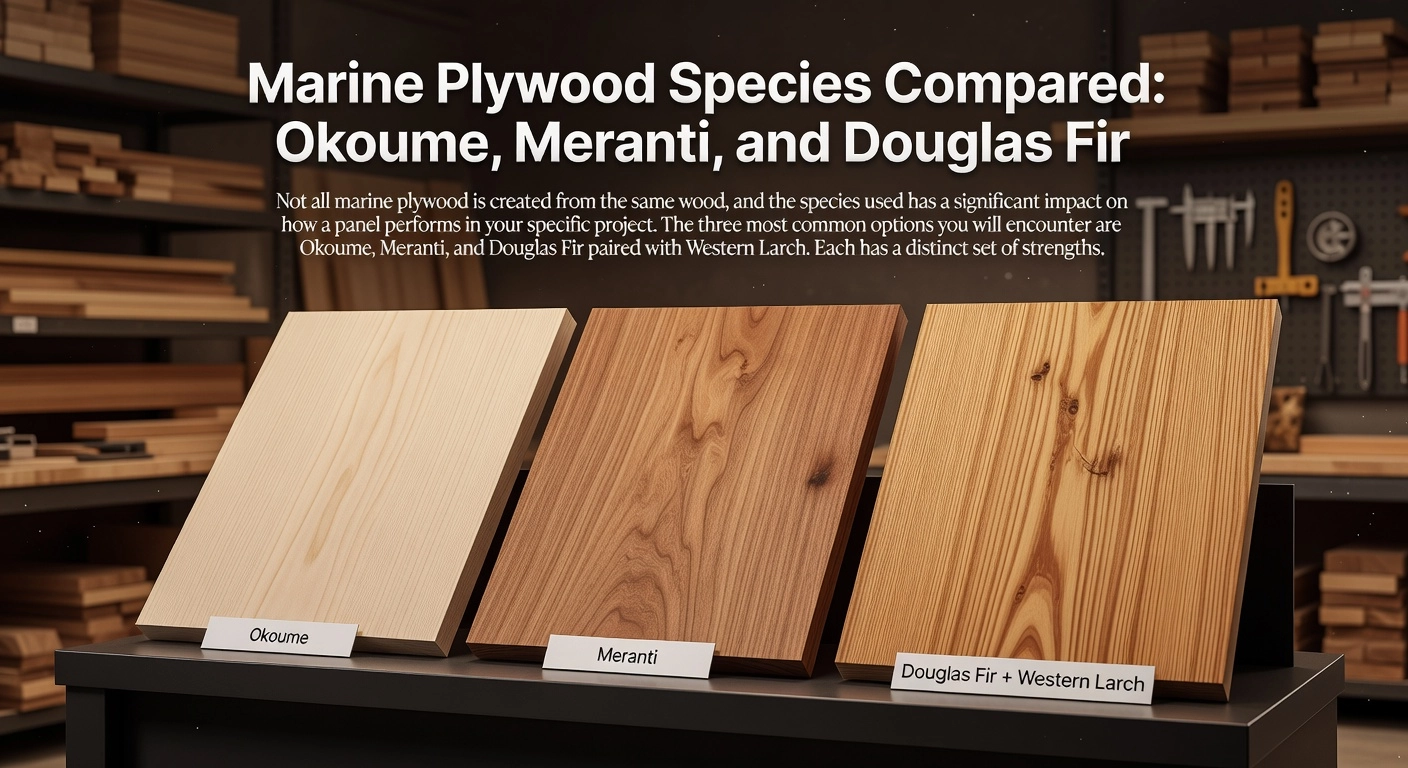
Marine Plywood Species Compared: Okoume, Meranti, and Douglas Fir
Not all marine plywood is created from the same wood, and the species used has a significant impact on how a panel performs in your specific project. The three most common options you will encounter are Okoume, Meranti, and Douglas Fir paired with Western Larch. Each has a distinct set of strengths, and choosing the right one comes down to understanding what your build actually demands.
Okoume (Gaboon)
Okoume is a lightweight tropical hardwood native to Central Africa, particularly Gabon, and it is widely considered the gold standard for premium marine plywood. It weighs roughly 25 to 32 pounds per cubic foot, making it noticeably lighter than competing species. Its fine, even grain makes it exceptionally smooth to work with, and it responds well to hand tools, bending, and shaping around compound curves. For beginners building a small boat hull, kayak, or interior cabin panel, Okoume is forgiving and manageable. The trade-off is that it has low natural rot resistance, so thorough epoxy or fiberglass sealing is essential. You can learn more about evaluating Okoume quality through this marine plywood consumer’s guide from WoodenBoat.
Meranti
Meranti comes from Southeast Asian hardwood forests and sits in a practical middle ground between lightweight performance and structural durability. It is roughly 10 percent heavier and denser than Okoume, which gives it better stiffness and improved natural rot resistance. It is also generally more affordable, making it a popular choice for decking, larger boat builds, and structural marine applications where a little extra weight is acceptable. Meranti is workable but less flexible than Okoume, so it is less ideal for projects requiring tight curves. For a cost-conscious beginner tackling a dock platform or structural panel, Meranti delivers solid value.
Douglas Fir and Western Larch
These North American softwood species are the heaviest of the three and produce the stiffest marine-grade panels available domestically. They meet APA standards and excel in heavy-duty structural roles such as framing, subfloors, and keelsons. However, their rigidity makes bending difficult, and they can develop surface checking over time without protective coatings. They are best suited to applications where raw strength matters more than weight savings or refined finishing.
Choosing the Right Species for Your Project
| Species | Weight | Workability | Rot Resistance | Relative Cost |
|---|---|---|---|---|
| Okoume | Lightest | Easiest | Low (needs sealing) | Premium |
| Meranti | Medium | Moderate | Good | Affordable |
| Douglas Fir | Heaviest | Stiffest | Good | Variable |
As a simple rule for beginners: choose Okoume for lightweight builds where ease of working matters, Meranti for structural or budget-conscious marine projects, and Douglas Fir where rigidity and raw strength are the priority.
Finally, when sourcing either Okoume or Meranti, look for panels carrying FSC certification or similar chain-of-custody credentials. Sustainably certified versions of both species are increasingly available as responsible forestry practices expand across Africa and Southeast Asia.
Certified panels support responsible land management and often come from mills with tighter quality controls, meaning you get a better product while making a more environmentally sound purchase. Details on why certified Okoume is a recommended choice are worth reviewing before you buy.
Marine Plywood Grading Standards Explained
Grading standards are what separate genuine marine plywood from cheaper imitations, and understanding them gives you the confidence to buy the right panel every time.
BS 1088 is the gold standard for marine plywood worldwide, particularly for boatbuilding and any application involving prolonged moisture exposure. This British Standard specifies that all face and core veneers must come from selected tropical hardwood species, such as okoume, meranti, or sapele, meeting minimum density and natural fungal resistance requirements. The glue must be Weather and Boil Proof (WBP), typically phenolic or melamine-formaldehyde resin, capable of surviving boiling water, steam, and extreme weather cycles without failing. Face veneers must present a solid, defect-free surface with no open knots, gaps, or splits, and core veneers allow only tightly controlled defects with edge gaps no larger than 0.5 mm. Crucially, no significant voids are permitted anywhere in the panel structure. According to Boatcraft Pacific’s detailed BS 1088 summary, BS 1088 is a voluntary standard, meaning the stamp alone does not guarantee compliance. Purchasing from reputable mills or panels with third-party approval, such as Lloyd’s Register Type Approval, adds meaningful verification.
For buyers in North America, the APA EXTERIOR rating is the primary benchmark to look for at the lumber yard. When you find the APA trademark stamp on a sheet, it tells you the panel was produced at a mill subject to rigorous third-party auditing. The “EXTERIOR” bond classification confirms fully waterproof structural adhesive, suitable for repeated wetting and drying cycles. A true APA Marine designation goes further, requiring all plies to be Grade B or better, using Douglas Fir or Western Larch exclusively, and limiting core voids to a maximum of 1/8 inch. As WoodenBoat magazine notes in its consumer guide, exterior-rated plywood is not automatically marine grade, even if it shares waterproof glue, because the core void and veneer quality requirements are far stricter for marine panels.
Veneer face grade combinations tell you about surface quality on the outer plies. An A-A panel features two premium, defect-free faces ideal for visible surfaces and clear varnish finishes. An A-B panel offers one clean A face and one B-grade back with minor allowable knots, making it a practical and economical choice when only one side will be visible, such as cabinetry or interior paneling. Neither combination replaces the importance of core construction and glue quality for overall structural performance.
One of the most common mistakes beginners make is purchasing panels labeled “marine grade” without any verifiable certification stamp. These panels frequently contain large core voids, non-WBP adhesives, or misrepresented species, and they fail quickly under moisture through delamination and rot.
Before purchasing any sheet, run through this quick inspection checklist:
- Check for a legible grade stamp showing BS 1088 or APA EXTERIOR Marine with manufacturer details
- Inspect the panel edges for visible voids, gaps, or delamination in the core layers
- Confirm the glue type on the label, looking specifically for WBP, phenolic, or waterproof exterior adhesive listed
Marine Plywood vs. Exterior Plywood: Which One Do You Actually Need?
Choosing between marine plywood and exterior plywood comes down to one practical question: how much moisture will your project face, and for how long? Both materials use waterproof adhesives, but the similarities largely end there.
Five Key Differences at a Glance
Void tolerance is where the gap between these two products becomes most visible. Marine plywood allows a maximum core void of just 1/8 inch per APA marine specifications, giving the panel consistent strength and no hidden pockets where water can collect and rot the core. Exterior grades like CDX permit voids that can approach an inch or more, which is fine for dry applications but creates failure points under sustained moisture.
Veneer grade follows a similar pattern. Marine panels use A or B-grade face veneers with minimal knots or repairs, while exterior grades commonly feature C and D-grade veneers with knots, patches, and surface defects. Glue type is less of a differentiator than most beginners expect; both products use waterproof phenolic resin adhesives. The real distinction lies in construction quality, not chemistry. Rot resistance in marine plywood is superior because void-free cores prevent moisture from migrating inward and weakening the structure. Exterior plywood handles intermittent exposure reasonably well but degrades faster when water consistently finds those internal gaps. Cost reflects all of the above, with marine panels typically running two to four times more per sheet than comparable exterior grades.
When Exterior Plywood Gets the Job Done
Exterior plywood is a sensible, budget-friendly choice for covered outdoor furniture, pergolas, and garden storage units where a quality paint or sealant finish provides adequate protection. It also performs reliably in dry interior builds such as shelving, cabinetry outside wet zones, and subflooring in climate-controlled spaces. Short-term or temporary projects, including formwork and event structures, rarely justify the premium of marine-grade material.
When You Need True Marine Plywood
Boat decking, hulls, and bulkheads demand marine plywood because a hidden void at the wrong location can compromise structural integrity in ways that are both costly and dangerous. Docks and waterfront platforms facing constant submersion or splash exposure carry the same requirement. Bathroom subfloors and kitchen cabinet bases positioned directly beneath sinks or in high-humidity wet zones are interior applications where marine plywood genuinely earns its price premium by preventing delamination and rot over years of use.
A Realistic Price Comparison
For a standard 4×8 foot sheet, marine plywood pricing for BS 1088-certified panels typically ranges from roughly $85 to $110 for 1/4-inch thickness and $140 to $180 for 3/4-inch thickness. Standard exterior grades like ACX or CDX generally fall in the $30 to $60 range for comparable sheet sizes. That upfront gap looks significant, but a marine panel lasting 15 to 25 years in a wet application often delivers a lower annualized cost than exterior plywood requiring early replacement. Budget accordingly by reserving marine plywood for the applications where its performance characteristics are genuinely non-negotiable, and using quality exterior grades confidently everywhere else.
What Can You Build with Marine Plywood?
Marine plywood’s premium construction makes it the right choice across a surprisingly wide range of projects. Whether you’re working on something that sits in the water or simply lives in a humid corner of your home, understanding where this material truly earns its price tag helps you make smarter building decisions.
Boat Building and Repair
The most traditional application for marine plywood is exactly what the name suggests. Decks, hulls, bulkheads, and transoms all depend on a panel that maintains structural integrity under constant or repeated water exposure.
The void-free core construction is critical here; any gap in a standard panel can trap moisture and trigger rot from the inside out, often before you notice any surface damage. Lightweight species like Okoume are popular for small boat hulls in stitch-and-glue construction, while denser hardwood panels handle larger vessels that demand greater load-bearing capacity. When properly sealed with epoxy or fiberglass cloth, marine plywood can deliver decades of reliable service in boat building and repair applications.
Docks, Pontoons, and Coastal Decking
Structures built over or beside water face relentless humidity cycling, salt air, and direct splash exposure. Marine plywood handles these stresses better than any standard panel, resisting warping and delamination even as conditions shift dramatically between seasons.
Bathroom and Kitchen Cabinetry
Inside the home, under-sink cabinets, vanity bases, and kitchen cabinet substrates in high-humidity households all benefit from marine plywood’s moisture resistance. Steam, condensation, and occasional spills can cause interior-grade plywood to delaminate within a few years. Marine plywood holds its shape and provides a stable base for laminates, paint, or veneer finishes.
Outdoor Furniture and Small DIY Projects
Benches, planters, and storage boxes built from marine plywood outlast pine or CDX alternatives significantly in outdoor settings. For smaller DIY builds like kayak shells using 3-4mm Okoume panels, storage lockers, and floating shelves in laundry rooms or garages, marine plywood eliminates the rot risk that cheaper panels carry wherever moisture intrusion is possible.
How to Seal and Finish Marine Plywood the Right Way
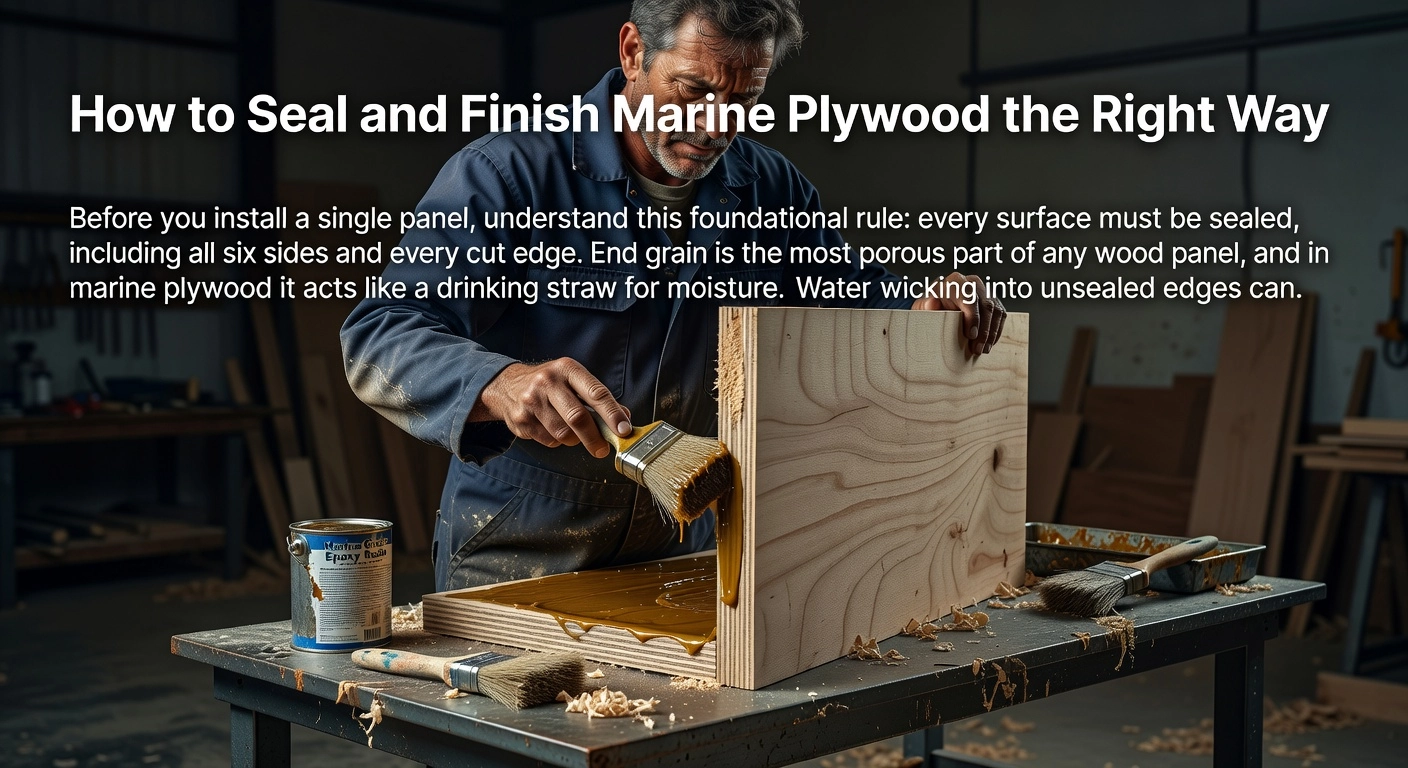
Before you install a single panel, understand this foundational rule: every surface must be sealed, including all six sides and every cut edge. End grain is the most porous part of any wood panel, and in marine plywood it acts like a drinking straw for moisture.
Water wicking into unsealed edges can cause delamination and rot far faster than surface exposure ever would. Skipping this step is the single most common reason marine plywood fails well before its potential 15 to 25-year lifespan.
Step 1: Sand, Clean, and Apply Your First Epoxy Coat
Start by sanding all faces and edges to 120-grit. This removes mill marks, opens the grain, and creates a surface that allows the sealer to penetrate deeply rather than sitting on top. Once sanding is complete, wipe away all dust with a tack cloth or vacuum, then follow up with a clean, dry cloth. Any dust left behind will interfere with adhesion.
Apply a penetrating epoxy sealer across every surface, working edges and end grain first since these areas absorb the most resin. The epoxy fills micro-pores at a cellular level, consolidating the surface and creating the foundation of your moisture barrier.
Step 2: Build the Continuous Moisture Barrier
After the first epoxy coat cures fully, apply a second thin coat to build a seamless, continuous film. This second application is where gaps in coverage from the first coat get filled in. Pay extra attention to edges again, applying additional material to ensure no raw wood remains exposed. Thin coats cure more evenly and bond better than thick ones, so resist the urge to overload your brush.
Step 3: Apply the Protective Topcoat
Once the epoxy system is cured, sand lightly with 180 to 220-grit paper to de-nib the surface, then apply two to three coats of a UV-resistant marine spar varnish or exterior polyurethane. Sand lightly between each coat for proper adhesion. These topcoats provide critical UV protection that epoxy alone cannot offer, along with abrasion resistance for high-traffic surfaces.
The two mistakes that shorten marine plywood lifespan most significantly are leaving edges unsealed and using interior-grade varnish as a substitute finish.
Interior varnishes lack the flexibility and water resistance required for exterior exposure, and they tend to peel or check under sustained moisture. According to Ply Direct’s plywood durability overview, raw edges and inadequate finishes are consistently identified as the primary lifespan killers for marine panels. Doing the job completely the first time protects your investment and keeps the wood performing for decades.
How Long Does Marine Plywood Last?
Properly sealed and maintained marine plywood delivers a realistic service life of 15 to 25 years, according to both The Spruce and LBI Fiberglass. That benchmark assumes full encapsulation of every surface, appropriate topcoats, and routine annual inspections. Panels that receive this level of care consistently outperform standard exterior plywood by two to three times, making the upfront cost investment well justified for any project facing consistent moisture exposure.
Several variables can significantly cut that lifespan short. Incomplete sealing is the most common culprit, especially at cut edges and fastener penetrations where moisture enters quickly and quietly.
UV exposure without a protective topcoat degrades the surface veneer faster than most beginners expect, which is why recoating every one to two years outdoors is strongly recommended.
Standing water pooling on horizontal surfaces, poor ventilation trapping humidity beneath panels, and fastener corrosion from non-stainless hardware all introduce moisture pathways that accelerate rot and delamination from the inside out.
Species selection also influences how demanding your maintenance schedule will be. Okoume panels, while lightweight and easy to work with, have lower natural density and require more frequent inspections and recoating under heavy outdoor exposure. Meranti and Douglas Fir, both denser and more naturally rot-resistant, tend to hold up better with less intensive upkeep in high-wear or fully exposed conditions.
Knowing the early warning signs of failure helps you catch problems before they require full panel replacement. Watch for surface checking (fine cracks in the outer veneer), paint or varnish bubbling, soft spots that feel spongy when pressed firmly, and visible delamination at panel edges where plies begin to separate.
Any of these signals demands immediate attention and targeted repair.
The encouraging news for DIYers is that a well-sealed panel installed in a partially protected setting, such as a bathroom accent wall, a shaded deck, or a covered porch, can realistically meet or even exceed that 25-year mark when given consistent annual care.
Marine Plywood Maintenance Schedule and Inspection Tips
Every investment in quality marine plywood pays off only when backed by a consistent maintenance routine. The good news is that inspections are straightforward once you know exactly what to look for and when.
Seasonal Inspection Routine
Each spring, before humidity and rainfall peak, conduct a thorough review of every marine plywood surface in your project. Run your hand firmly across the entire panel and press down on any area that feels slightly different from the surrounding wood. Soft or spongy spots signal moisture infiltration and possible early rot beneath the surface.
Visually scan for surface cracks, bubbling finish, or peeling varnish, since any breach in the topcoat allows water to work its way into the wood fiber underneath.
Inspect every fastener as well; rust staining around screw heads or bolt holes indicates that water is tracking down the hardware directly into the panel.
Topcoat Refresh Schedule
For exposed outdoor applications such as docks, boat components, and outdoor furniture, plan to lightly sand the surface with 220-grit paper and apply a fresh topcoat of marine-grade varnish or epoxy sealer every two to three years. In tropical climates or high-UV regions, shorten that interval to every one to two years, since intense sunlight degrades finishes significantly faster than in temperate zones.
How to Detect Delamination Early
Glue failure between plies is one of the most serious problems marine plywood can develop, and it often starts invisibly. Tap the surface systematically with a small mallet or even a coin. Solid, well-bonded areas return a sharp, clear sound, while delaminated sections produce a noticeably dull, hollow thud. Catching this early allows targeted epoxy injection repairs before the separation spreads across the panel.
Bathroom and Kitchen Edge Seals
In wet interior installations, inspect every caulk line and edge seal annually. Reapply mold-resistant silicone caulk anywhere you spot gaps, shrinkage, or discoloration.
For deeper guidance on protecting these surfaces from UV exposure and repairing existing moisture damage, the WoodStuffHQ guides on UV protection and water damage repair serve as practical companion resources to keep your marine plywood performing for decades.
Where to Buy Marine Plywood and What to Expect to Pay
True marine plywood is primarily available through specialty lumber yards, dedicated marine suppliers, and select online retailers focused on boatbuilding and high-end woodworking. Some big-box hardware stores carry panels labeled as marine grade, but quality varies considerably by source.
Specialty suppliers emphasize certified, void-free cores and consistent species identification, while general retailers may stock basic exterior panels with inferior glues that happen to carry marine-sounding descriptions. For certified product, sourcing from a dedicated marine or hardwood lumber supplier gives you the most reliable results.
Standard sheets measure 4 x 8 feet, with thicknesses ranging from 1/8 inch (approximately 4 mm) up to 3/4 inch (approximately 18 to 19 mm). Thinner panels in the 1/8 to 1/4 inch range suit lightweight applications like cabinet backs, thin interior paneling, and small boat components such as kayak hulls.
Mid-range thicknesses around 3/8 to 1/2 inch work well for cabinetry, furniture sides, and wall paneling. The thicker 5/8 to 3/4 inch panels are the go-to choice for boat decks, dock surfaces, outdoor furniture, and any high-load structural application.
Pricing runs considerably higher than standard CDX or exterior plywood. Generic marine-labeled panels without certification typically fall between $45 and $90 per sheet, while BS 1088-certified Okoume panels range from roughly $85 to $180 depending on thickness.
Expect 3/4 inch premium sheets to approach or exceed $150 at many suppliers. The higher cost reflects stricter manufacturing tolerances, superior adhesives, and void-free core construction.
Before purchasing, always request the grade stamp, confirm the species, and physically inspect every panel edge for voids or signs of delamination. This step is especially important at general hardware retailers where stock can be inconsistent. Look for permanently stamped markings on the face or edge rather than removable paper labels.
Finally, be cautious of unlabeled panels described verbally as marine grade without any printed certification. This is a recognized upsell tactic at some retail lumber counters that can result in standard exterior plywood failing prematurely in wet conditions. No stamp means no guarantee, regardless of what a salesperson claims.
Choosing and Caring for Marine Plywood: Key Takeaways
Marine plywood earns its premium reputation through four non-negotiable qualities: void-free cores, superior hardwood veneers, fully waterproof phenolic glue, and verifiable certification under BS 1088 or APA EXTERIOR standards. If a panel cannot be confirmed against one of those benchmarks, it is not true marine plywood, regardless of how it is labeled at the point of sale.
Species selection shapes your project’s success from day one. Choose Okoume when weight savings matter, Meranti when you need proven durability at a manageable cost, and Douglas Fir when structural strength is the priority for North American builds.
The single most important thing you can do after purchasing quality panels is seal all six sides completely, including every cut edge, before installation. That step combined with regular topcoat inspections and timely maintenance is what delivers the full 15 to 25 year service life this material is capable of providing.
Treat every marine plywood installation as a living surface rather than a finished product. An annual inspection catches small failures before moisture finds a path inside. For your next steps, explore the WoodStuffHQ sealing tutorials and UV protection guides to ensure your topcoat system is matched correctly to your project’s specific exposure conditions.
Conclusion
Marine plywood is not a luxury. It is the right tool for the job when water, humidity, and weather are part of the equation. You now understand what separates marine-grade plywood from standard sheets, how to read grades and match them to your project’s demands, and how proper sealing and maintenance dramatically extend its lifespan.
The takeaway is simple: invest in the right material upfront, prepare it correctly, and protect it consistently. Doing so saves you money, time, and frustration down the road.
Now it is time to put this knowledge to work. Head to your local supplier, ask the right questions, and choose with confidence. Whether you are building a boat, a dock, or a waterside structure, the right marine plywood, properly maintained, will serve you well for decades to come. Build smart, and build to last.
1 thought on “Marine Plywood: What It Is, How to Choose It, and Make It Last”