

Picture this: you walk into your kitchen and immediately feel frustrated by the clutter, the outdated style, or the doors that just won’t close properly. Sound familiar? The truth is, your kitchen cabinets have a bigger impact on your daily life than you might realize. They set the tone for your entire kitchen and make or break both the functionality and the look of the space.
The good news is that you don’t need to be a seasoned contractor to understand, upgrade, or even install kitchen cabinets yourself. With the right knowledge and a little confidence, even a complete beginner can tackle cabinet projects without breaking the bank.
In this guide, we’re walking you through everything you need to know about kitchen cabinets. From choosing the right style and material to measuring correctly and avoiding common mistakes, we’ve got you covered. By the time you finish reading, you’ll have a clear, practical roadmap to transform your kitchen into a space you actually love. Let’s dive in!
Why Wood Grain Cabinets Are Dominating Kitchens Right Now
If you’ve been scrolling through kitchen inspiration photos lately, you’ve probably noticed something: warm, natural wood tones are everywhere. That’s not just your algorithm. According to the NKBA 2026 Kitchen Trends Report, wood grain cabinetry has officially overtaken white as the top design choice for the first time in years. A full 59% of design professionals surveyed said wood grain is growing in popularity, while the era of the all-white kitchen is quietly cooling off.
The Houzz 2026 U.S. Kitchen Trends Study puts real numbers behind that shift. Wood tones now claim 29% of homeowner choices, up six percentage points from the previous year, edging out white cabinets at 28%. It’s a small margin, but it marks a genuine turning point in how people think about their kitchens.
So which wood is winning? White oak leads the pack at roughly 51% popularity among specified wood species. It’s easy to see why. White oak has a subtle, versatile grain that works equally well in modern, Scandinavian, and coastal-inspired kitchens. Walnut and warm medium tones are rising fast behind it, bringing richer depth and a more expressive, nature-forward feel to the space.
Style-wise, flat and slab door designs are the perfect match for natural wood species. They keep things clean and modern while letting the grain itself do the decorating, no ornate details needed. Two-tone cabinet layouts are also gaining ground, typically pairing natural wood uppers with a painted or contrasting lower in shades like sage green or creamy white.
For homeowners, this trend matters beyond aesthetics. Choosing wood grain cabinets in a timeless species like white oak is a smart long-term investment. Natural wood ages gracefully, adapts to evolving styles through hardware swaps or partial repaints, and tends to hold broad appeal when it comes time to sell.
Types of Kitchen Cabinets and How to Choose the Right One
Not all kitchen cabinets are created equal, and understanding the differences before you buy can save you serious money and frustration down the road. Here’s a breakdown of the main types and what actually matters when choosing the right one for your project.
1. Stock, Semi-Custom, and Custom Cabinets
Stock cabinets are mass-produced in standard sizes and come ready to go, often within days. They’re the most budget-friendly option, but you get limited choices in size, style, and finish. Semi-custom cabinets give you more flexibility, letting you tweak dimensions, door styles, and finishes within a manufacturer’s existing lineup. They hold roughly 38% of the kitchen cabinet market as of 2025, which makes sense because they deliver most of the benefits of custom at a fraction of the cost. Full custom cabinets are built entirely to your specs, ideal for oddly shaped kitchens or high-end builds, but expect longer lead times and significantly higher costs.
2. Ready-to-Assemble (RTA) Cabinets
RTA cabinets ship flat-packed and are assembled on-site, either by you or a contractor. They’re the fastest-growing cabinet segment right now, fueled by online shopping and the rising popularity of DIY kitchen renovations. Most ship within a week, which is a huge advantage over made-to-order options. Quality varies widely, so always check whether the box is plywood or particleboard before ordering.
3. Plywood vs. Particleboard Boxes
The cabinet box material matters more than most beginners realize. Plywood boxes handle moisture better, hold screws more reliably, and can last 20 to 30 years with proper care. Particleboard is cheaper but swells when it gets wet and tends to strip out around hardware over time. For a kitchen, that difference is significant. If longevity and wood care matter to you, plywood is worth the extra investment.
4. Framed vs. Frameless Construction
Framed cabinets have a solid wood border attached to the front of the box. They’re forgiving to install and very sturdy, making them a great choice for beginners. Frameless cabinets skip that border entirely, giving you a sleeker modern look and slightly more interior storage space. The tradeoff is that frameless requires more precise installation to look right.
5. Matching Cabinet Type to Your Goals
Think about three things: your budget, your timeline, and your skill level. If you’re renovating on a tight budget and want to do the work yourself, RTA or stock cabinets with plywood boxes are your best starting point. If this is your forever home and you want something that looks and feels custom without the custom price tag, semi-custom is the sweet spot for most homeowners. Reserve full custom for truly unique spaces or when nothing else fits.
Best Wood Species for Kitchen Cabinets in 2026
Now that you know which cabinet style fits your kitchen, the next big decision is what wood you’re actually building or buying with. The species matters more than most beginners realize. It affects how your cabinets look, how they hold up to moisture and daily use, and what kind of maintenance you’ll be dealing with years down the road. Here are the five best wood species to consider for kitchen cabinets in 2026.
1. White Oak: The Clear Crowd Favorite
White oak is dominating kitchen design right now, and for good reason. According to the NKBA 2026 Kitchen Trends Report, 51% of design professionals specify white oak as their preferred cabinet species. What makes it stand out from red oak is its cooler, more neutral undertone. Red oak leans warm and pinkish with a wavy, pronounced grain pattern. White oak is calmer, with a straighter grain (especially when rift-sawn or quarter-sawn) that works beautifully in both modern and transitional kitchens.
White oak also has a closed-pore structure with natural tyloses, which makes it noticeably more moisture-resistant than red oak. That’s a real advantage in a kitchen environment. For finishes, stick with matte or satin water-based topcoats to keep the natural look intact without yellowing over time. Light or natural stains preserve the warm tone, and oil-based finishes like Rubio Monocoat are popular for a tactile, raw-wood feel. Skip the high-gloss; it competes with the grain rather than complementing it.
2. Walnut: The Premium Statement Maker
Walnut is the go-to choice when you want drama and richness without going bold on color. Its deep chocolate tones with subtle purple undertones shift beautifully depending on how light hits the surface. Because walnut is on the pricier side and works best in well-lit spaces, most people use it strategically, as a kitchen island, lower cabinets, or in a two-tone pairing with white oak or maple on the perimeter. A matte or hand-rubbed finish lets the natural grain take center stage. It’s particularly well-suited to mid-century modern and organic modern kitchens. You can learn more about how wood and white finishes compare in 2026 kitchen trends if you’re weighing your options.
3. Maple: The Reliable Workhorse
If you’re planning a semi-custom build or working with a tighter budget, maple is one of the smartest choices you can make. It has a tight, fine grain and a light, neutral blonde tone that takes paint and stain with impressive consistency, meaning no blotchy spots or unpredictable color variation. That makes it a favorite for painted cabinet projects where you want a perfectly smooth, clean result. Maple also opens up smaller kitchens visually, bouncing light around in a way that darker species simply can’t. It sits at around 1,450 on the Janka hardness scale, making it very durable for daily wear.
4. Cherry and Hickory: Character-Forward Choices
Cherry and hickory both bring personality to a kitchen in ways that maple and oak don’t. Cherry starts out with a warm, medium reddish-brown tone and deepens beautifully over time with light exposure, giving older cherry cabinets a rich, almost antique quality. It suits traditional and transitional kitchens well. Hickory, on the other hand, is bold from day one with dramatic color swings from creamy white to dark brown within the same board. That variation is either a feature or a dealbreaker depending on your style, but for rustic, farmhouse, or high-character kitchens, it’s hard to beat.
5. How Hardness and Moisture Resistance Affect Your Care Routine
Understanding the Janka hardness rating of your chosen species helps you anticipate how much wear your cabinets can handle. Hickory tops the list at around 1,820, followed by hard maple at 1,450, white oak at roughly 1,350, red oak at 1,290, walnut at 1,010, and cherry at around 950. Harder species like hickory and maple resist dents and surface scratches better in busy kitchens, while softer options like cherry and walnut need a bit more care. For moisture resistance, white oak leads the pack thanks to its closed-pore structure. Walnut and cherry are more vulnerable in humid environments and need well-sealed finishes to stay protected. Regardless of species, consistent cleanup of spills and a stable kitchen humidity level will go a long way in protecting your investment. According to NAR data, wood cabinets have now overtaken white as the top choice in kitchen remodels, so choosing a durable, well-finished species is more relevant than ever.
RTA, Semi-Custom, or Custom: Which Cabinet Route Makes Sense for You
Once you’ve settled on a wood species and cabinet style, the next question hits your wallet pretty hard: how are you actually going to get these cabinets? The route you choose affects your budget, your timeline, and how much work lands on your plate.
RTA (ready-to-assemble) cabinets are the budget-friendly starting point most beginners gravitate toward, and for good reason. They ship flat-packed to your door and you put them together yourself, which keeps costs as low as $100 to $300 per linear foot. A standard 10×10 kitchen can come in under $4,500 in materials, saving you 30 to 70 percent compared to pre-assembled options. According to current RTA pricing data, lead times run just one to three weeks, making RTA the fastest path from order to installation. Modern RTA lines have come a long way too, with soft-close hinges, dovetail drawers, and solid plywood construction that can last 20 or more years. The trade-off is limited sizing flexibility and assembly quality that depends entirely on your patience and attention to detail.
Semi-custom cabinets are where most homeowners land, and they currently hold around 38% of the kitchen cabinet market. You start with a manufacturer’s existing templates but can adjust dimensions, door styles, and finishes within their catalog. Costs typically run $200 to $800 per linear foot, with lead times of four to six weeks. It is a solid middle ground if you want more design input without paying full custom prices.
Full custom cabinets are built to your exact measurements and specifications, which makes them the right call when standard sizes simply will not fit your space. Think irregular layouts, heritage homes, or unusually angled walls. Expect to pay $500 to $1,200 or more per linear foot, plus longer lead times of eight to twelve weeks.
The fourth option most beginners overlook is a DIY build. Using measured plans and detailed cut lists, you can build plywood cabinets that rival semi-custom quality at a fraction of the cost. Materials for a full kitchen can run well under several thousand dollars. WoodStuffHQ’s cabinet build guides include step-by-step instructions with measured drawings and cut lists specifically designed for non-professionals, making them a practical and approachable starting point if you’re seriously considering picking up a saw instead of a credit card.
How to Clean and Degrease Kitchen Cabinets Without Damaging the Wood
Grease is the number one enemy of wood cabinet finishes, and it builds up faster than most people realize. Every time you fry, sauté, or boil something on the stovetop, tiny droplets of oil and steam float through the air and settle on nearby surfaces. The cabinets above and beside your range take the hardest hit. Over time, that invisible film hardens into a sticky, dull layer that dulls your finish and can actually bond to the wood surface if left too long. The good news is that a simple cleaning routine keeps this from ever becoming a real problem.
The Right Cleaning Agents for Wood Cabinets
Not every cleaner is safe for finished wood, so choosing the right one matters. A few drops of dish soap mixed into a bowl of warm water is one of the most effective and gentle degreasers you can use on most finished wood cabinets. It cuts through cooking grease without attacking the protective finish underneath. According to The Kitchn’s cabinet cleaning tests, this simple solution outperformed many specialty products. White vinegar can help with sticky buildup when diluted in a 50/50 mix with water, but use it sparingly. Undiluted vinegar can dull certain finishes over time, and it should be avoided entirely on unsealed or oiled wood. When in doubt, stick with the dish soap method.
Step-by-Step Degreasing Method
Follow these steps and you will get clean cabinets without risking the finish or raising the wood grain:
- Mix your solution. Add a few drops of grease-cutting dish soap to a bowl of warm water.
- Wring out your cloth completely. Use a soft microfiber cloth, damp but not dripping wet. Excess moisture is where problems start.
- Test first. Wipe a small hidden spot, like the inside corner of a door, and check for any finish changes.
- Wipe with the grain. Work along the wood grain using gentle, controlled strokes. For stubborn spots, apply a little more solution directly to the cloth and let it sit for 30 seconds before wiping.
- Rinse with a clean damp cloth. Use plain water to remove any soap residue.
- Dry immediately. Follow up right away with a dry microfiber cloth. Do not let moisture sit on the surface, especially near joints and edges where water can seep in and cause swelling.
The Dawn guide to cleaning greasy kitchen cabinets confirms this approach works reliably for most sealed finishes when you keep the moisture minimal.
What to Avoid Completely
Some common cleaning products are genuinely harmful to wood cabinets. Ammonia-based cleaners can strip finishes and cause yellowing over time. Abrasive scrubbers, rough sponges, and baking soda pastes scratch the surface even when they feel gentle. Soaking the wood or letting water pool near joints is one of the fastest ways to cause warping. Heavy oil polishes and silicone-based sprays leave a residue that attracts more grime.
How Often Should You Clean?
Your cooking habits should drive your schedule. If you cook daily with a lot of stovetop frying or baking, a light weekly wipe-down of the cabinets nearest to your range will prevent any real buildup. Moderate cooks can typically get away with a deeper clean once a month. If you rarely cook, bi-monthly maintenance is usually enough. This matters more than most people think. Rustic Kitchen and Bath notes that consistent care is the single most effective way to extend the life of your cabinet finish. Refinishing a full kitchen averages $1,500 to $5,000 or more, and refacing runs even higher. Fifteen minutes a month is a much easier investment.
Fixing Scratches, Water Stains, and Dry Wood on Kitchen Cabinets
Even well-maintained kitchen cabinets pick up damage over time, and the good news is that most of it is fixable without calling in a professional. Here are five practical ways to tackle the most common wood cabinet problems at home.
1. Fix Surface Scratches with a Stain Marker or Wax Stick
Surface scratches on stained wood cabinets look worse than they usually are. For shallow marks that haven’t cut through to bare wood, a color-matching stain marker or wax fill stick is often all you need. Pick up a stain pen in a shade that matches your cabinet finish, drag it lightly along the scratch, and wipe away any excess with a soft cloth. For deeper nicks, a wax stick does a better job because it fills the groove before adding color. Check out this step-by-step scratch repair guide from Today’s Homeowner for a visual walkthrough of both methods. Always test on an inconspicuous spot first, like the inside edge of a door, before working on the visible face.
2. Remove Water Stains and White Rings Without Sanding
White rings on cabinet wood are caused by moisture getting trapped under the topcoat finish. The finish clouds over but the wood itself is usually still fine, which means you can fix it without sanding. Start with the gentlest approach: hold a hair dryer a few inches from the stain and move it back and forth on medium to high heat. This evaporates the trapped moisture and often clears the ring in a few minutes. If heat alone doesn’t do it, apply a small amount of mineral oil or even plain mayonnaise to a soft cloth, rub it with the wood grain, and let it sit for a few hours before buffing it clean. For stubborn rings, 0000 extra-fine steel wool dampened lightly with mineral spirits can be worked gently along the grain, followed by a wipe-down and a fresh coat of furniture wax.
3. Treat Dry or Cracked Wood Before It Gets Structural
When cabinet doors start to look dull, feel rough, or develop small surface cracks, that’s a sign the protective finish has broken down and the wood is drying out. Left alone, dry wood shrinks and warps, which turns a cheap fix into an expensive one. Start by cleaning the surface thoroughly to remove any grease or residue, then apply a wood conditioning oil, such as lemon oil, tung oil, or food-safe mineral oil, with a soft cloth. Work it into the wood along the grain and let it absorb fully before buffing off the excess. Repeat this process once or twice over a few days if the wood looks thirsty. For small cracks, use a thin bead of wood glue, press the crack closed, wipe away the squeeze-out, and let it dry before oiling.
4. Know When a Spot Repair Is Enough (and When It Isn’t)
Not every problem needs a full sand-and-refinish job. Spot repairs work well when the damage is shallow, covering a small area, and the finish around it is still intact. If a single door has a few scratches or one ring stain near the sink, touch it up and move on. You should think about sanding and refinishing when damage covers multiple cabinet doors, the finish is peeling or flaking in large sections, or water has soaked deep enough to swell or warp the wood. On solid wood cabinets, refinishing is very much worth the effort and delivers strong return on investment. On particleboard or MDF panels with severe swelling, replacement is often the more realistic option since those materials don’t recover well from deep moisture exposure.
5. Use Simple Tools You Probably Already Have
You don’t need a workshop full of specialized equipment to restore wood cabinets. A few microfiber cloths, a pack of 0000 steel wool, and a bottle of food-safe mineral oil cover most of the repairs described above. Keep a matching touch-up pen or repair kit on hand so small scratches get addressed right away instead of growing into bigger problems. The key habit is catching damage early. A scratch treated in week one takes two minutes to fix. The same scratch ignored for a year, with water getting into it every time someone washes dishes nearby, can require a full door refinish to correct properly.
Choosing the Right Finish for Your Wood Kitchen Cabinets
Once you’ve restored or prepped your cabinet surfaces, the next decision that trips up most beginners is choosing the right finish. Get this wrong and you’ll either be reapplying every few months or end up with a color you didn’t expect. Here are the five things you need to know before you commit.
1. The Three Main Finish Categories Work Very Differently
Film-forming finishes like polyurethane and lacquer sit on top of the wood and create a hard protective shell. Polyurethane is tough, moisture-resistant, and handles the daily abuse of a kitchen well, which is why it’s one of the most popular choices for cabinets. Lacquer dries fast, looks smooth, and wipes clean easily, making it a great fit for modern flat-door styles. The trade-off with both is that if they chip or crack, spot repairs are tricky without showing patch marks. Penetrating oils work completely differently; they soak into the wood fibers rather than coating the surface, which enhances the natural grain beautifully and gives a tactile, organic feel. They’re easier to spot-fix but need refreshing more often in a busy kitchen. Wax is the softest option of the three, offering a lovely patina but very little protection against moisture and grease. For kitchen cabinets specifically, wax works best on low-traffic pieces rather than doors right next to your cooktop.
2. Your Wood Species Actually Determines Which Finish Will Work
This one surprises a lot of beginners. White oak has high tannin content and an open grain, which means oil-based finishes can pull it toward warm yellow or orange tones. If you want that clean, Scandinavian raw-wood look that’s so popular right now, a water-based finish is a much safer bet for white oak. Walnut behaves almost opposite; its tighter grain and lower tannin levels actually benefit from oil-based clear coats, which deepen its chocolate-brown richness without any unwanted color shifts. Always test your finish on a scrap piece first, because what you see in the can is not always what you get on the wood.
3. Low-VOC and Water-Based Options Are Worth Considering
Kitchens are enclosed spaces where you spend a lot of time, so indoor air quality matters more than most people think about. Traditional solvent-based finishes off-gas volatile organic compounds that linger for days. Water-based and low-VOC formulas have improved significantly and now offer solid durability with faster dry times, minimal odor, and a much friendlier application experience. Look for certifications like GREENGUARD Gold as a reliable indicator of lower chemical emissions.
4. Sheen Level Affects Both Looks and How Easy Life Gets
Matte finishes look warm and hide small dents and scratches well, but they hold onto grease and fingerprints stubbornly. Semi-gloss is the easiest surface to wipe down and resists moisture best, though it shows every fingerprint and surface flaw more clearly. Satin sits right in the middle and is the most commonly recommended sheen for kitchen cabinets because it balances a clean look with practical cleanability.
5. Refinishing Beats Replacing Almost Every Time
If your cabinet boxes are structurally solid, refinishing is the smarter move by a wide margin. Professional refinishing typically costs between $1,500 and $9,500, while full cabinet replacement can run $4,000 to well over $30,000 depending on your kitchen size. Beyond the cost savings, solid hardwood cabinets that are properly refinished can last 50 or more years through multiple finish cycles. You’re also keeping quality wood out of the landfill, which aligns with the broader shift toward sustainable home renovation that’s driving so many decisions in 2026.
Refinishing, Painting, or Replacing: Making the Right Call
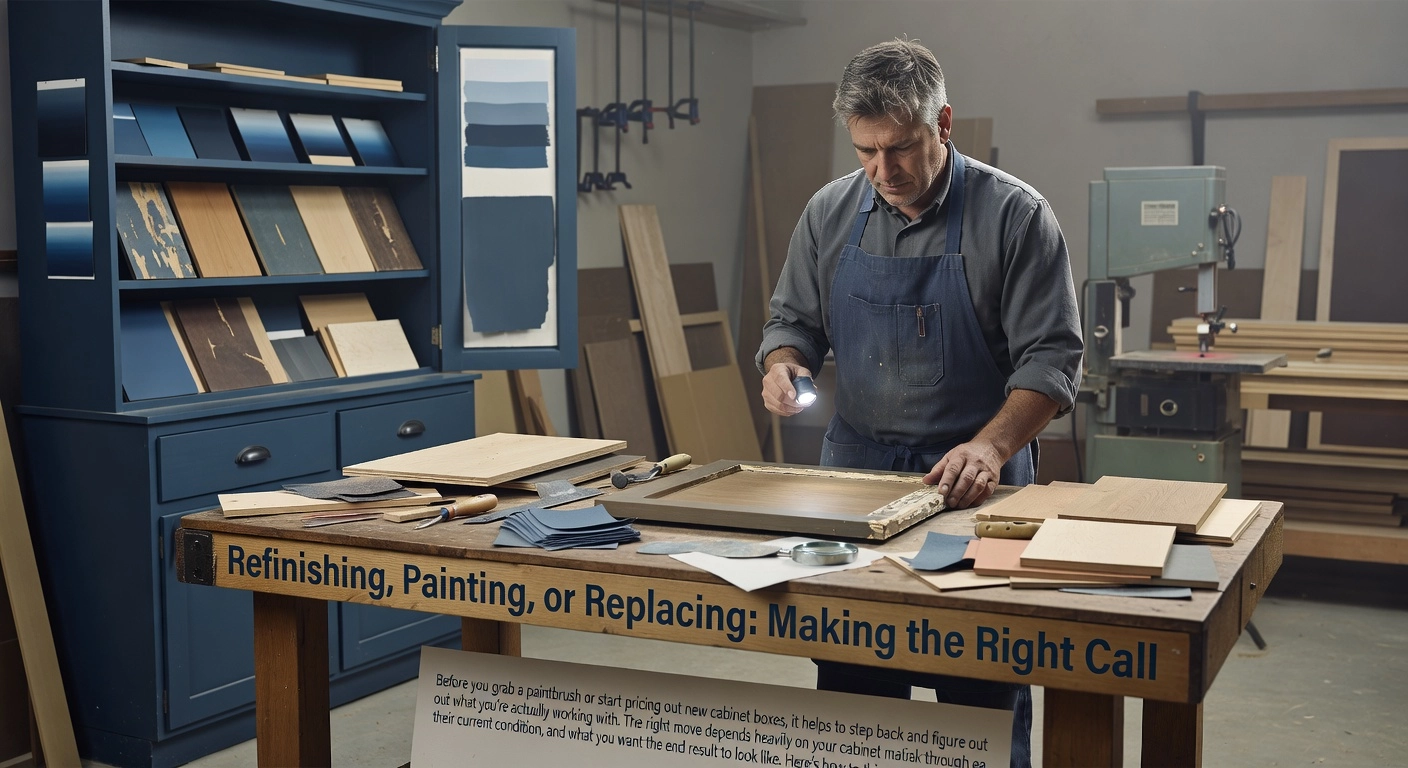
Before you grab a paintbrush or start pricing out new cabinet boxes, it helps to step back and figure out what you’re actually working with. The right move depends heavily on your cabinet material, their current condition, and what you want the end result to look like. Here’s how to think through each option.
1. Refinishing works best when solid wood is still structurally sound.
If your cabinets are solid wood and the boxes aren’t warped, swollen, or falling apart, refinishing is almost always the smartest first option. The process involves cleaning the surfaces thoroughly, sanding off the old finish, and applying a fresh stain or topcoat to bring the wood back to life. You’re preserving all that natural grain and character that’s nearly impossible to replicate with new materials. Cost-wise, refinishing runs a fraction of what full replacement costs, and solid wood can go through this process multiple times over its lifetime, meaning you’re extending the life of your cabinets by decades, not just a few years.
2. Painting makes sense when the stain is outdated but the structure is fine.
Sometimes the issue isn’t damage, it’s just that your golden oak stain from 2003 is making the whole kitchen look tired. Painting is a legitimate fix for that exact problem. It’s relatively affordable, typically in the $2,000 to $7,000 range professionally, and it can completely transform the feel of the space in just a few days. The one catch is that painting covers the natural wood grain permanently. Once you go that route, you can’t simply sand back to bare wood and stain it later. It’s a solid choice if you’re leaning toward a more modern or painted look anyway, but it’s worth knowing it’s a one-way door.
3. Refacing is the middle-ground option that often gets overlooked.
Cabinet refacing means replacing just the doors and drawer fronts while keeping your existing cabinet boxes in place. It’s more visually transformative than painting alone, but significantly less disruptive and expensive than tearing everything out. Most refacing projects run between $4,000 and $13,500 and can be completed in just a few days. If your boxes are solid but your doors look dated, this is a genuinely smart path.
4. Replacement is worth it when the boxes themselves are failing.
If your cabinets are built from particleboard or MDF and they’re showing signs of swelling, delamination, or water damage, no amount of painting or refacing will fix the underlying problem. Engineered wood materials simply can’t be sanded and restored the way solid wood can. Replacement also makes sense when you need a completely different layout or more storage functionality. It’s the most expensive and disruptive option, but sometimes it’s the only one that actually solves the problem.
5. Solid wood is the more sustainable long-term choice.
Here’s something worth considering beyond the immediate project: solid wood cabinets can be refinished repeatedly over many decades, while particleboard typically ends up in a landfill after one cycle of damage. Refinishing keeps good wood in your kitchen longer, reduces waste, and avoids the cost and hassle of buying new. With natural wood tones trending strongly right now, investing in refinishing quality solid wood cabinets is both an aesthetically forward and environmentally responsible choice.
How Humidity and Climate Affect Wood Kitchen Cabinets
Here’s something that catches a lot of first-time cabinet owners completely off guard: your beautiful wood cabinets are actually breathing. Not literally, but wood is hygroscopic, which means it constantly absorbs and releases moisture from the air around it. As the moisture content inside the wood changes, the wood expands and contracts. Do that repeatedly over months and years, and you end up with warped doors, stressed joints, and a finish that looks like it’s seen better days.
Why Humidity Numbers Actually Matter
The sweet spot for keeping wood cabinets stable is an indoor relative humidity between 35 and 55 percent, paired with temperatures in the 60 to 80°F range. Consistently falling outside that window is where the real trouble starts. When humidity drops too low, wood shrinks and you start seeing gaps at door edges, cracked finish, and joints that have visibly pulled apart. When it climbs too high, wood swells, doors stick, and the pressure on joints can cause them to buckle or separate. Kitchens already run 10 to 20 percent more humid than other rooms thanks to cooking, boiling water, and the dishwasher doing its thing, so this room is naturally high-risk.
Seasonal Changes Are the Usual Suspect
If your cabinet doors suddenly start sticking every winter or summer, humidity is almost certainly the cause. In winter, indoor heating pulls moisture out of the air and the wood shrinks, sometimes fast enough to crack the finish or open up small gaps around panels. Come summer, moisture floods back in and everything swells up again. This back-and-forth cycle puts real stress on your cabinets over time, and solid wood feels it more than engineered options.
Prevention Is Much Easier Than Repair
A few simple habits go a long way here. Run a humidifier during dry winter months and a dehumidifier or air conditioner when summer humidity spikes. Keep your range hood fan running while you cook, and make sure cabinets near the sink or dishwasher aren’t catching direct steam. When installing or refinishing cabinets, sealing the end grain properly slows down moisture exchange at the most vulnerable spots.
Fixing What Humidity Has Already Done
If damage has already set in, start by stabilizing the humidity before touching anything else. For swollen doors that won’t close right, carefully plane or sand the swollen edge down, then re-seal that surface immediately to prevent the same problem from repeating. Separated or loose joints can usually be fixed with fresh wood glue and a clamp; just make sure the wood is fully dry before you glue. For finish that has cracked or checked, lightly sand the affected area, clean it well, and spot-apply a matching finish. Catching these issues early almost always means a simpler fix.
Smart Storage and Cabinet Layout Ideas Worth Knowing
Getting your cabinet layout right from the start saves you from years of awkward reaching, wasted space, and kitchen frustration. Here are five smart storage and layout ideas that are worth building into your plan.
1. Go floor to ceiling with your upper cabinets. According to the NKBA 2026 Kitchen Trends Report, floor-to-ceiling cabinetry is one of the most-requested design features among kitchen professionals right now. It eliminates that dusty gap above standard upper cabinets, adds significant storage volume, and gives your kitchen a clean, built-in look. If you are working with a tighter space, this vertical approach is one of the best ways to expand storage without touching your floor plan at all.
2. Replace lower shelves with deep drawer bases. This is one of those upgrades that feels obvious once you try it. Deep drawers, typically 21 to 24 inches, let you see and reach everything in one pull. No more kneeling on the floor to find the right pan buried in the back of a dark cabinet. For pots, pans, baking sheets, and pantry staples, drawers consistently outperform shelves on both accessibility and usable storage density.
3. Retrofit your existing cabinets before replacing them. Pull-out shelves, lazy Susans, and drawer inserts can be added to most standard cabinet boxes for anywhere from $10 to $100 in materials. These are low-effort upgrades that make a real difference in corner cabinets and deep base cabinets, and they do not require a full renovation to install.
4. Add an island with built-in drawers. Islands packed with drawer storage are trending hard for 2026, and they are very achievable as a standalone DIY build. Plan for 42 to 48 inches of clearance on each side and a 12 to 15 inch seating overhang if you want stools.
5. Plan your layout around cooking zones, not just the work triangle. The classic triangle connecting your sink, stove, and refrigerator is still a solid starting point, but layering in dedicated zones for prep, cooking, cleanup, and storage reduces cross-kitchen traffic significantly. Think about where you actually move during a typical cooking session, then build your cabinet placement around those real habits.
How to Maintain New Wood Cabinets and Keep Them Looking Fresh
Getting new cabinets installed is exciting, but the work doesn’t stop once the doors are hung. Here are five simple maintenance habits that will keep your wood cabinets looking great for years to come.
1. Give Your Cabinets a Break-In Period
New wood cabinets need a little time to settle in after installation. Wood is a natural material, and it reacts to the temperature and humidity in your specific home. During the first few weeks, you might notice very minor door misalignment or slight swelling in drawer fronts. This is completely normal. Try to keep your kitchen humidity between 35 and 50 percent and your temperature reasonably stable. Avoid making aggressive adjustments to hinges right away. Give everything a few weeks to acclimate first, then make small corrections as needed.
2. Apply a Food-Safe Oil or Conditioner Early On
If your cabinets have a natural wood or oil-based finish, plan to apply a light coat of food-safe mineral oil or wood conditioner within the first few months. This replenishes moisture in the wood and prevents the finish from drying out, cracking, or looking dull before its time. Use a soft cloth, work with the grain, and wipe away any excess. Avoid silicone-based spray products, as they leave a residue that builds up over time.
3. Check and Tighten Hardware Around the 60 to 90 Day Mark
Wood movement from humidity shifts can loosen screws in hinges, drawer pulls, and knobs faster than you’d expect. Do a quick walk-through of all your hardware around the two to three month mark. Snug everything up with a screwdriver, but don’t over-tighten, which can strip the screw holes. Add this same check to your seasonal cleaning routine going forward.
4. Keep Steam-Producing Appliances at a Safe Distance
Coffee makers, kettles, and pressure cookers release a surprising amount of steam. If that steam is directed at cabinet sides or the undersides of upper cabinets, it can cause white film, swelling, or finish damage over time. Pull countertop appliances forward so steam vents away from cabinet surfaces, and run your range hood fan when cooking. A little spacing goes a long way toward preventing damage that’s genuinely difficult to reverse.
5. Keep a Simple Maintenance Log
This one sounds fancier than it is. A basic note on your phone or a sticky note inside a cabinet door works perfectly. Jot down when you last cleaned, oiled, or tightened something, and flag any small scratches or spots that need attention. Quality wood cabinets can last 15 to 25 years or more with consistent care, and a simple log helps you stay on top of small issues before they become bigger ones.
The Bottom Line on Kitchen Cabinets for DIY Homeowners
By now, you have a solid foundation for understanding kitchen cabinets as a long-term wood investment rather than just a kitchen feature. Knowing your cabinet types, wood species, and care routines puts you in control of one of the highest-value assets in your home.

Here is the single most important takeaway from everything covered above: if you have solid wood cabinets, restore and refinish before you even think about replacing. Solid wood can be sanded, refinished, and repaired multiple times over decades. Engineered alternatives like particleboard typically last 10 to 20 years and cannot be brought back the same way. Refinishing often costs a fraction of full replacement and delivers stronger returns on your investment.
For your next step, head over to WoodStuffHQ for detailed guides on degreasing, scratch repair, finish selection, and downloadable DIY cabinet build plans with measured drawings and cut lists.
Start simple. Spend 20 minutes cleaning and assessing your current cabinets. Check for grease buildup, surface scratches, and finish wear. That single step tells you exactly where you stand and what comes next.
Conclusion
Your dream kitchen is closer than you think. Throughout this guide, you’ve learned how to choose the right cabinet style and materials, measure your space accurately, and sidestep the most common DIY mistakes. You now have the foundational knowledge to approach your cabinet project with confidence rather than guesswork.
The biggest takeaway? You don’t need to hire a professional or spend a fortune to get results you’re proud of. With careful planning, the right tools, and a clear vision, transforming your kitchen is absolutely within reach.
Now it’s time to take action. Start by assessing your current cabinets, sketch out your ideal layout, and set a realistic budget. Take it one step at a time, and before you know it, you’ll be standing in a kitchen that finally works for you. You’ve got this!