Your hardwood floors are an investment worth protecting, and choosing the right cleaner can mean the difference between floors that shine for decades and ones that dull or deteriorate prematurely. With so many products on the market, two names consistently rise to the top of the conversation: Bona wood floor cleaner and Minwax.
Both brands have earned loyal followings among homeowners and flooring professionals alike, but they approach wood floor care from distinctly different angles. Understanding those differences is essential before you commit to a product that will regularly touch your floors.
In this comparison, you will get a clear, detailed breakdown of how Bona wood floor cleaner stacks up against Minwax across key factors including formula composition, ease of use, finish compatibility, and long-term floor health. Whether you are maintaining recently refinished hardwood or trying to restore some life to older floors, this guide will give you the knowledge to make a confident, informed choice. By the end, you will know exactly which product belongs in your cleaning routine.
Quick Verdict: Bona vs. Minwax at a Glance
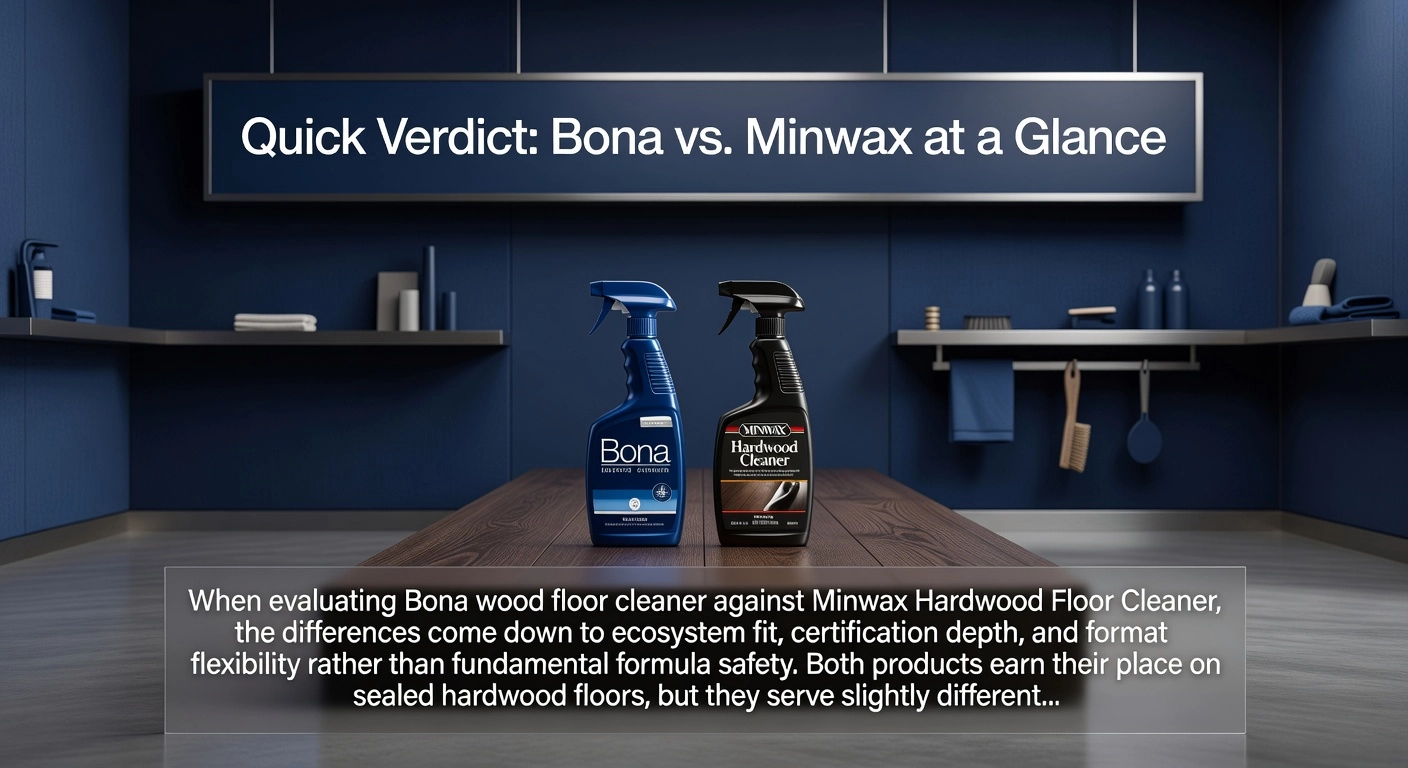
When evaluating bona wood floor cleaner against Minwax Hardwood Floor Cleaner, the differences come down to ecosystem fit, certification depth, and format flexibility rather than fundamental formula safety. Both products earn their place on sealed hardwood floors, but they serve slightly different homeowner profiles.
| Criteria | Bona | Minwax |
|---|---|---|
| Formula Type | Water-based, pH-neutral, plant-derived ingredients | Water-based, pH-neutral, biodegradable, non-toxic |
| Finish Compatibility | All sealed polyurethane, pre-finished, laminate | Sealed polyurethane, pre-finished; natural synergy with Minwax-finished floors |
| Eco-Certifications | EPA Safer Choice certified, USDA BioPreferred | Biodegradable and non-toxic; no prominent third-party certification |
| Available Formats | 32 oz spray, 128 oz refill, concentrate, robotic mop formula | Primarily 32 oz ready-to-use liquid |
| Price Per Use | ~$9-15 per 32 oz; concentrates reduce long-term cost | Comparable or slightly lower per 32 oz bottle |
| Residue Performance | Streak-free, fast-drying; industry-recognized in expert testing | No-residue formula; effective on compatible finished surfaces |
Bona holds a 4.3 out of 5 stars across thousands of verified reviews and consistently earns top rankings in expert roundups from publications like The Spruce and Good Housekeeping, frequently receiving “best overall” recognition in 2025-2026 evaluations. Minwax, backed by a trusted finishing brand, positions itself as a credible, straightforward alternative with a biodegradable, non-toxic formula that handles everyday dirt and grease effectively.
Bona’s primary strengths lie in brand recognition built through professional-grade applications, a broad format lineup, and seamless integration with its own spray mop system for efficient one-handed cleaning routines. Minwax holds a natural advantage for homeowners whose floors were originally finished or stained with Minwax products, since the brand’s entire ecosystem is engineered for compatibility across its own product line.
Critically, both cleaners share the fundamentals that matter most: pH-neutral, water-based formulas that protect sealed polyurethane hardwood without leaving soap film, dulling the finish, or introducing harmful chemicals into your home. Neither product is appropriate for waxed, oiled, or unfinished wood surfaces.
For scenario-specific guidance, including recommendations for pet households, high-traffic areas, or eco-conscious maintenance routines, the detailed sections below break down exactly when each product earns the edge.
What Bona Wood Floor Cleaner Does Well
Bona’s core formula is built around a pH-neutral, water-based solution engineered specifically for sealed, polyurethane-finished hardwood floors. This precision matters because general-purpose cleaners often contain alkaline agents or soap residues that gradually degrade polyurethane coatings. Bona avoids this entirely, delivering a residue-free, fast-drying clean that evaporates quickly without leaving behind the dulling films that frustrate so many hardwood floor owners. The formula contains no ammonia, phosphates, dyes, or formaldehyde, making it safe for households with children and pets while still cutting through dirt, scuff marks, and sticky soils effectively.
Format flexibility is one of Bona’s strongest practical advantages. The 32 oz spray bottle handles everyday spot cleaning and room-by-room maintenance with minimal setup. For households with larger floor coverage, the 128 oz refill reduces both cost per use and plastic waste significantly. A concentrated bio-based version is formulated specifically for robotic mops and mopping vacuums, an increasingly important category as automated cleaning tools gain popularity. Scent preferences are addressed through unscented and cedarwood-infused variants, giving sensitive households a genuine choice rather than a single formula.
The eco-credentials behind select Bona formulas carry real weight. EPA Safer Choice certification and USDA BioPreferred status, with some formulas reaching 95% USDA-certified biobased content, are third-party verifications with documented ingredient review standards. These are not self-applied marketing labels. For buyers comparing certified products against uncertified alternatives, this distinction is meaningful and increasingly relevant as households prioritize safer cleaning products.
Expert validation reinforces what consistent user ratings reflect. The Spruce named it best overall hardwood floor cleaner in February 2026 after lab and home testing, awarding perfect scores for gentleness and stain removal. Good Housekeeping echoed that ranking in April 2026, highlighting its performance across more than 216 stains and scuffs evaluated in testing. The Amazon product listing aggregates thousands of consumer reviews that align closely with these expert findings.
Limitations are real and worth noting directly. Bona is incompatible with waxed, oiled, unfinished, or certain exotic wood floors. Some users report streaking or haze, though this typically traces back to over-application rather than product failure. Working in small sections, applying a light mist, and using a quality microfiber mop along the wood grain eliminates most streaking complaints. Bona also works with spray mop systems and select robotic mop models, making it adaptable across manual and automated cleaning setups without requiring additional product lines.
What Makes Minwax Hardwood Floor Cleaner Different
Minwax Hardwood Floor Cleaner takes a fundamentally different approach by functioning as an integrated component of a complete floor care system rather than a standalone cleaning solution. The formula is pre-diluted and ready to use straight from the bottle, meaning you apply it in an “S” pattern across small floor sections and mop immediately with a well-wrung microfiber mop. No measuring, no mixing, no second-guessing concentration levels. This matters because over-dilution weakens cleaning power while over-concentration is precisely what drives the streaking complaints occasionally reported with products that require user-controlled dilution.
Ecosystem Compatibility and Finish Protection
The most compelling case for Minwax’s cleaner is its built-in compatibility with Minwax-finished hardwood floors. If your last refinishing project used Minwax stains, polyurethane topcoats, or fast-drying floor finishes, this cleaner was formulated to work alongside those specific chemistries. The biodegradable formula contains no soap-based surfactants, which is significant for long-term floor health. Soap residues accumulate over repeated cleaning cycles, gradually creating a film that scatters light and dulls the finish. By eliminating that mechanism entirely, Minwax reduces cumulative risk on its own coated surfaces with each cleaning session.
The Bundled Care Advantage
Where Minwax genuinely separates itself is the breadth of its product ecosystem. Beyond cleaning, the lineup extends into wood stains, polyurethane finishes, and the Minwax Hardwood Floor Reviver, a product that restores lost sheen between refinishing cycles in either high or low gloss. This stain-to-finish-to-clean-to-revive framework gives homeowners a single-brand solution covering every phase of floor care. Standalone cleaning brands, regardless of their cleaning performance, simply cannot replicate this continuity. For a homeowner who refinished with Minwax products and wants consistent, predictable results across every maintenance step, that integrated care path is a practical and logical advantage worth considering seriously.
Bona vs. Minwax: A Detailed Head-to-Head Breakdown
Residue Performance
Both products market residue-free results on sealed floors, but the real-world picture is more nuanced. Consumer Reports testing has flagged mixed residue outcomes with Bona under certain conditions, with one report scoring it 43 out of 100 overall and noting a 3 out of 5 rating for leaving floors truly clean. User reviews echo this, with some long-term Bona users reporting a faint cloudy film when the product is over-applied or used without a properly wrung microfiber mop. Minwax’s soap-free formula directly addresses this vulnerability; by eliminating soap entirely, it removes the primary mechanism behind residue buildup on finished surfaces. For households where floors receive heavy daily foot traffic and frequent cleaning, Minwax’s formulation carries a structural advantage in residue prevention.
Drying Time
Drying speed is one of Bona’s most cited strengths in 2025 and 2026 expert roundups, with test conditions showing the floor surface ready for foot traffic in approximately 90 seconds when applied correctly with a microfiber spray mop. This matters practically for busy households where waiting for floors to dry creates real inconvenience. Minwax’s pre-diluted ready-to-use formula also performs well in this category, drying without leaving wet patches or slippery surfaces. Both products pull ahead of soap-based and all-purpose alternatives that tend to leave longer drying windows and greater streaking risk. The edge here belongs to Bona for speed, but the gap between the two is narrower than marketing might suggest.
Eco-Credentials
Bona holds a clear certification advantage, carrying EPA Safer Choice certification across multiple product lines and USDA BioPreferred status on select formulations. The company has been an EPA Safer Choice Partner since approximately 2020 and has reformulated products to exclude parabens, formaldehyde, ammonia, phthalates, and phosphates. Minwax counters with a non-toxic, biodegradable formula that carries no formal third-party eco-certifications but aligns well with the priorities of pet and child households. For buyers who need documented proof of ingredient safety, Bona’s certifications are verifiable and specific. For buyers who simply want a gentle, family-safe product without the certification research, Minwax’s positioning is straightforward and credible.
Price, Availability, Scent, and Finish Compatibility
On pricing and availability, both products are accessible at major retailers, with Bona holding a broader footprint across Home Depot, Lowe’s, Walmart, Costco, and Target. Bona’s 128 oz refill format, typically priced between $20 and $22, delivers strong per-use value for larger homes or high-frequency cleaning schedules. Minwax is primarily available in 32 oz ready-to-use bottles at comparable per-bottle pricing but without equivalent large-format refill options. On scent, Bona offers both unscented and Cedar Wood variants, giving sensitive households genuine options. Minwax keeps things simple with a fragrance-free formula, which many users prefer for rooms with limited ventilation. On finish compatibility, Bona’s pH-neutral formula is engineered broadly for any sealed polyurethane surface, while Minwax is specifically optimized for floors already finished with Minwax products, making it the natural choice for anyone whose floors were originally stained or coated within the Minwax system.
Which Cleaner Should You Choose for Your Situation
Choosing between these two cleaners becomes straightforward once you match your specific situation to each product’s strengths. Here is a practical breakdown to guide your decision.
Post-Refinishing Care
If your floors were recently stained, finished, or refinished using Minwax products, Minwax Hardwood Floor Cleaner is the logical choice for ongoing maintenance. The cleaner is designed as part of a cohesive Minwax floor care system, meaning it complements the chemistry of Minwax finishes rather than working against them. Using a manufacturer-matched cleaner helps preserve finish integrity over time and ensures you are following recommended maintenance protocols. This is particularly relevant when Minwax Hardwood Floor Reviver is part of your routine, as both products are formulated to work together without soap residue buildup interfering with the coating.
Pet and Child Households
Both products avoid harsh chemicals and are considered safe for use around pets and children when applied as directed. However, Minwax’s emphasis on its non-toxic, biodegradable formula and fragrance-free option gives it a measurable edge for households where ingredient transparency is a priority. Families who are sensitive to scents or cautious about chemical exposure will appreciate the low-odor, soap-free formulation. Bona does hold EPA Safer Choice certification on select formulations, so it is far from a poor choice in this category, but Minwax’s straightforward, minimalist ingredient profile resonates with parents and pet owners seeking simplicity.
Robotic Mop Users
This category belongs clearly to Bona. The concentrated bio-based version of bona wood floor cleaner is specifically engineered for robotic mop compatibility, designed to deliver effective cleaning without excessive sudsing inside automated machines. If you rely on a robotic mop for your cleaning routine, Bona is the only option between these two with a purpose-built formulation for that application. According to HGTV’s hardwood floor cleaner reviews, Bona’s versatility across cleaning systems is a consistent advantage in expert evaluations. Minwax does not currently offer a robotic-compatible formulation.
High-Traffic Areas and Routine Maintenance
For homes where floors see heavy daily use, Bona’s retail footprint and format range give it a practical advantage. Larger refill options, including 128 oz formats widely available at major retailers, make high-frequency cleaning more economical and sustainable. Minwax is conveniently sized but is typically offered in smaller volumes, making it less suited for households that clean multiple times per week.
Exotic, Oiled, Waxed, or Unfinished Floors
Neither product applies here. Both manufacturers explicitly advise against using their standard hardwood floor cleaners on waxed, oiled, shellacked, or unfinished surfaces. Applying a water-based cleaner to these floor types risks penetration, finish disruption, or irreversible damage. Consult finish-specific products and manufacturer guidance before cleaning non-polyurethane surfaces with any general hardwood floor cleaner.
Older Floors With Unknown Finish Type
When finish type is uncertain, proceed with caution and always patch-test in a low-visibility area first. In this scenario, Minwax’s pre-diluted, soap-free formula offers a slightly lower risk profile because it is gentler on unknown coatings and less likely to cause residue accumulation if the surface reacts unexpectedly. Bona’s 2026 trend report reinforces the importance of using compatible, gentle formulas to preserve the increasingly popular matte and satin finishes found on older and newer floors alike. If wear or coating uncertainty is significant, a professional assessment before committing to any cleaner is always the safest path forward.
What EPA Safer Choice and Biodegradable Labels Actually Mean
Green and eco-friendly labels on cleaning products have become so widespread that they can feel meaningless without context. Understanding what specific certifications actually require helps you cut through marketing noise and make genuinely informed choices.
EPA Safer Choice certification sets a notably higher standard than most green claims because it evaluates every intentionally added ingredient individually, not just the finished product as a whole. EPA scientists assess each component against criteria covering carcinogenicity, reproductive toxicity, aquatic toxicity, persistence, and bioaccumulation potential. No ingredient hides behind confidentiality exemptions. This ingredient-by-ingredient scrutiny means a Safer Choice label signals something substantive: the formulation has been built from the ground up with verified safe components, rather than simply passing a surface-level finished-product test. General “natural” or “eco-friendly” marketing claims carry no such requirement.
USDA BioPreferred designation addresses a different dimension entirely. Rather than safety screening, it verifies that a specific percentage of a product’s content derives from renewable agricultural or forestry materials rather than petroleum feedstocks. Third-party radiocarbon testing (ASTM D6866 methodology) confirms the bio-based percentage, which for some floor cleaner formulations reaches 92 to 95 percent. This designation supports reduced petroleum dependence and lower carbon footprints, though it does not independently certify ingredient safety. The two labels therefore complement each other rather than overlap.
Biodegradable claims on Minwax’s hardwood floor cleaner formula indicate the product breaks down through natural microbial processes into water, carbon dioxide, and minerals without leaving persistent chemical residues. This distinction carries practical weight for households on septic systems, where non-biodegradable or phosphate-heavy cleaners can disrupt the beneficial bacteria that process waste, increasing the risk of system failures or groundwater contamination. Unlike Safer Choice or BioPreferred, biodegradability is not a federally regulated label, so reviewing formulation details alongside the claim adds confidence.
Low-VOC formulas address indoor air quality directly. Volatile organic compounds off-gas into interior spaces and accumulate quickly in rooms with limited ventilation, contributing to respiratory irritation over time. Water-based, low-VOC hardwood floor cleaners reduce this exposure significantly, which matters most in tightly sealed modern homes, smaller rooms, or any space where cross-ventilation is limited during cleaning.
Taken together, these labels give homeowners a framework for evaluating products on measurable criteria rather than brand reputation alone, aligning floor maintenance decisions with broader household health and environmental priorities.
Why Your Cleaner Choice Should Match Your Floor Finish
Hardwood floors consistently deliver strong returns on investment, with recent analyses showing cost recovery rates exceeding 100% at resale. That level of financial stake makes the choice of maintenance products far more consequential than most homeowners realize. The finish type applied during installation or your last refinishing project is the single most important variable in selecting the right cleaner. Polyurethane surface finishes, penetrating oil finishes, and wax finishes each react differently to cleaning chemistry, and using the wrong formula is not simply ineffective; it actively works against the floor’s protective layer over time.
Incompatible cleaners create problems that compound gradually rather than appearing immediately. Oil soaps, vinegar-based solutions, and multi-surface products can leave waxy or surfactant residues that trap dirt, reduce sheen, and create a cloudy film across the floor surface. Reversing that buildup typically requires professional intervention, including thorough chemical stripping and in some cases light abrasion before any protective coating can be reapplied. The cumulative cost of that remediation often exceeds what a homeowner might have saved by using a cheaper or more convenient product for routine cleaning.
This is precisely where a coordinated product ecosystem offers a meaningful practical advantage. Minwax covers the complete floor lifecycle, from wood stains and polyurethane finishes to dedicated hardwood floor cleaning solutions, all formulated with inter-product compatibility in mind. When the same brand architects both the protective coating and the maintenance cleaner, the risk of adverse chemical interactions drops significantly. Homeowners avoid the compatibility guesswork that comes with mixing products from unrelated lines, and long-term floor appearance benefits from that consistency.
For homeowners planning to refinish or touch up floors in the near future, the cleaner currently in use deserves close scrutiny. Residue-leaving products can interfere with coating adhesion during recoating, requiring additional preparation steps before new polyurethane layers will bond properly. Confirming that your current cleaner is residue-free and finish-compatible before any refinishing project protects both the coating performance and the overall investment in the floor.
Choosing the Right Hardwood Floor Cleaner for Your Home
Bona stands out as the reliable default choice for most homeowners with sealed polyurethane floors, offering wide retail availability at Home Depot, Walmart, and Target, multiple formats including sprays and concentrated refills, and strong eco-credentials like EPA Safer Choice certification and GREENGUARD Gold status. Its pH-neutral formula delivers streak-free results and works with spray mops, microfiber systems, and robotic mop-compatible versions, making it versatile across different cleaning setups.
Minwax Hardwood Floor Cleaner is the smarter pick for floors already finished with Minwax products, households prioritizing biodegradable and soap-free formulas, or anyone building a unified wood care routine under one trusted brand. Its integration with Minwax revivers, polishes, and finishes creates a seamless system from cleaning through protection and refinishing.
Match your final decision to your floor’s specific finish type and household priorities, whether that means pet safety certifications, robot mop compatibility, or post-refinishing care protocols. Neither product is appropriate for waxed, oiled, or unfinished floors without verifying manufacturer compatibility first.
For a complete hardwood floor care routine covering cleaning, protection, and long-term finishing, explore the full Minwax product lineup to keep your floors performing and looking their best.
Conclusion
Choosing between Bona wood floor cleaner and Minwax comes down to your specific floor type, finish, and goals. Bona excels as a daily maintenance solution, offering a gentle, residue-free formula designed to protect finished hardwood long-term. Minwax, by contrast, leans toward restoration and conditioning, making it better suited for older or unfinished wood that needs deeper treatment.
Both products have earned their reputations, but using the wrong one on the wrong floor can cause more harm than good. Always check your floor’s finish type before committing to either brand.
Ready to make your decision? Assess your floors today, check the manufacturer’s finish recommendations, and choose the product that aligns with your floor’s actual needs. Your hardwood deserves thoughtful care, and with the right cleaner in hand, those floors can stay beautiful for generations to come.
Frequently Asked Questions
Can I use Bona or Minwax hardwood floor cleaner on waxed, oiled, or unfinished wood floors?
No. Both Bona and Minwax hardwood floor cleaners are designed exclusively for sealed, polyurethane-finished hardwood floors. Using either product on waxed, oiled, shellacked, or unfinished surfaces can cause water penetration, finish disruption, or irreversible damage. If you are unsure of your floor's finish type, always patch-test in a low-visibility area first or consult a flooring professional before applying any cleaner.
Which cleaner is better for homes with pets and children?
Both products are considered safe for households with pets and children when used as directed, as neither contains ammonia, phosphates, or harsh chemicals. However, Minwax has a slight edge in this category due to its fragrance-free, non-toxic, biodegradable, and soap-free formula, which appeals to families prioritizing a minimalist ingredient profile. Bona also performs well here, especially formulas carrying EPA Safer Choice certification, which verifies ingredient safety through a rigorous third-party review process.
Is Bona or Minwax compatible with robotic mops?
Bona is the clear winner for robotic mop users. It offers a concentrated bio-based formula specifically engineered for robotic mop compatibility, designed to clean effectively without excessive sudsing inside automated machines. Minwax does not currently offer a robotic-compatible formulation, making Bona the only viable option between the two for homeowners who rely on automated cleaning systems as part of their regular floor care routine.
What does EPA Safer Choice certification actually mean, and does it matter when choosing a floor cleaner?
EPA Safer Choice certification is a meaningful, third-party verified standard that evaluates every intentionally added ingredient in a product individually, assessing each for risks related to carcinogenicity, reproductive toxicity, aquatic toxicity, and bioaccumulation. Unlike vague 'eco-friendly' or 'natural' marketing labels, this certification requires transparent ingredient disclosure and rigorous safety screening. For buyers who want documented proof of ingredient safety rather than self-applied marketing claims, Bona's EPA Safer Choice certification across select formulas provides verifiable assurance that Minwax's biodegradable label, while credible, does not formally match.
Which product offers better long-term value for large homes or high-frequency cleaning?
Bona offers better long-term value for large homes or high-frequency cleaning routines due to its wider range of available formats. In addition to the standard 32 oz spray bottle, Bona provides a 128 oz refill option typically priced between $20 and $22, which significantly reduces the cost per use and plastic waste over time. Minwax is primarily available in 32 oz ready-to-use bottles without equivalent large-format refill options, making it less economical for households that clean multiple times per week or have extensive floor coverage to maintain.
4 thoughts on “Bona Wood Floor Cleaner vs. Minwax: Which Is Right for You?”