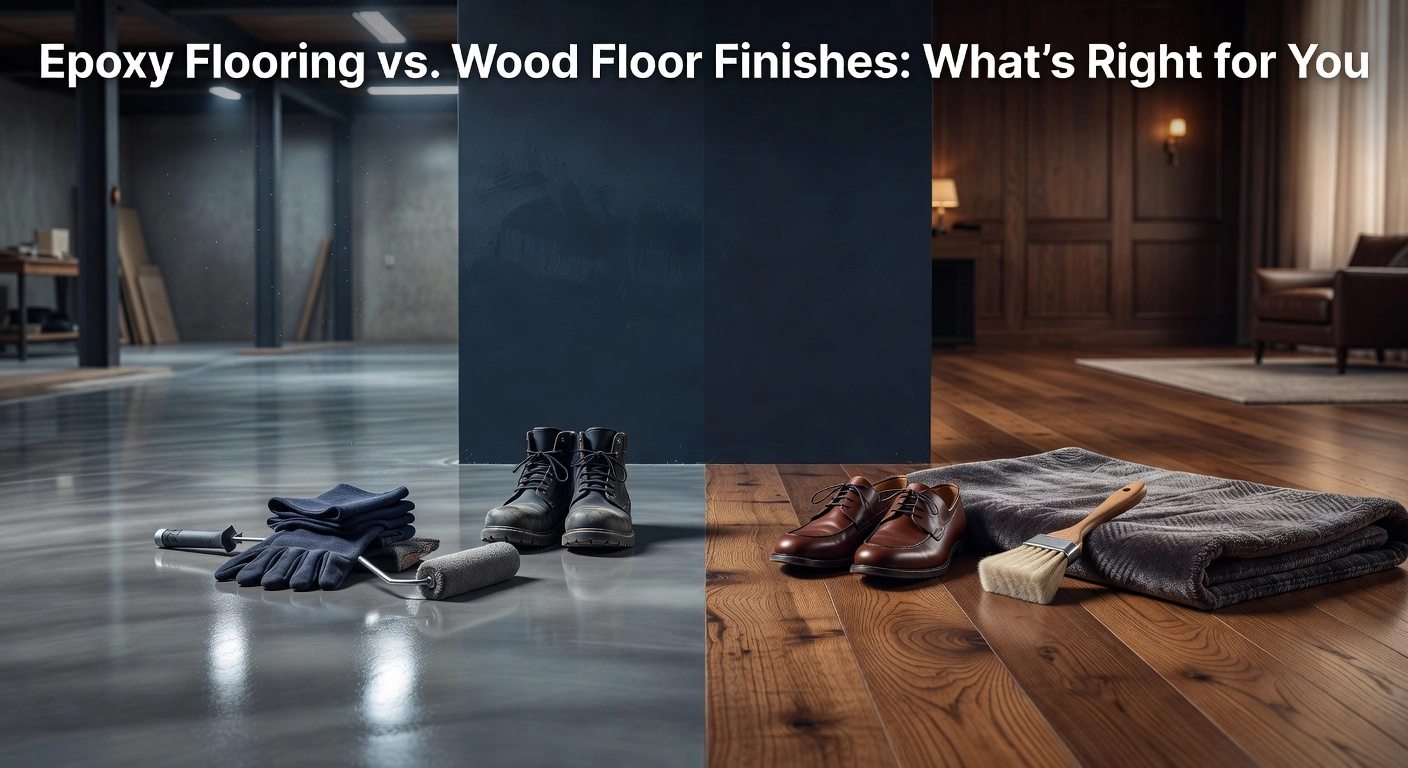
Choosing the right floor finish can make or break the look, durability, and functionality of any space. Whether you are renovating your garage, updating a kitchen, or refreshing a living room, the flooring decision you make today will impact your home for years to come. Two of the most popular options on the market are epoxy flooring and traditional wood floor finishes, and understanding the differences between them is essential before spending a single dollar.
Epoxy flooring has surged in popularity in recent years, and for good reason. It offers a tough, seamless surface that stands up to heavy use, moisture, and wear. Wood finishes, on the other hand, bring warmth and classic beauty that many homeowners love. But which option is actually right for your specific needs?
In this guide, we will break down both choices in a clear, straightforward way. You will learn about costs, durability, maintenance, appearance, and best use cases for each option. By the end, you will have the confidence to make a smart, informed decision for your home.
What Is Epoxy Flooring and Where Does It Actually Work?
Epoxy flooring is a thermosetting polymer coating system created by combining epoxy resin with a chemical hardening agent. Once mixed, these two components trigger an irreversible chemical reaction that produces a hard, seamless, incredibly durable layer bonded directly to a prepared concrete substrate. You will most commonly find it installed in garages, basements, warehouses, industrial facilities, and commercial spaces where performance demands are high and maintenance needs to stay low. Understanding exactly what epoxy is, and where it performs best, helps you make a smarter decision before committing to any flooring project.
How Epoxy Bonds to Concrete vs. Wood
One of the most important distinctions beginners need to understand is how epoxy interacts with different surfaces. On concrete, epoxy forms both a mechanical and chemical bond with the porous, rigid substrate, creating a non-porous, chemical-resistant surface that resists oils, fuels, acids, abrasion, and heavy impact. On wood, however, the story changes dramatically. Wood naturally expands and contracts with shifts in temperature and humidity, and epoxy’s rigid, inflexible nature cannot accommodate that movement. The result is cracking, delamination, and premature coating failure. For homeowners with hardwood floors, traditional polyurethane-based wood finishes are specifically engineered to flex with wood’s natural behavior, making them a far more reliable choice than epoxy on wooden surfaces.
Where Epoxy Genuinely Excels
The primary use cases for epoxy flooring consistently include four environments where its strengths shine without compromise.
- Garage floors benefit from epoxy’s resistance to vehicle fluids, road salts, tire marks, and dropped tools, while also delivering an attractive, easy-to-clean finish.
- Warehouse and industrial floors depend on epoxy’s ability to handle forklift traffic, heavy loads, and constant chemical exposure without breaking down.
- Basement slabs are transformed from dusty, porous concrete into sealed, moisture-resistant, usable living or storage spaces.
- Commercial kitchens and food facilities rely on epoxy’s non-porous, sanitary surface that stands up to grease, harsh cleaners, and rigorous food safety requirements.
Epoxy Is a Coating System, Not a Floor Material
This distinction matters enormously. Epoxy does not replace your floor; it enhances and protects the substrate beneath it. Its performance depends entirely on the condition, type, and preparation of that underlying surface. Cracks in the concrete telegraph directly through the coating, and moisture vapor rising from below can cause bubbling and adhesion failure if not properly addressed during installation. The North American epoxy flooring market reached USD 1.92 billion in 2024 and is projected to climb to USD 3.1 billion by 2030, reflecting growing demand across residential, commercial, and industrial sectors. That market growth signals real value, but only when epoxy is applied to the right substrate with proper preparation and professional-grade execution.
Why Epoxy and Hardwood Floors Are a Risky Combination
Wood is a living, breathing material, and that fundamental characteristic is precisely what makes it incompatible with epoxy coatings. Unlike inert materials such as concrete, wood responds directly to changes in humidity and temperature by expanding and contracting continuously throughout its lifespan. When moisture levels rise, wood fibers absorb that humidity and swell; when conditions dry out, they shrink back. This cyclical movement occurs across every plank, at every seam, and along every grain line on your floor. Epoxy, once cured, becomes a rigid, inflexible shell that simply cannot bend or shift with the substrate beneath it. The result is a system working against itself, and the floor inevitably loses that battle.
Delamination: When the Coating Fights the Floor
The most visible consequence of this mismatch is delamination, a process where the epoxy coating separates from the wood surface. As the planks beneath shift and move, the rigid coating is pushed and pulled in directions it was never designed to handle. This stress concentrates most intensely along plank seams and edges, which is exactly where separation begins. You will notice bubbling, lifting edges, hairline cracks spreading across the surface, and eventually full patches peeling away from the floor. According to flooring experts who have tested epoxy on wood substrates, this failure can occur within months rather than years, and repairing it typically requires stripping the entire coating back to bare wood and starting over.
Concrete vs. Wood: A Study in Stability
The reason epoxy performs so reliably on garage floors and industrial slabs comes down to one word: stability. Concrete, once properly cured and prepared, does not expand or contract meaningfully in response to humidity or temperature fluctuations. It gives the epoxy a firm, stationary foundation to bond against, allowing the coating to cure completely and hold its adhesion over years of heavy use. As Sherwin-Williams technical guidance confirms, standard epoxy systems are engineered for similarly inflexible substrates. Wood subfloors are the opposite of that requirement, making the pairing structurally problematic from the start.
Moisture Trapping and Hidden Damage
Beyond movement, epoxy creates a second serious problem for hardwood: it is completely non-breathable. Cured epoxy forms a vapor-impermeable barrier that seals moisture vapor beneath the coating rather than allowing it to dissipate naturally. Wood that cannot breathe will begin to warp, cup, or buckle as trapped moisture builds up within the planks. This damage often develops slowly and out of sight, making it worse by the time it becomes visible on the surface. Even if you test your wood’s moisture content before application and it registers within acceptable levels, seasonal changes will introduce new moisture vapor that has nowhere to escape.
What the Experts Actually Recommend
Industry professionals and flooring specialists consistently point to polyurethane finishes as the correct choice for finished hardwood floors. Oil-based and water-based polyurethane products are specifically formulated to flex with wood movement, allow a measured degree of vapor transmission, resist UV yellowing, and provide durable protection that can last 10 to 20 years with proper maintenance. Purpose-built wood finishes work with the natural behavior of hardwood rather than against it. For homeowners wanting to protect and beautify their hardwood floors, choosing a finish designed for wood is not just the safer option; it is the smarter long-term investment.
Epoxy vs. Wood Floor Finishes: A Side-by-Side Breakdown
Understanding exactly where epoxy excels and where wood-specific finishes win comes down to five core categories. The table below gives you a quick reference, followed by a deeper look at each factor.
| Category | Epoxy (on concrete) | Wood Floor Finishes (polyurethane + Minwax stains) |
|---|---|---|
| Durability | Superior abrasion and chemical resistance | Engineered for foot traffic and furniture on wood |
| Moisture Handling | Traps vapor; high warping risk on wood | Breathable; supports natural moisture exchange |
| Refinishability | Often requires full mechanical removal | Screen and recoat multiple times over decades |
| Aesthetics | Bold metallic, terrazzo, high-gloss effects | Preserves natural wood grain and warmth |
| DIY Difficulty | High prep, precise mixing, long cure times | Simpler brush, roller, or pad application |
Durability: Different Strengths for Different Substrates
Epoxy creates a rigid, thick film that handles heavy machinery, chemical spills, oils, and vehicular traffic on concrete surfaces with ease. Its high compressive strength makes it the go-to choice for warehouses, garages, and industrial floors, as detailed in this overview of epoxy flooring market performance. Oil-based and water-based polyurethanes take a fundamentally different approach, building in just enough flexibility to move with wood as it expands and contracts. That flexibility prevents cracking under furniture legs, high heels, and everyday foot traffic, making polyurethane the smarter durability choice on hardwood. Matching the coating to the substrate is not optional; it is what determines long-term performance.
Moisture Handling and Refinishability
Epoxy forms a non-breathable vapor barrier, and on wood that creates a dangerous trap. Seasonal humidity shifts force moisture to accumulate beneath the coating, leading to bubbling, warping, and delamination, a problem explained thoroughly in this expert discussion of epoxy on wood floors. Wood finishes such as polyurethane allow the floor to breathe normally, reducing the risk of cupping and mold. On the refinishability side, a hardwood floor finished with polyurethane can be lightly screened and recoated several times over its lifetime, adding years of fresh protection without full removal. Failed epoxy on wood, by contrast, typically demands aggressive mechanical grinding, which risks gouging the wood surface beneath and turns a simple refresh into a costly, time-consuming project.
Aesthetics and DIY Practicality
Epoxy delivers striking decorative possibilities on concrete, including metallic finishes, terrazzo looks, and custom color flake systems that suit modern showrooms and statement garage floors. However, none of those effects enhance real wood the way Minwax stains and polyurethane finishes do. Minwax stains penetrate the grain to deepen color while preserving the organic character that makes hardwood uniquely beautiful, and a quality topcoat brings out that warmth with a finish ranging from matte to high gloss.
From a DIY standpoint, epoxy demands thorough surface etching or grinding, precise two-part mixing ratios, controlled temperature and humidity, and cure windows that can stretch several days. Wood floor finishes simplify the process considerably. Sanding or screening the surface, applying thin coats with a brush, roller, or applicator pad, and allowing each coat to dry between applications is a workflow that most motivated homeowners can manage confidently. For anyone starting out, that accessibility gap alone makes wood-specific finishes the practical choice on hardwood.
The One Scenario Where Epoxy Over Wood Can Make Sense
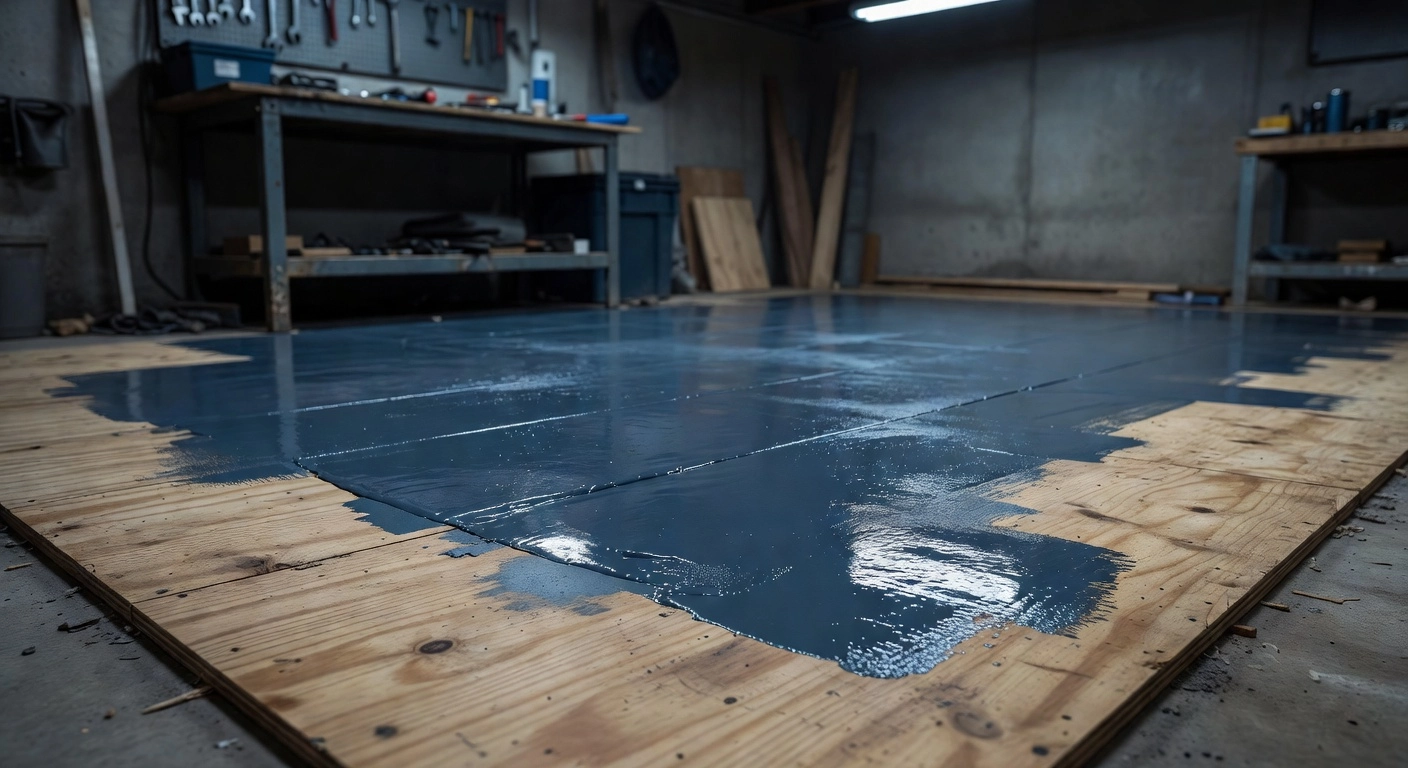
There is one narrow situation where applying epoxy over a wood surface can be a defensible choice: an unfinished plywood subfloor in a garage, workshop, or utility room where heavy-use durability is the clear priority and aesthetics are largely irrelevant. In this specific context, the plywood must be firmly fastened to the joists below, showing no flex or bounce underfoot, and the space must have controlled moisture levels. When all of those conditions are met, epoxy can deliver a hard, chemical-resistant, easy-to-clean surface that offers genuine functional value over bare plywood.
Preparation Is Non-Negotiable
Even in this favorable scenario, the preparation process is demanding and must be followed without shortcuts. Begin by countersinking all fasteners and screwing down any loose panels. Sand the entire surface with 80-grit to remove any gloss or contaminants and create mechanical adhesion. Next, fill every plank seam, joint, and screw hole with a compatible flexible filler, then apply fiberglass mesh tape over the seams while the primer is still wet. After curing, sand again, vacuum thoroughly, and ensure the wood is completely dry before applying any coating. Critically, select a flexible epoxy formulation designed for wood substrates rather than a rigid industrial-grade product. Rigid systems have elongation rates near 3%, while flexible alternatives can reach 60%, giving them far greater ability to move with the wood without cracking.
A Better Alternative Often Exists
Even when plywood prep is done correctly, flexible polyurea or polyaspartic coatings frequently outperform epoxy in this scenario. These systems tolerate significantly more substrate movement, cure faster, and tend to last longer under impact and chemical exposure. For epoxy applied over wood floors, the margin for error is thin, and polyurea systems offer a more forgiving buffer against the seasonal shifts that wood inevitably experiences.
This entire discussion applies only to utility subfloors in non-living spaces. Finished or solid hardwood flooring in any living area is categorically unsuitable for epoxy, as experts consistently identify it as one of the surfaces not recommended for epoxy coatings. Skipping even a single prep step, whether that means insufficient seam filling, inadequate sanding, using the wrong product, or coating damp wood, dramatically increases the risk of peeling, bubbling, or delamination within the first twelve months. The wood’s natural porosity and movement amplify every preparation mistake, leaving no room for a casual approach.
What to Use Instead: Proven Finishes for Real Hardwood Floors
When hardwood floors are the foundation of your home, the right finish makes all the difference. Minwax’s complete range of hardwood floor products offers purpose-built solutions specifically engineered for real wood, including both oil-based and water-based polyurethane options. Products like Minwax Super Fast-Drying Polyurethane for Floors, Ultimate Floor Finish, and Ultra Fast-Drying Polyurethane for Floors are formulated to work with wood’s natural properties rather than against them, delivering lasting protection without the risks that come with rigid coatings.
How These Finishes Work With Wood, Not Against It
The critical difference between Minwax polyurethane finishes and epoxy lies in how each product interacts with the wood surface. Minwax oil-based and water-based polyurethanes create a protective yet flexible film that accommodates the natural expansion and contraction wood undergoes with seasonal humidity and temperature shifts. Minwax Hardwood Floor Reviver takes this further as a water-based topcoat that bonds directly to existing polyurethane-finished floors, renewing shine and protection without sanding in most cases. This flexibility is something a rigid epoxy film simply cannot provide on a living wood substrate.
A Finish You Can Maintain for Decades
One of the strongest arguments for choosing Minwax finishes is the long-term maintenance advantage. Minwax Ultimate Floor Finish allows recoating in as little as two hours with no sanding required between coats when applied within 24 hours, making full-day DIY projects realistic. Refinishing typically costs $3 to $8 per square foot compared to $8 to $25 or more for full replacement, and solid hardwood floors can be refinished three to seven times over their lifespan. That translates to decades of renewed beauty without tearing out and replacing your floors.
Color Customization Before You Seal
Before applying any topcoat, Minwax Wood Finish oil-based penetrating stains give homeowners genuine creative control. Available in dozens of colors including Special Walnut, Provincial, and Ebony, these stains absorb deeply into bare wood for even, consistent color that highlights the natural grain. Epoxy applied over wood frequently produces uneven coloring that obscures the wood’s character and is extremely difficult to correct cleanly. Staining first, then sealing with polyurethane, produces personalized results that honor the material beneath.
Aligned With Today’s Green Building Standards
Water-based Minwax formulas carry a low-VOC profile that directly supports the sustainability priorities shaping 2025 to 2026 home renovation and building trends. These formulas feature reduced odors, soap-and-water cleanup, and lower emissions compared to traditional solvent-based systems, making them compatible with green building preferences and improved indoor air quality goals. Homeowners who want performance without sacrificing environmental responsibility now have a clear path forward with water-based polyurethane finishes designed for hardwood.
How 2026 Flooring Trends Apply to Wood Floor Owners
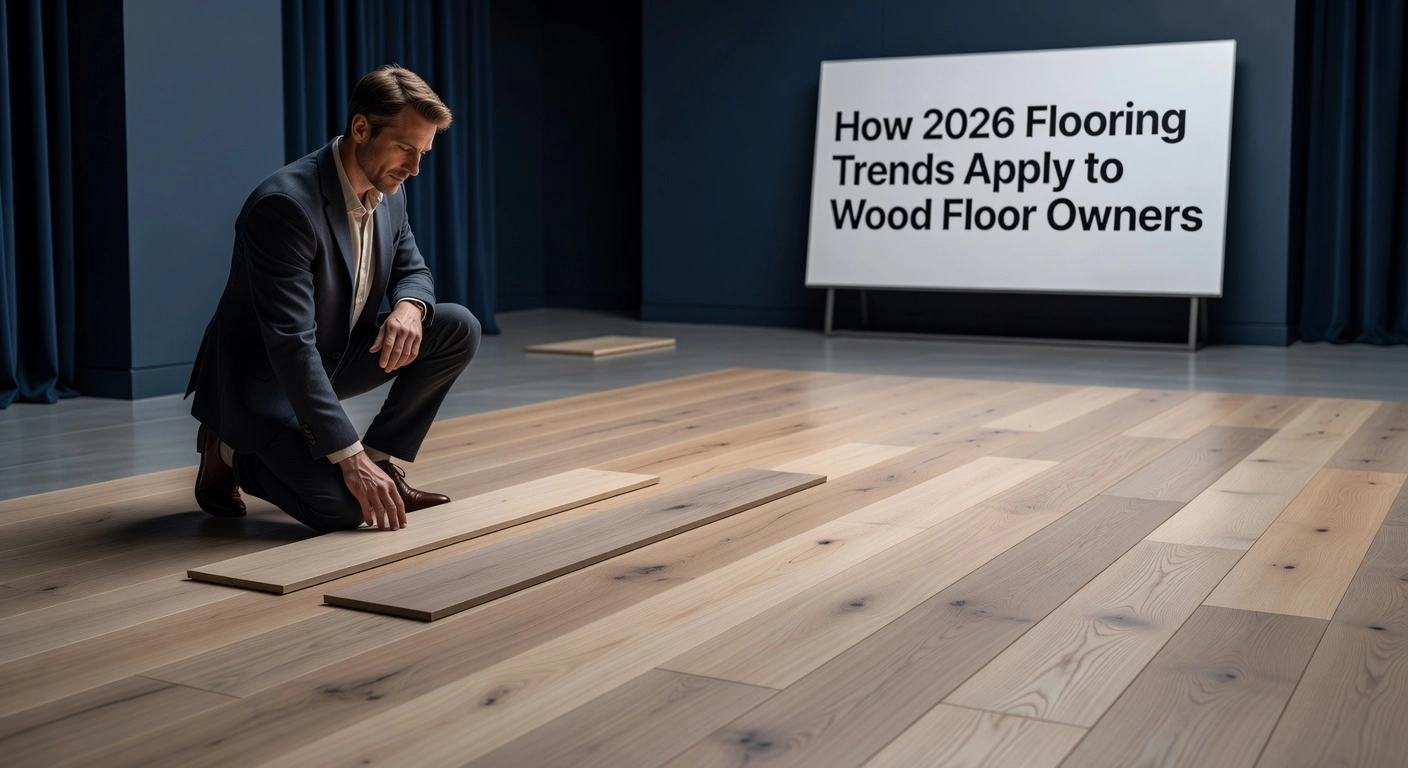
The dominant flooring aesthetic story heading into 2026 is a clear departure from the cold, high-gloss industrial gray that once defined modern epoxy floors. Across both residential and commercial spaces, designers and homeowners are gravitating toward matte finishes, warm neutrals, and organic palettes featuring taupes, greiges, moss greens, terracotta, and honey-oak-inspired tones. The appeal is rooted in biophilic design principles, which prioritize materials and environments that foster a psychological connection to nature. Glossy, reflective surfaces feel clinical in this context; matte and satin finishes feel grounded, inviting, and appropriately timeless.
Here is the revealing detail for wood floor owners: decorative epoxy trends are actively working to imitate what real hardwood already provides naturally. Epoxy manufacturers are now blending nature-inspired pigments, matte topcoats, and warm color palettes specifically to capture the earthy warmth that authentic wood grain delivers without any effort at all. Wide-plank hardwood in walnut, light European oak, or maple with a wire-brushed or low-sheen finish is not chasing the trend. It IS the trend, expressed in its most genuine form.
Sustainability is equally central to 2026 flooring preferences. Consumers across all floor types are actively seeking low-VOC, eco-conscious coating options, driven by health awareness, stricter regional regulations, and a preference for responsible product choices. Minwax water-based finishes, including Water-Based Oil-Modified Polyurethane and Polycrylic Protective Finish, align precisely with this shift. They offer low odor, fast drying, water cleanup, and VOC compliance without sacrificing the durability hardwood floors demand. Minwax’s 2026 Color of the Year, Special Walnut, further underscores this direction, delivering a warm, earthy medium brown that pairs beautifully with water-based stain formulas.
Metallic and terrazzo epoxy effects do retain real appeal, and it is worth acknowledging that honestly. In garages, basements, and polished concrete residential or commercial spaces where wood is absent or impractical, these finishes provide customizable depth, seamless durability, and genuine visual impact. Matte topcoats over metallic epoxy are increasingly popular in these spaces for a softer, more current look.
For homeowners with existing hardwood, however, the clearest path to the warm, organic aesthetic that defines 2026 is simply a quality wood finish applied correctly. Refinishing or topping your hardwood with a low-VOC, water-based product achieves the matte, nature-connected look the market is chasing, without the adhesion risks or moisture complications that come with applying a concrete-formulated coating over a wood substrate.
How to Choose the Right Coating for Your Floor Type
Choosing the right floor coating comes down to one foundational question: what material sits beneath your feet? Use this simple three-path framework to guide your decision.
If your substrate is concrete (a garage slab, basement floor, or warehouse surface), epoxy and polyaspartic coatings are legitimate, well-proven options worth exploring. Concrete is dimensionally stable, handles rigid coatings without cracking, and provides the bond strength these systems need to perform correctly over years of heavy use.
If your floor is finished hardwood, engineered wood, or solid wood planks in any living space, a purpose-built wood finish is the correct and safer choice. As covered earlier in this guide, wood expands and contracts with humidity changes, and rigid epoxy simply cannot flex with it. A quality polyurethane or oil-modified wood finish is formulated specifically for this dynamic substrate.
If you have an unfinished wood subfloor in a utility area, do not assume any coating will work. Consult a flooring professional first, seek out flexible formulations, and consider polyaspartic systems as a more adaptable alternative to standard rigid epoxy.
Before committing to any coating, work through this quick checklist:
- Substrate type: concrete, finished wood, or raw subfloor?
- Current finish condition: existing coatings, damage, or surface irregularities?
- Expected traffic: light foot traffic, vehicle loads, or heavy equipment?
- Moisture levels: high humidity or active vapor transmission can cause any coating to fail prematurely
For homeowners still uncertain about the right finish for their specific wood floor, Minwax offers free guidance and product-matching tools at woodcare.com to help you make a confident, informed choice.
The Bottom Line on Epoxy Flooring and Wood Floors
The verdict is clear: epoxy is a high-performance coating built for concrete, not finished hardwood. Its rigidity, vapor-blocking properties, and inability to flex with seasonal wood movement make it a poor match for hardwood floors, where the risk of cracking, delamination, and moisture damage is significant and costly to reverse.
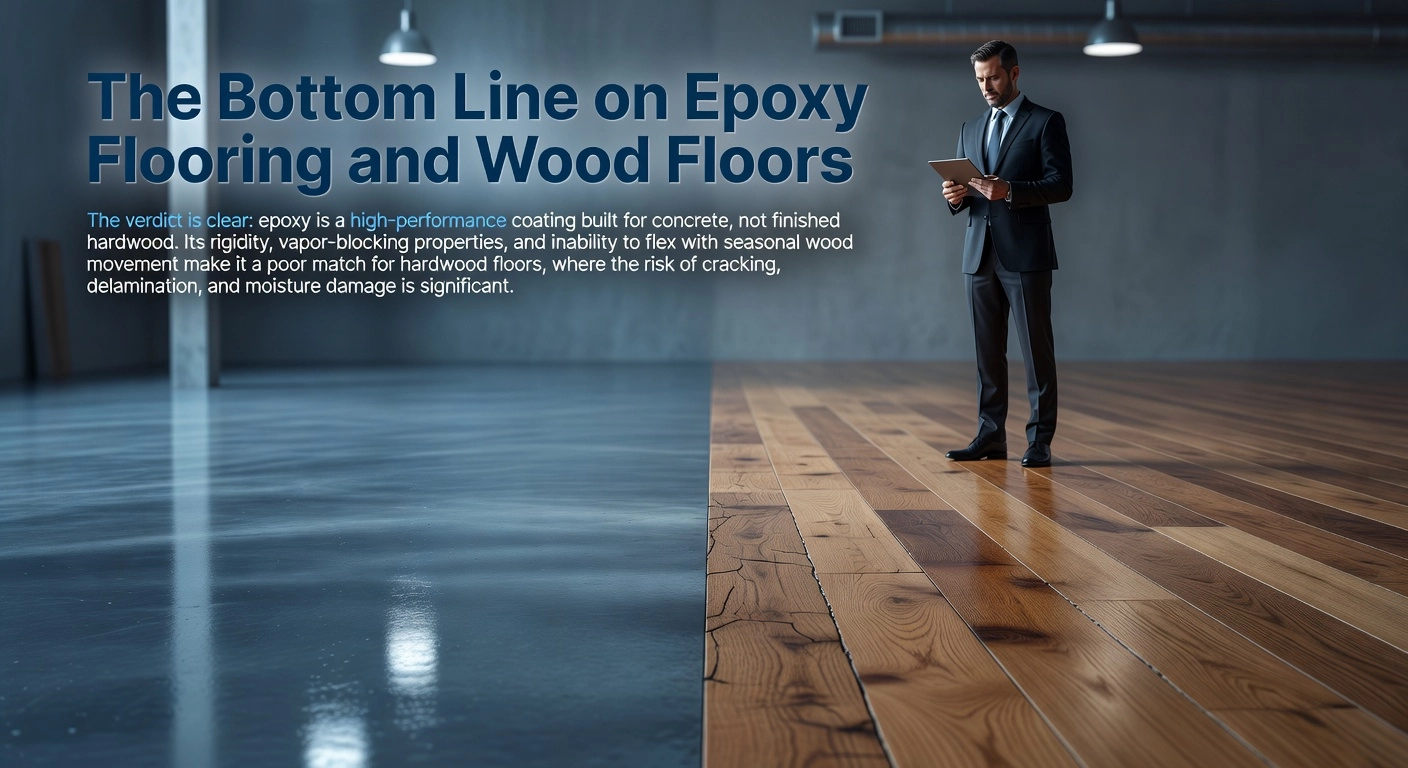
Hardwood floors deserve a finish engineered specifically for them. Purpose-built wood finishes from Minwax deliver exactly that, combining proven durability with the flexibility hardwood requires, the ability to be refinished over time, and formulations that enhance rather than obscure the natural grain and warmth of wood. That combination is simply not achievable with a rigid epoxy system.
Protecting your flooring investment starts with matching the right product to the right substrate. Using the wrong coating does not just underperform; it can permanently damage your floors and trigger expensive repairs. The correct match ensures longevity, beauty, and maintainability for years ahead.
For hardwood floors, the logical next step is straightforward. Explore Minwax polyurethane and stain options at woodcare.com to find the ideal finish for your specific project.
Conclusion
Choosing between epoxy flooring and wood floor finishes comes down to four key factors: your space, your lifestyle, your budget, and the look you want to achieve. Epoxy delivers unmatched durability and moisture resistance, making it ideal for garages, basements, and high-traffic areas. Wood finishes bring timeless warmth and elegance, perfect for living spaces where comfort and aesthetics take priority. Neither option is universally better; the right choice is simply the one that fits your unique situation.
Now that you have the knowledge, it is time to act. Walk through your space, assess your needs, and revisit the comparisons covered in this guide. If you are still unsure, consult a flooring professional for a personalized recommendation. The perfect floor is within reach, and making an informed decision today means enjoying beautiful, functional results for years to come.
Frequently Asked Questions
Can I apply epoxy flooring directly over my hardwood floors?
No, applying epoxy directly over hardwood floors is strongly discouraged. Wood naturally expands and contracts with changes in temperature and humidity, while epoxy cures into a rigid, inflexible shell that cannot accommodate that movement. The result is delamination, bubbling, cracking, and peeling that can occur within months. Epoxy also creates a vapor-impermeable barrier that traps moisture beneath the coating, leading to warping, cupping, and hidden structural damage in the wood. For finished hardwood floors, purpose-built polyurethane finishes are the correct and safer choice.
What is the best finish to use on hardwood floors if not epoxy?
Oil-based and water-based polyurethane finishes are widely recommended by flooring professionals as the best options for hardwood floors. Products like Minwax Super Fast-Drying Polyurethane for Floors and Minwax Ultimate Floor Finish are specifically formulated to flex with wood's natural movement, allow proper vapor transmission, and provide durable protection lasting 10 to 20 years with proper maintenance. Water-based formulas also carry a low-VOC profile, making them a healthier and more eco-friendly choice for indoor spaces.
Where does epoxy flooring actually perform best?
Epoxy flooring performs best on stable concrete substrates in high-demand environments. The top use cases include garage floors, where it resists vehicle fluids, tire marks, and road salts; warehouse and industrial floors that handle forklift traffic and chemical exposure; basement slabs that need sealing against moisture and dust; and commercial kitchens requiring a non-porous, sanitary surface. In these environments, epoxy's rigidity, chemical resistance, and seamless surface are genuine strengths rather than liabilities.
Is there any situation where applying epoxy over wood is acceptable?
Yes, but only in one narrow scenario: an unfinished plywood subfloor in a non-living utility space like a garage or workshop, where heavy-use durability is the priority and aesthetics are not a concern. Even then, the plywood must be firmly fastened with no flex, moisture levels must be controlled, and a flexible epoxy formulation designed specifically for wood substrates must be used. Rigid industrial-grade epoxy should be avoided. Thorough preparation including countersinking fasteners, sanding, filling seams, and applying fiberglass mesh tape is non-negotiable. Polyurea or polyaspartic coatings are often a better alternative even in this case.
How do 2026 flooring trends affect the choice between epoxy and wood finishes?
Heading into 2026, flooring aesthetics are shifting strongly toward matte finishes, warm neutrals, and organic palettes inspired by biophilic design principles. Interestingly, decorative epoxy manufacturers are actively developing nature-inspired pigments and matte topcoats to imitate the warmth that real hardwood already provides naturally. For homeowners with existing hardwood floors, this trend works in their favor. Refinishing wood floors with a low-VOC, water-based polyurethane finish in a warm tone like Minwax's 2026 Color of the Year, Special Walnut, achieves the exact matte, organic aesthetic the market is chasing without the adhesion risks or moisture complications associated with epoxy coatings.
1 thought on “Epoxy Flooring vs. Wood Floor Finishes: What’s Right for You”