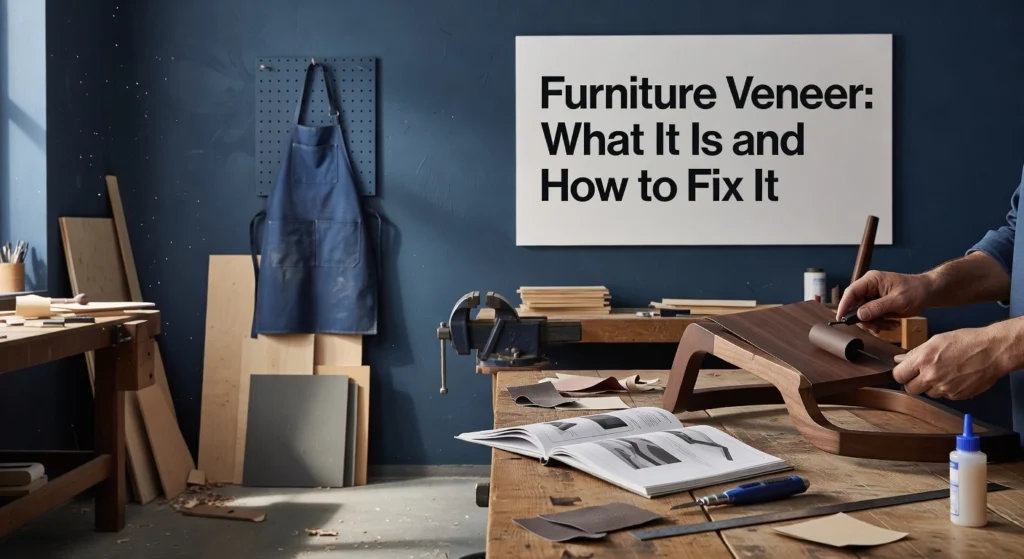

Have you ever noticed the surface of a beautiful wooden table or cabinet starting to peel, bubble, or lift at the edges? Before you panic and assume the whole piece is ruined, there is a good chance you are dealing with a furniture veneer problem, and the great news is that it is totally fixable!
Furniture veneer is something most people interact with every day without even realizing it. It is a thin layer of real or synthetic wood that gets bonded to a less expensive base material, giving furniture that gorgeous wood-grain look without the hefty price tag of solid wood. It is clever, practical, and extremely common in modern and vintage furniture alike.
But like anything, veneer can run into trouble over time. Moisture, heat, and everyday wear can cause it to lift, crack, or separate from the surface beneath it.
In this tutorial, we are going to break down exactly what furniture veneer is, why it gets damaged, and how you can repair it yourself even as a complete beginner. No fancy tools or woodworking experience required. Let’s get started!
What Is Furniture Veneer?
If you’ve ever admired the gorgeous wood grain on a piece of furniture and wondered whether it’s actually solid wood all the way through, you’ve already stumbled onto the concept of furniture veneer. Simply put, furniture veneer is a thin slice of real wood, typically less than 1/8 inch thick (usually somewhere between 0.6 and 3 mm), that gets glued onto a stable core material called a substrate. That substrate is usually something like MDF, plywood, particleboard, or hardboard. The result looks and feels like genuine wood on the surface because, well, it actually is real wood on the surface.
The magic here is in how the two layers work together. The thin veneer layer handles everything you see and touch, delivering that authentic wood grain, warm color, and natural texture. The substrate underneath does the heavy structural lifting, keeping the piece stable, preventing warping, and bringing the overall cost down significantly. This combination means you can enjoy the look of premium exotic hardwoods like walnut or mahogany without paying for a solid slab of the stuff.
How Veneer Differs From Laminate and Solid Wood
It’s easy to mix up veneer with laminate or solid wood, but they’re quite different materials. Laminate is a synthetic, plastic-based coating made from layers of paper printed with a wood-grain image and fused with resin. It’s durable and cheap, but it’s not real wood at all. You generally can’t sand or refinish it the way you can with veneer. Solid wood, on the other hand, is exactly what it sounds like: consistent wood material from top to bottom, no substrate involved. Solid wood is sturdy and highly repairable, but it costs more and can be heavier. Veneer sits in a smart middle ground, offering the authentic look of real wood with better cost efficiency than solid wood and far more refinishing potential than laminate.
Book-Matching and Substrate Options
One cool technique you’ll hear about with modern veneer is book-matching. Manufacturers take two consecutive slices from the same log and open them up like the pages of a book, creating a perfectly mirrored, symmetrical grain pattern. This technique gives high-end furniture that stunning, almost butterfly-wing appearance on tabletops and cabinet doors.
The substrate material underneath also matters quite a bit. MDF is incredibly smooth and stable, making it ideal for flat, painted, or finely finished surfaces. Plywood offers more strength and better screw-holding ability, which is great for structural pieces. Particleboard is the most budget-friendly choice and works well for large flat panels, though it’s more vulnerable to moisture and doesn’t hold screws as well at the edges. Each option comes with its own trade-offs, and knowing which substrate your furniture uses can actually help you care for and repair it more effectively down the road.
A Brief History of Wood Veneer
Veneer isn’t a modern shortcut or a sign of cheap manufacturing. It’s actually one of the oldest woodworking techniques in human history, with roots stretching back over 5,000 years.
The story begins in ancient Egypt, where craftsmen faced a real problem: beautiful, exotic woods like ebony were incredibly scarce and expensive. Their solution was clever. They sliced these prized woods into thin sheets and glued them onto less valuable cores, getting far more decorative surface area from a single precious log. You can even find examples of early veneered furniture in artifacts from Tutankhamun’s tomb.
European cabinetmakers picked up the technique and ran with it during the 17th and 18th centuries. French craftsmen called ébénistes turned veneering into a true art form, creating elaborate marquetry patterns with exotic woods and figured grains. Masters like Thomas Chippendale used veneer to make stunning, ornate furniture accessible to a broader (if still wealthy) audience, since expensive figured walnut or mahogany could stretch much further as a thin surface layer than as solid construction.
The Industrial Revolution changed everything. Mechanized slicing meant veneered furniture could be mass-produced efficiently, reducing waste and making beautiful wood furniture available to everyday households throughout the 19th and 20th centuries.
Today, precision slicing and AI-assisted automation make modern veneer more consistent and uniform than ever before, with quality control systems that can detect tiny defects in real time.
This history is genuinely useful to know. When you’re browsing antique shops or inheriting old furniture, the odds are high that beautiful pieces from past centuries are veneered rather than solid wood. That was intentional craftsmanship, not a compromise.
How Furniture Veneer Is Made and What Types Exist
Now that you know what veneer is and where it came from, let’s get into the nuts and bolts of how it’s actually made and what formats you’ll find when you go shopping for it.
The Three Main Cutting Methods
Veneer production starts with logs that are typically steamed or soaked to soften the wood fibers, which helps the blade cut more cleanly and reduces cracking. From there, manufacturers use one of three primary cutting methods, and each one produces a noticeably different look in the finished sheet.
Rotary cutting is the most common method by far. The whole log is mounted on a giant lathe and spun against a long, stationary blade, essentially peeling the log like you’d unroll a paper towel. This method is efficient and produces wide, continuous sheets with bold, sweeping “cathedral” grain patterns, those dramatic arching curves you’ve probably seen on plywood panels.
Flat slicing takes a half-log and passes it back and forth across a blade that cuts parallel to the center of the log. The result is a classic, varied grain with cathedral arches in the middle that gradually straighten toward the edges. This is the look you’ll see on a lot of traditional oak and cherry furniture.
Quarter slicing cuts the log into quarters first, then slices each piece so the blade hits the growth rings at a right angle. This produces tight, straight, uniform lines with very little visual movement. It’s a cleaner, more modern look, and it’s currently trending hard in wood veneer cutting and design, especially with white oak and walnut species. You can explore detailed veneer cut types to see side-by-side comparisons.
Veneer Formats for DIYers
Once the veneer is cut, dried, and trimmed, it gets packaged in different formats depending on who’s using it. As a beginner, this part matters a lot because the format determines how easy the project will be.
Raw veneer is just the plain wood slice with no backing. It requires contact cement or wood glue plus a veneer press or vacuum bag to apply properly. It’s better suited to experienced woodworkers.
Paperbacked veneer has a thin paper layer bonded to the back, which adds flexibility and makes it much easier to handle and cut. You apply it with contact cement, but it’s far more forgiving than raw veneer for beginners.
Peel-and-stick veneer is exactly what it sounds like. A factory-applied pressure-sensitive adhesive sits under a peel-off liner. You prep your surface, peel, and press. No special tools needed, just a roller and a utility knife.
Those last two formats are genuinely perfect for homeowners refreshing cabinet faces, worn tabletops, or tired furniture pieces without buying expensive equipment.
The demand for these DIY-friendly options is clearly growing. The global wood veneers market is estimated at USD 4.95 billion in 2026 and projected to reach USD 7.39 billion by 2033, with residential remodeling and kitchen upgrades identified as major drivers of that growth. People are discovering that real wood veneer is an accessible, affordable way to transform a space without starting from scratch.
How to Tell Veneer Apart from Solid Wood and Laminate
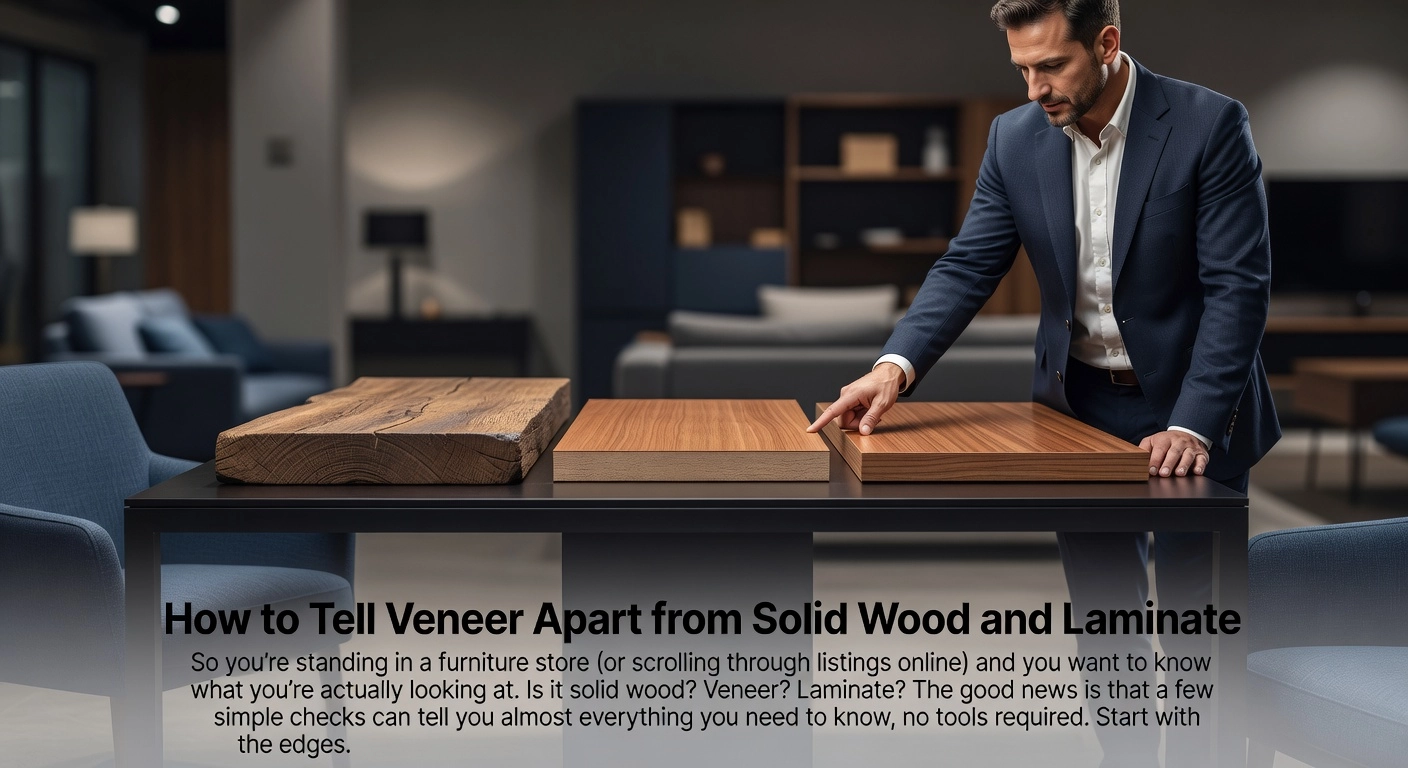
So you’re standing in a furniture store (or scrolling through listings online) and you want to know what you’re actually looking at. Is it solid wood? Veneer? Laminate? The good news is that a few simple checks can tell you almost everything you need to know, no tools required.
Start with the edges. Flip a drawer upside down or peek at the corners of a tabletop. On solid wood, the grain runs continuously all the way through the piece, and you’ll often spot end grain at cut edges, those tight, circular ring-like patterns that look like a cross-section of a tree. With veneer furniture, the edge tells a different story. You’ll usually see a thin top layer sitting over a noticeably different material, like uniform particleboard or plywood beneath. The surface and the edge simply don’t match up. That mismatch is your first big clue.
Next, study the grain pattern closely. Solid wood has naturally irregular, asymmetrical grain with random knots, color shifts, and flow variations. Veneer, on the other hand, can display strikingly wide, symmetrical, or perfectly mirrored grain patterns, especially book-matched surfaces where two sheets are opened like a book for a mirror-image effect. If the grain looks almost too perfect or too consistent across a large surface, you’re almost certainly looking at veneer. Laminate takes it a step further by showing a printed pattern that repeats visibly under close inspection, which no real wood ever does. This breakdown of laminate vs. veneer vs. solid wood is a helpful reference if you want to compare examples side by side.
Try the knuckle tap test. Give the surface a firm tap with your knuckle and listen carefully. Dense solid wood returns a solid, dull thud. Veneer over a composite core often sounds noticeably hollower, because you’re essentially tapping over an empty-ish substrate rather than thick timber. Laminate sounds similar or even more plastic-like. This test works best as a supporting check alongside the visual ones, not as a standalone verdict.
Pay attention to how the surface feels. Laminate has a plasticky, slick, uniformly smooth feel that often comes with a slight synthetic sheen. Real veneer, like solid wood, has subtle texture variation and a warm, organic feel that synthetic materials just can’t replicate. If you’re unsure whether something is veneer or laminate, try gently sanding an inconspicuous spot; laminate will reveal paper or plastic underneath, while veneer shows actual wood fibers. For a deeper dive into telling veneer apart from laminate, this guide walks through the tactile and visual differences clearly.
Finally, look for edge banding. Edge banding is a thin strip of material, often plastic, melamine, or a thin wood veneer, applied to exposed edges of a composite core. It’s essentially a finishing touch used to cover up particleboard or MDF edges so they look presentable. Solid wood doesn’t need this treatment because the grain simply continues naturally around the piece. If you spot a visible seam where the edge meets the surface, or notice that the edge strip looks slightly different from the main face, you’re looking at engineered construction with veneer or laminate on top. For more practical identification tips, this guide on veneer versus solid wood covers additional details worth bookmarking.
Combine two or three of these checks and you’ll have a confident answer almost every time.
Advantages and Disadvantages of Furniture Veneer
Now that you know how to spot veneer in the wild, it’s worth taking a step back and asking a bigger question: is veneer actually a good thing? Like most materials, it comes with a real mix of strengths and weaknesses, and understanding both sides will help you make smarter decisions when buying or restoring furniture.
The Upsides Are Pretty Significant
The most obvious advantage is cost. Solid wood furniture made from premium or exotic species like ebony, zebrawood, or figured maple can cost several times more than a veneered equivalent. Because veneer uses only a razor-thin slice of that beautiful wood over a less expensive substrate, you get the same stunning visual result at a fraction of the price. That’s not a compromise; that’s just smart use of materials.
Veneer is also surprisingly eco-friendly. A single log can yield dramatically more usable surface area as veneer than it ever could as solid planks. That means fewer trees harvested to achieve the same result, which is a genuine win for sustainability. As FSC and PEFC certification programs grow in popularity, more manufacturers are offering verified, responsibly sourced veneers, making it easier for eco-conscious buyers to feel good about their purchase. You can learn more about the advantages and disadvantages of wood veneers in detail if you want a deeper breakdown.
Another underrated perk is dimensional stability. Solid wood expands and contracts with seasonal humidity changes, which can cause warping, sticking drawers, or cracked panels over time. Veneered furniture, bonded to engineered substrates like MDF or plywood, resists that movement beautifully. This makes it an excellent choice for built-in shelving, large tabletops, and cabinet doors.
The Downsides You Should Know About
The biggest drawback is fragility. That thin wood layer can peel, bubble, chip, or delaminate when exposed to moisture, heat, or adhesive failure. A spilled glass of water left sitting too long or a hot pan placed directly on the surface can cause real damage. Unlike solid wood, which has plenty of material to work with, veneer furniture has very little room for error.
Refinishing also requires extra caution. Sand too aggressively and you’ll burn straight through the veneer layer, exposing the substrate underneath and essentially ruining the surface. Stick to fine-grit sandpaper and light passes, and avoid power sanders whenever possible during restoration work.
Common Furniture Veneer Problems and What Causes Them
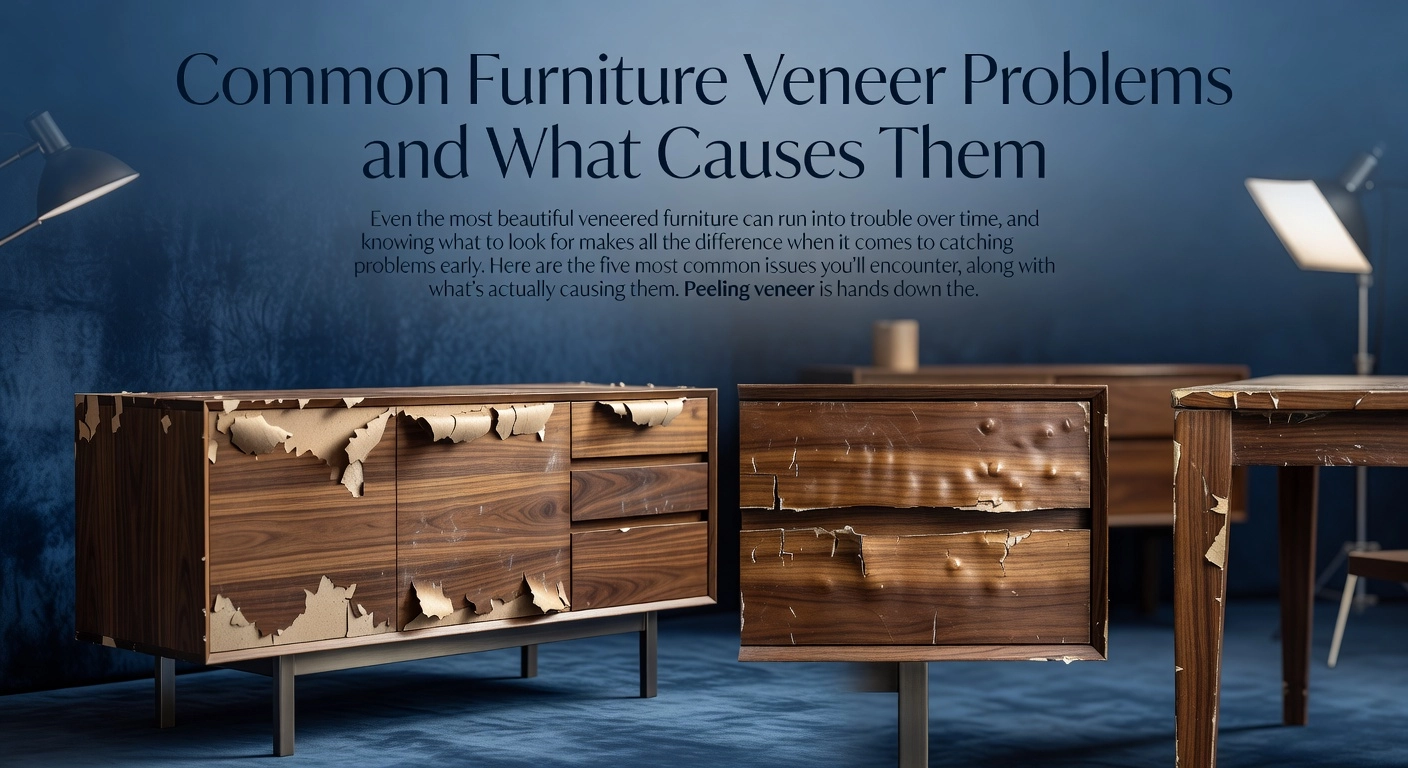
Even the most beautiful veneered furniture can run into trouble over time, and knowing what to look for makes all the difference when it comes to catching problems early. Here are the five most common issues you’ll encounter, along with what’s actually causing them.
Peeling veneer is hands down the most frequent complaint you’ll hear from furniture owners. It happens when the original adhesive beneath the thin wood layer starts to break down. On older and vintage pieces especially, manufacturers often used animal hide glues that simply weren’t designed to hold up against modern conditions. Humidity fluctuations are a big culprit here, since wood naturally expands when it absorbs moisture and contracts when it dries out. Do that enough times and the bond between the veneer and its substrate starts to give way. Prolonged heat exposure and water sitting on the surface speed up the process considerably.
Bubbling and blistering look a little different. Instead of an edge lifting, you’ll notice a raised bump or ridge somewhere in the middle of a flat surface. This happens when moisture or heat causes a localized spot of adhesive to fail, creating a small pocket of air or trapped moisture between the veneer and the core beneath. It’s more common on tabletops and dresser surfaces where drinks or humidity from the air can work their way in over time. You can learn more about identifying these issues in guides like this breakdown of peeling and chipping veneer repairs.
Chipping and cracking tend to show up at corners, edges, and high-traffic areas like drawer fronts and tabletop edges. These spots take the most mechanical abuse from everyday use, and since veneer is extremely thin, there isn’t much material to absorb impact before it chips or cracks.
Water damage is particularly nasty because the real problem isn’t just the veneer itself. Once moisture seeps through, it reaches the MDF or particleboard core underneath, which absorbs water like a sponge. That causes the core to swell, warp, and push the veneer off from below. You’ll often see dark staining on the surface as an early warning sign.
Large-area delamination usually means multiple problems have combined at once, old adhesive, a humid storage environment like a garage or basement, and little to no protective finish left on the surface. Research confirms that unprotected veneer panels in high-humidity zones can experience delamination at rates dramatically higher than pieces kept in stable conditions.
How to Repair Furniture Veneer Step by Step
The good news is that most furniture veneer repairs are completely manageable for a beginner with a little patience and the right approach. You don’t need a workshop full of specialized tools. What you need is to match the repair method to the type of damage you’re dealing with.
Fixing Small Peeling or Lifted Edges
For minor peeling, start by gently lifting the loose veneer just enough to work underneath it without cracking it further. Clean out any dust, old glue residue, or debris from both the underside of the veneer and the substrate beneath it, since fresh glue won’t bond well over contaminated surfaces. Using a toothpick, palette knife, or even a small syringe, work a thin bead of wood glue or contact cement under the lifted area and spread it as evenly as you can. Press the veneer firmly back down, wipe away any squeeze-out immediately with a damp cloth, and lay a sheet of wax paper over the repair to protect the surface. Then clamp it down or stack some heavy books on top and leave it for at least one hour, though letting it sit overnight gives you a much stronger bond.
The Iron Method for Bubbles and Blisters
If your veneer has developed bubbles or blisters but hasn’t actually separated at an edge, there’s a good chance the original adhesive is still there and just needs a little encouragement. Lay a slightly damp cloth over the problem area and press a household iron set to medium heat directly over the cloth for about 20 to 30 seconds. The heat and moisture work together to reactivate the old hide glue or similar adhesive underneath. As soon as you lift the iron, apply firm, even pressure right away using a flat block of wood or your palm, and hold it there as the area cools. The glue re-bonds as it cools under pressure. Keep the iron moving slowly rather than holding it in one spot too long, and never let the iron touch the veneer or finish directly.
Patching Missing or Chipped Sections
When a chunk of veneer is actually gone, you’ll need to cut and fit a replacement patch. Source a piece of veneer that matches the original as closely as possible in species, color, and grain direction. Cut your patch slightly larger than the damaged area, dry-fit it first to check alignment with the surrounding grain, then glue it in place using wood glue, pressing and weighting it down until fully cured. Once dry, trim the edges flush with a sharp utility knife and sand lightly to blend the surface.
Filling Dents and Cracks
For dents, cracks, or small chips where no material is actually missing, wood putty or a two-part filler like Bondo works well. Overfill the area slightly, let it cure completely, then sand it smooth starting with a medium grit and finishing with fine 220-grit sandpaper. Touch up with a matching wood stain applied in thin layers, blending outward from the center of the repair to avoid a hard edge.
Sealing with a Protective Topcoat
No repair is truly finished without a protective topcoat. Once your repair is fully cured and sanded smooth, apply a thin coat of polyurethane, shellac, or lacquer over the repaired area to seal it and blend the sheen with the surrounding finish. This final step also creates a moisture barrier that helps prevent the same problem from coming back. Apply it in thin, even coats and test the finish on a hidden spot first to make sure it’s compatible with whatever is already on the piece.
How to Refinish and Stain Veneer Furniture Safely
The great news about furniture veneer is that it can be stained and refinished just like solid wood, which means that tired, worn tabletop or dresser doesn’t have to stay that way. However, the process requires a gentler touch than you’d use on solid wood, and understanding why makes all the difference between a beautiful result and a ruined piece.
The single biggest mistake beginners make is sanding too aggressively. Most modern veneers are only 0.5 to 1mm thick, roughly the same as one or two stacked credit cards. At that thickness, coarse sandpaper can burn right through the veneer and expose the MDF or particleboard core underneath in a matter of seconds. Once that happens, there’s no coming back without re-veneering the entire surface. Keep your 80-grit and 100-grit paper far away from this project.
Instead of sanding to strip the old finish, reach for a chemical stripper. Apply a gel or semi-paste formula in small sections using a brush, let it dwell until the old finish bubbles and lifts (usually 30 to 60 minutes), then gently scrape it away using a plastic scraper, always following the direction of the wood grain. Clean up any residue with mineral spirits and a soft rag. Reserve your 220-grit sandpaper strictly for light scuffing between finish coats, not for stripping purposes.
When it comes time to apply stain, skip the brush and use a soft cloth instead. Brushes can raise the grain and push too much product into the wood too quickly, which leads to blotchy results, especially on figured or book-matched veneer surfaces where the grain direction shifts. Work in the direction of the grain, apply a thin layer, and wipe off the excess promptly before it has a chance to sit and soak unevenly.
Before committing to any stain or finish across the whole piece, always test on a hidden area first, such as the inside of a drawer or the underside of the top. Veneers, particularly those bonded over MDF, can absorb finishes inconsistently due to prior polishes, age, or surface porosity.
Once your stain is dry, apply a thin coat of dewaxed shellac as a sealer before your final topcoat. This step locks in the stain color evenly, seals any porous spots, and creates a reliable bonding surface for either oil-based or water-based polyurethane. Think of it as the bridge coat that ties everything together and gives your finish a smooth, professional foundation to build on.
Care and Maintenance Tips to Make Veneer Last Longer
You’ve already put in the hard work of repairing and refinishing your veneer, so the last thing you want is to undo all of that progress through everyday habits that slowly wear it down. The good news is that keeping veneered furniture in great shape doesn’t require special products or a lot of time. A few consistent routines make a surprising difference over the years.
Start with gentle cleaning. When your veneered surface needs more than a quick dusting, use a soft microfiber cloth lightly dampened with a solution of a few drops of mild dish soap mixed in water. Wipe in the direction of the wood grain, then follow immediately with a dry cloth to remove every trace of moisture. This matters because veneer is thin, and even small amounts of water sitting at seams or edge joints can work its way under the veneer and weaken the adhesive over time. Skip the spray cleaners entirely; the mist can settle into gaps you can’t even see.
Certain products are off-limits. Abrasive scrubbing pads scratch right through the finish layer. Ammonia-based cleaners strip the protective coating and degrade the adhesive beneath. Steam cleaners are probably the worst option because they deliver both heat and moisture directly into the wood, which is a reliable recipe for swelling, lifting, and delamination. Stick with mild soap and water, and you’ll avoid most cleaning-related damage entirely.
Control your indoor humidity. Wood veneer expands and contracts in response to moisture in the air, and that movement stresses the adhesive bond every single time it happens. Keeping indoor humidity between 40 and 55 percent year-round reduces that cycle significantly. This is especially worth paying attention to in kitchens and bathrooms, where humidity swings are more dramatic.
Protect the surface daily. Use felt pads under lamps, vases, and decorative objects. Always place a coaster, placemat, or trivet between hot dishes or cups and the surface, because heat can blister the finish and open the door to moisture damage.
Check for early trouble once a year. Run your fingers along seams, edges, and corners and look for any slight lifting. Catching a small loose area early and pressing it back down with a dab of wood glue takes about two minutes. Ignoring it for another year turns it into a much bigger repair project.
Veneer as a Sustainable Wood Choice
Here’s something that might surprise you: choosing furniture veneer over solid wood isn’t just a budget decision. It’s actually one of the greener choices you can make for your home.
Think about how a solid wood table is made. A tree gets felled, and a relatively small percentage of that log ends up as usable lumber after milling. Veneer works completely differently. Because sheets are sliced or peeled at thicknesses of roughly 0.6 to 3 millimeters, a single log can generate an enormous amount of surface coverage. Some estimates put the efficiency ratio at around 40 to 1 compared to solid lumber processing, and rotary peeling can utilize up to 85 to 90 percent of a log. That same resource goes dramatically further, which means less pressure on slow-growing hardwoods like walnut, cherry, and mahogany.
The sustainability story gets even better when you look at how veneer is sourced. More consumers and designers are specifically seeking out FSC (Forest Stewardship Council) and PEFC-certified veneers, which verify that the wood came from responsibly managed forests. Certified veneers are increasingly easy to find, and choosing them for your next restoration or remodeling project is a simple way to align your spending with your values.
There’s also progress happening with the adhesives used in veneer production. Traditional glues have historically contained urea-formaldehyde, which raises indoor air quality concerns. Newer bio-based adhesives made from lignin and tannin, natural compounds derived from wood pulp and tree bark, are gaining ground as lower-VOC alternatives that reduce those risks without sacrificing bond strength.
And honestly, the most sustainable choice of all? Fixing the veneered furniture you already own rather than tossing it. Every repair you make keeps materials out of a landfill and reduces demand for new production. That’s the core idea behind the circular economy, and it turns out a bottle of wood glue and a bit of patience can be genuinely eco-friendly acts.
The market reflects this shift. The residential remodeling segment accounted for roughly 37.89% of the global veneer sheets market in 2025 and is projected to grow faster than any other segment through the early 2030s. More homeowners are upgrading existing furniture and cabinetry rather than replacing everything outright, and veneer is at the center of that trend.
Putting It All Together: Your Next Steps with Furniture Veneer
By now, you’ve got a solid foundation for working with furniture veneer confidently. Remember the quick identification shortcut: check the edges. Solid wood shows continuous grain running all the way around. Veneer reveals a thin wood layer sitting over a different substrate. Laminate feels plasticky, often sounds hollow when tapped, and displays repeating patterns that never quite look natural. That single edge-check habit will save you from misidentifying furniture ever again.
The repair side of things is equally reassuring. Peeling, bubbling, and chipping are the most common veneer problems, and all three are fully fixable at home using wood glue, a household iron, some sandpaper, and basic wood filler. No professional tools, no expensive contractors required. Just patience and a willingness to work in stages.
Before diving into any repairs, take ten minutes to inspect your furniture today. Run your fingers along edges and tabletops, feeling for any lifting or soft spots. Catching a small loose corner early takes minutes to fix; ignoring it until a large section delaminates turns a simple job into a much bigger project.
When you’re ready to go further, WoodStuffHQ has you covered with dedicated guides on wood furniture restoration, fixing scratches on wood furniture, and protecting wood from sun damage. Finally, remember that restoring a veneered piece rather than replacing it keeps money in your pocket, keeps furniture out of landfills, and often produces results that look even better than buying new.
Conclusion
Furniture veneer is more common than most people realize, and knowing how to work with it is a genuinely valuable skill. Here are the key things to remember: veneer is a thin wood layer bonded to a base material, damage is usually caused by moisture, heat, or age, and most repairs can be done at home with basic tools and a little patience.
You do not need to be a professional woodworker to restore a beautiful piece of furniture. With the right approach, even a bubbling or lifting surface can look brand new again.
Now it is your turn. Grab that damaged table or cabinet you have been ignoring and give it the attention it deserves. Share your before and after results in the comments below. Every piece of furniture has a second life waiting, and you now have everything you need to bring it back.



Pingback: Wood Floating Shelves: A Complete Guide for DIYers - WoodStuffHQ
Pingback: Murphy Beds: 9 Things Every DIY Woodworker Should Know - WoodStuffHQ