Choosing the right flooring for your home is one of the most important decisions you will make as a homeowner, and it can also be one of the most confusing. Walk into any home improvement store and you will quickly find yourself standing between two of the most popular options on the market: vinyl flooring and hardwood. Both look beautiful, both have passionate supporters, and both come with very different price tags.
So which one is actually worth your money? That depends on several key factors that most beginners simply are not aware of before making a purchase. In this guide, we will break down everything you need to know about vinyl flooring and hardwood flooring side by side. We will cover cost, durability, maintenance, appearance, and long-term value so you can make a confident, informed decision. Whether you are renovating a single room or updating your entire home, understanding the real differences between these two options will save you time, money, and plenty of regret down the road. Let us get started.
Upfront Cost vs. Lifetime Cost of Ownership
When comparing vinyl flooring and hardwood side by side, the upfront numbers tell only half the story. Vinyl flooring materials typically run $2 to $6 per square foot, while hardwood comes in at $5 to $20 or more per square foot installed. For a 1,000 square foot home, that gap can easily reach $5,000 to $10,000 before you even factor in labor. It is completely understandable why so many beginners look at those numbers and immediately lean toward vinyl. The lower entry price is real, and for short-term budgets or rental properties, it can be the right call. However, treating that upfront figure as the final verdict is one of the most common and costly mistakes homeowners make.
The Replacement Cycle Changes Everything
The critical difference between these two flooring types is not price; it is permanence. Vinyl flooring has a lifespan of roughly 10 to 25 years depending on wear layer quality, foot traffic, and maintenance. Once it degrades, scratches accumulate, or the surface delaminates, there is no recovering it. You must rip it out and start over. Hardwood, by contrast, can last 50 to 100 years with proper care. Each time the surface shows wear, a professional can sand it down and apply a fresh finish, restoring it to near-original condition. According to a detailed hardwood versus vinyl cost comparison, hardwood’s refinishing advantage is one of the most significant factors in long-term cost modeling.
Refinishing vs. Full Replacement Costs
A professional hardwood refinishing project typically costs $3 to $8 per square foot, covering sanding, buffing, and the application of a quality finish system. Using Minwax hardwood finishing products, that process renews your floors without the disruption, debris, and compounding expense of a full replacement. Compare that to vinyl replacement, which brings material costs, professional labor, demolition, disposal fees, and subfloor repairs, often totaling $5 to $13 per square foot or more per cycle. Over a 30-year ownership period, a homeowner could face two or three full vinyl replacements. Each cycle adds hidden costs including furniture moving, potential subfloor damage remediation, and landfill disposal fees that quietly compound.
The 30-Year Ownership Picture
Long-term cost analyses from flooring specialists consistently show that hardwood becomes the more economical choice somewhere between the 15 and 25-year mark. The vinyl savings accumulated at purchase are gradually erased by replacement cycles, while hardwood simply receives a refinish and keeps performing. Hardwood also delivers a 70 to 80 percent resale ROI, a figure that further offsets its higher initial investment. For homeowners planning to stay in their home long-term, the math strongly favors hardwood. Vinyl wins on day one; hardwood wins over a lifetime.
Durability and Lifespan: Refinishable vs. Replace-Only
Beyond the price tag, the more revealing comparison between vinyl flooring and hardwood comes down to how long each floor actually lasts and what happens when it starts to show its age.
Vinyl flooring lifespan typically ranges from 5 to 25+ years, with that wide range determined almost entirely by the thickness and quality of the wear layer. A thinner, budget-grade product with a 6 mil wear layer may show visible scratches, dullness, or surface wear within 5 to 12 years under normal household traffic. A premium product with a 20 mil wear layer can realistically last two decades or more. One useful industry guideline suggests that roughly 1 mil of wear layer corresponds to approximately 1 year of expected residential service life. The critical limitation, however, applies across every tier: once that wear layer is scratched through or worn down, the floor cannot be repaired or restored. Replacement of the damaged planks or the entire floor is the only path forward. For a deeper look at how vinyl and hardwood compare over a full ownership cycle, the lifetime cost picture shifts considerably in hardwood’s favor.
Solid hardwood, properly maintained, routinely lasts 50 to 100 years. Unlike vinyl, hardwood can be sanded and refinished multiple times over its lifetime, often 3 to 7 full cycles depending on board thickness and species. Each refinishing removes a thin layer of wood, roughly 0.75 to 1 mm per pass, exposing fresh material and restoring the surface to near-original condition. This renewable quality gives hardwood a structural durability advantage that no vinyl product can match. When surface scratches, stains, or dullness appear on a hardwood floor, targeted repairs and treatments using products like Minwax floor finish can refresh the appearance without any board replacement. Spot sanding followed by a fresh coat of finish addresses localized damage efficiently, extending the floor’s life by years rather than requiring a full overhaul. This ability to restore rather than replace is one of the most compelling long-term arguments for hardwood.
Rigid-core luxury vinyl plank performs impressively in the short term. Its dense, stone-plastic composite core resists dents, repels moisture, and handles spills without warping, making it a practical choice for kitchens or basements. Over the long term, though, rigid-core LVP can develop gapping, lifting, or buckling caused by temperature fluctuations, insufficient expansion gaps, or minor subfloor imperfections. These issues are far less common in properly installed solid hardwood, which remains dimensionally stable across decades. Understanding how lifespan and durability differ between LVP and hardwood helps homeowners make a more informed choice based on where the floor will live and how long they expect it to perform.
Resale Value and Return on Investment
When it comes to protecting your home’s financial future, the flooring you choose matters far more than most beginners realize. Hardwood flooring consistently delivers an estimated 70 to 80% return on investment at resale, placing it among the highest-performing interior home improvements available. According to the National Association of Realtors’ Remodeling Impact Report, new hardwood floors can recover roughly 118% of their installation costs at resale, while refinishing existing hardwood recovers an even more remarkable 147%, ranking it as the top-performing interior project tracked in the report. For a beginner weighing vinyl flooring against hardwood, these numbers carry serious weight.
What Buyers Actually Want
Real estate surveys leave little room for debate: buyers across most price brackets actively seek authentic hardwood and are willing to pay premiums to get it. Approximately 54% of homebuyers report they would pay more for a home with hardwood floors, with average premiums ranging from $5,000 to $6,500. A 2025 survey found that 61% of Americans prioritize wood flooring when buying or designing a home. This preference shows up most strongly in living rooms, main hallways, and bedrooms, where hardwood creates the warm, timeless first impression that drives emotional buying decisions. Homes with hardwood in these key areas consistently sell faster and at higher price points in competitive markets, with some real estate agents reporting value increases of up to 10% depending on location and square footage.
How Luxury Vinyl Plank Compares at Resale
Despite significant improvements in aesthetics and texture, luxury vinyl plank is still widely viewed by buyers and appraisers as a lower-value material. Appraisers frequently treat hardwood as the gold standard, particularly in homes valued above $400,000. LVP resale ROI estimates typically land in the 50 to 60% range, compared to hardwood’s stronger performance. The core issue is perception: even high-quality vinyl is understood to be a synthetic, replaceable product with a finite lifespan, while hardwood shipments outpacing vinyl plank two-to-one in recent market data signals that buyers and builders alike are returning to wood for its long-term equity-building potential.
Preserving the Investment with Proper Care
Owning hardwood only delivers its full resale premium when the floor is properly maintained. Neglected hardwood with visible scratches, dullness, or worn finish can lose much of its buyer appeal before a sale ever happens. This is where a consistent care routine using Minwax hardwood floor care products makes a measurable difference. Regular cleaning, surface renewal, and protective finish touch-ups keep floors in the premium condition that buyers expect and appraisers reward. Unlike vinyl flooring, which requires simple mopping and occasional replacement, hardwood rewards ongoing investment with decades of increasing home value when properly cared for.
Maintenance and Repairability: A Critical Difference
Vinyl flooring earns its low-maintenance reputation honestly. Day-to-day care is genuinely simple: sweep regularly, damp mop with a mild cleaner, and avoid abrasive tools. No sealing, no waxing, no periodic professional treatments required. For busy households with kids and pets, that simplicity is a real advantage. However, the same synthetic construction that makes vinyl so easy to clean also makes it nearly impossible to restore once damage goes deeper than the surface.
When “Low Maintenance” Becomes “No Repair Options”
When vinyl suffers deep scratches, dents, gouges, or peeling edges, homeowners face a hard reality: there is no refinishing path. The options are limited to cosmetic patch kits (typically $15 to $150 for minor scuffs), individual plank or tile replacement, or full-floor replacement once the wear layer degrades. Matching discontinued patterns for partial repairs can be genuinely difficult, and professional repair costs range from $150 to $630 or more per affected area. According to a direct comparison of vinyl and hardwood repairability, a worn vinyl floor simply has no restoration path beyond replacement, while a worn hardwood floor is fundamentally a refinishing project. That distinction carries enormous long-term weight for homeowners planning to stay in their homes for a decade or more.
Hardwood floors operate under an entirely different model. Minor scratches and dents can be spot-filled or buffed out. Dull or worn surfaces can be re-coated without sanding. When the floor eventually shows significant wear after years of traffic, a full sand-and-refinish cycle restores it to like-new condition. Solid hardwood can typically be refinished four to five or more times over its lifetime, extending usable life to 50, 75, or even 100-plus years. That level of control over your floor’s condition and appearance simply does not exist with vinyl.
The Minwax Maintenance Ecosystem
This is precisely where having the right product lineup changes the equation for hardwood owners. Minwax offers a complete spectrum of hardwood maintenance solutions that support every stage of the care lifecycle. For routine cleaning, Minwax Hardwood Floor Cleaner removes dirt and grease without leaving residue or dulling the finish. When floors start looking tired and scratched, Minwax Hardwood Floor Reviver renews polyurethane-finished surfaces without sanding, restoring shine and adding a fresh protective layer. For more significant wear, full-strength options like Minwax Super Fast-Drying Polyurethane for Floors and the water-based Ultimate Floor Finish allow homeowners or professionals to apply durable new coats with minimal disruption.
This kind of tiered care system means a hardwood floor owner is never forced into replacement simply because the surface looks worn. Each product addresses a specific stage of wear, creating a logical, manageable path forward rather than a dead end.
DIY Accessibility Makes the Difference
For beginners, the idea of maintaining hardwood floors can feel intimidating, but modern products have made routine upkeep genuinely accessible. Cleaning and applying a refresher coat requires no specialized skills, no heavy equipment, and no professional help. Even re-coating with a finish is a realistic weekend project for most homeowners using the right preparation and product. Luxury vinyl plank vs. hardwood maintenance comparisons consistently confirm that while vinyl wins on daily cleaning simplicity, hardwood’s care lifecycle is far more flexible and restorable over time.
Vinyl’s promise of low maintenance is real for cleaning. But when damage occurs, that promise runs out quickly. Hardwood asks for slightly more ongoing attention, and in return it gives homeowners full control over the floor’s long-term condition, supported by a proven range of products designed to keep it looking its best for generations.
Sustainability: Real Wood vs. PVC-Based Vinyl
When evaluating vinyl flooring and real hardwood from an environmental perspective, the differences run deeper than most beginners expect. Vinyl flooring is manufactured from PVC (polyvinyl chloride) combined with petroleum-derived plasticizers, stabilizers, and other chemical additives. This composition creates documented concerns around volatile organic compound (VOC) off-gassing, particularly from phthalates, which can affect indoor air quality over time. Beyond what enters your home’s air, the end-of-life picture is equally problematic. PVC is not biodegradable, recycling rates remain low due to complex multi-layer construction, and disposal typically means landfills or incineration, both of which carry environmental consequences. Production itself is energy-intensive, starting from fossil fuel inputs and generating significant greenhouse gas emissions throughout the manufacturing chain.
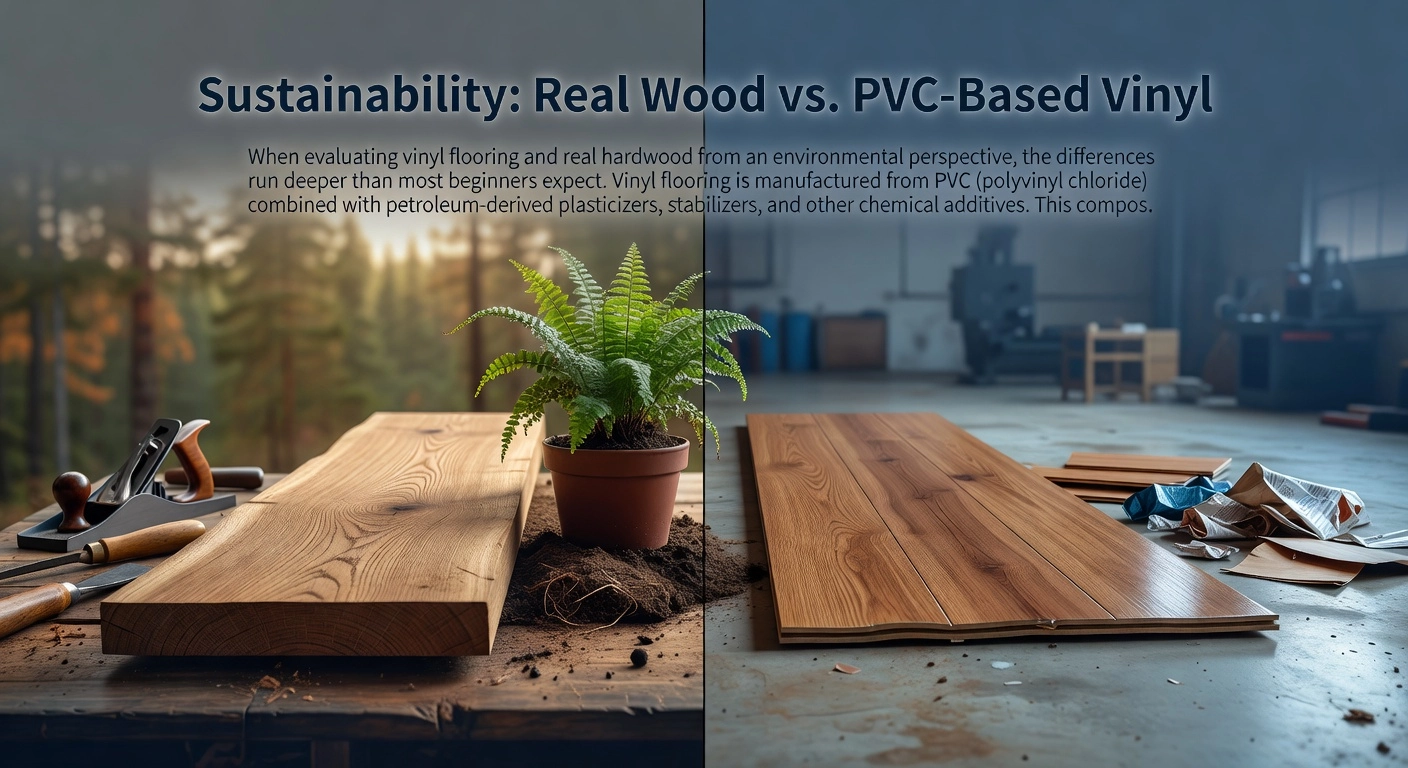
Real hardwood tells a fundamentally different story. As a renewable, biodegradable material, wood sequesters carbon during its growth phase and returns to the natural cycle at the end of its useful life without creating persistent chemical pollution. When sourced responsibly, hardwood floors carry certifications like the FSC (Forest Stewardship Council) label, which verifies that harvesting practices maintain biodiversity, prevent deforestation, and support legal and ethical forestry. Lifecycle assessments reinforce this advantage: solid hardwood typically generates roughly 9 to 12 kg CO2 equivalent per square meter over its full lifespan, compared to over 60 kg CO2 equivalent for rigid-core luxury vinyl plank, a gap of nearly seven times. You can review a detailed side-by-side breakdown of hardwood versus LVP environmental profiles to understand how these numbers translate into real-world impact.
Growing consumer awareness and regulatory pressure are pushing some vinyl manufacturers to reformulate products using recycled content, alternative polymers, or bio-based materials, and to pursue certifications such as GREENGUARD Gold or FloorScore. These are meaningful incremental steps, but PVC remains the dominant construction material across the vinyl category. Most products on the market today still carry the same fundamental sustainability limitations, regardless of how they are marketed. For a clearer look at which flooring materials carry the greatest health and environmental risks, independent research on toxic flooring materials offers useful context for health-conscious homeowners.
This is where product choices beyond the floor itself matter. Minwax offers water-based, low-VOC finishes and stains specifically designed for wood surfaces, including hardwood floors. These products reduce solvent use, minimize odor during application, and support healthier indoor air quality after installation, completing an environmentally responsible approach from the subfloor up. For homeowners weighing sustainability alongside performance and cost, authentic hardwood maintained with low-VOC care products represents a more defensible long-term choice than PVC-based vinyl. The combination of a renewable raw material, carbon storage, refinishability that extends the floor’s life across decades, and low-emission finishing products creates a full-cycle environmental advantage that reformulated vinyl products have not yet matched.
2026 Flooring Trends: Vinyl Is Imitating What Hardwood Already Is
Every dominant vinyl flooring trend heading into 2026 tells the same story: the industry is working overtime to replicate what real hardwood already delivers naturally. Warm light oak tones, greige finishes, wide-plank formats, matte textures, and herringbone patterns are all defined as the must-have looks for luxury vinyl plank this year. These are not vinyl innovations. They are direct imitations of authentic hardwood aesthetics that have defined premium interiors for generations.
Design sources confirm this pattern clearly. Decker Design highlights the sweeping shift toward honey, caramel, and warm chestnut tones in flooring, alongside herringbone layouts and wide planks with textured, matte surfaces. Carpet Exchange similarly identifies warm wood tones replacing cool grays, greige neutrals, and embossed wood-grain textures as the top LVP priorities for 2026. Both sources frame these features as ways to achieve the charm of real wood while keeping vinyl’s practical benefits. That framing itself raises an obvious and important question: if the entire industry is chasing the look of authentic hardwood, why not choose the real thing from the start?
The answer becomes even sharper when you look at what is going out of style. Glossy finishes, cool gray builder-grade planks, and heavily patterned vinyl are widely cited as outgoing trends. Designers describe these looks as cold, clinical, and prone to showing every footprint and scuff. What is replacing them are exactly the warm, high-variation, tactile aesthetics that define genuine hardwood floors. The organic depth and natural grain variation of real wood are not trends; they are what trends keep returning to.
This is where real hardwood holds an advantage that no vinyl product can close. Minwax wood stains give homeowners direct, precise control over tone, allowing you to dial in a warm white oak, a soft greige blend, or a rich natural brown that aligns perfectly with 2026’s most in-demand palette. Minwax’s 2026 Color of the Year, Special Walnut, exemplifies this; a tone that enhances the natural warmth and grain depth of real wood in ways that printed vinyl surfaces can approximate but never truly match.
Wide-plank hardwood floors finished with Minwax stains and a matte or satin topcoat deliver the exact premium aesthetic that luxury vinyl plank is engineered to imitate, with the authenticity, character, and long-term value that no synthetic alternative can replicate.
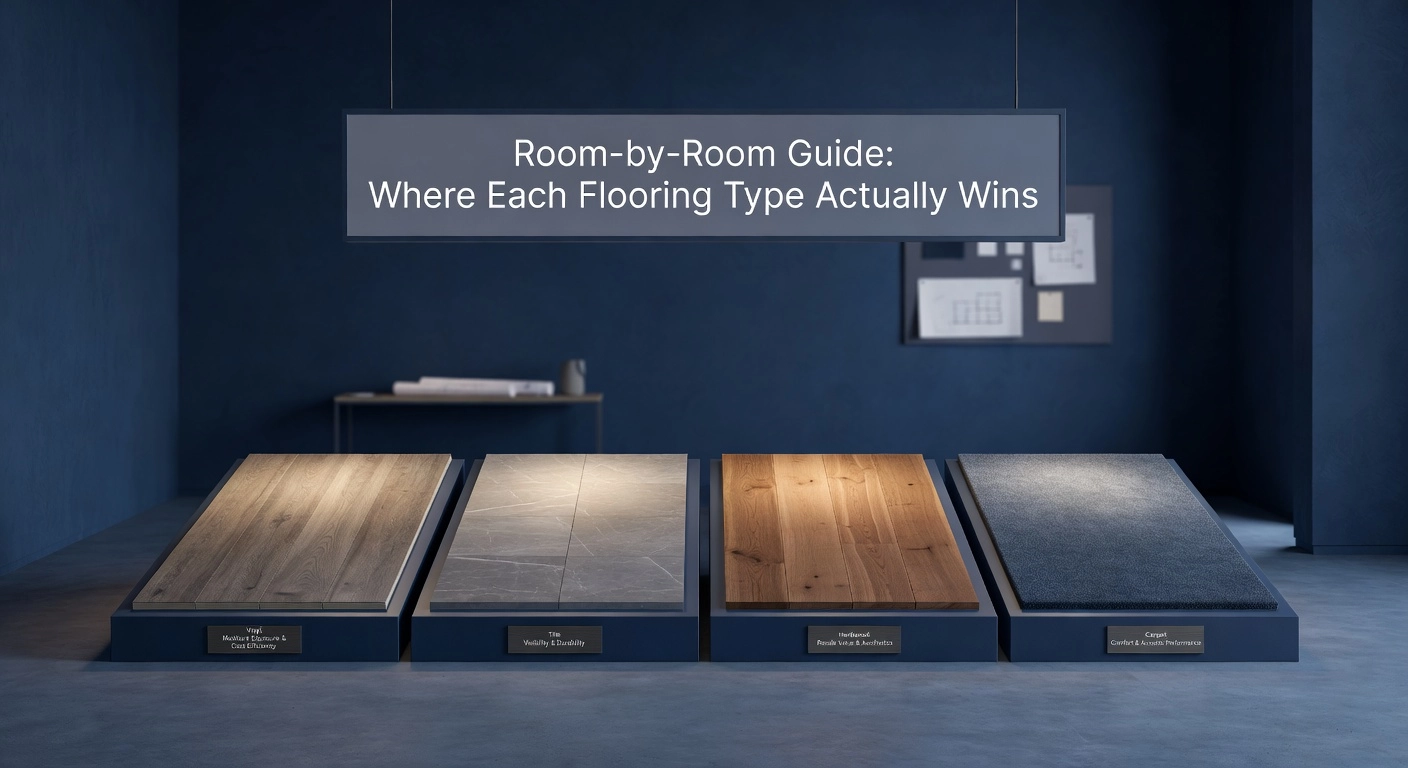
Room-by-Room Guide: Where Each Flooring Type Actually Wins
All the cost, durability, and resale data covered so far points toward the same practical question: which floor belongs in which room? The answer depends heavily on moisture exposure, visibility, and how much each space contributes to your home’s long-term value.
Wet Zones: Where Vinyl Wins Without Argument
Vinyl flooring holds a genuine, defensible advantage in bathrooms, laundry rooms, and basements. Its 100% waterproof construction, particularly in rigid-core and SPC formats, means water sitting on the surface never penetrates the core or reaches the subfloor. This protection directly prevents swelling, warping, mold growth, and mildew buildup, all of which are real risks for wood in consistently humid environments. Quality luxury vinyl plank products in these spaces carry expected lifespans of 15 to 25 years with minimal upkeep. For below-grade spaces like basements, vinyl is especially practical because it handles moisture vapor from concrete subfloors far better than any wood product can without significant added preparation.
Living Spaces: Hardwood’s Territory
Living rooms, dining rooms, bedrooms, and main hallways are where hardwood flooring earns its premium price without question. These are the high-visibility spaces that buyers walk through first, evaluate most critically, and remember longest. Hardwood’s natural grain variation, warmth, and texture create an impression that synthetic materials still cannot fully replicate, regardless of how realistic modern vinyl has become. The 70 to 80% resale ROI associated with hardwood is driven almost entirely by performance in these rooms. Wide-plank formats in warm honey oak and medium brown tones are dominant in 2026 design, and authentic hardwood delivers those aesthetics at their most credible and lasting.
Kitchens: The Nuanced Middle Ground
Kitchens require a more thoughtful decision. Hardwood performs well in most kitchen environments when it is properly finished and maintained. Prompt spill cleanup, consistent humidity control, and a high-quality protective finish keep hardwood viable even in a busy cooking space. Vinyl offers a lower-stakes alternative for households with young children, heavy pet traffic, or frequent large spills, where the waterproofing removes the margin-for-error entirely.
This is where products like Minwax® hardwood floor finishes make a meaningful difference. Applied in kitchens and other high-traffic areas, Minwax® polyurethane floor finishes create a tough, moisture-resistant surface layer that significantly extends hardwood’s performance. The added durability brings hardwood into rooms where many homeowners would otherwise default to vinyl out of caution.
The Hybrid Strategy Worth Considering
Many experienced homeowners combine both materials deliberately. Vinyl handles the wet utility zones, and authentic hardwood covers every living space where aesthetics and resale value are at stake. This approach balances practicality with long-term investment, giving each material the environment where it performs best.
Vinyl or Hardwood: How to Make the Right Call for Your Home
All the data covered throughout this guide points toward a single practical conclusion: the right flooring choice depends entirely on your specific situation, not on which material is trending.
When budget is genuinely tight and the space faces regular moisture exposure, quality rigid-core LVP is a practical, defensible choice. Kitchens, bathrooms, laundry rooms, and basements are environments where LVP’s 100% waterproof construction earns its place. This guide has never argued that vinyl is categorically wrong. In moisture-prone zones with limited budgets, LVP delivers reliable performance at a lower upfront cost and without the moisture-absorption risks that make real hardwood vulnerable in those same spaces.
For primary living areas where long-term value, authentic beauty, and resale ROI are priorities, hardwood remains the stronger investment. Real wood offers refinishability that no vinyl product can match, a lifespan that extends 50 to 100-plus years with proper care, and a consistent 70 to 80% resale ROI that outperforms vinyl’s typical returns. Buyers in most markets, particularly homes priced above $400,000, respond to authentic hardwood in ways that vinyl simply does not replicate, regardless of how realistic modern LVP visuals have become.
If you already have hardwood floors, you are sitting on an asset worth protecting. Refinishing existing hardwood typically costs $3 to $8 per square foot, compared to $7 to $15 or more per square foot for new LVP installation including labor. Maintaining your floors with products like Minwax Hardwood Floor Reviver or Minwax Hardwood Floor Cleaner restores appearance and adds a protective layer without sanding, extending the floor’s life at a fraction of replacement cost. Replacing existing hardwood with vinyl means forfeiting that investment and permanently losing refinishability.
The global vinyl flooring market is growing at a 5.5 to 6.5% CAGR through the mid-2030s, reflecting genuine consumer demand. That growth is real. However, broad market trends reflect aggregate purchasing patterns across commercial buildings, high-moisture residential zones, and budget-driven renovations; they do not define the smartest choice for your specific home.
Use this four-point framework before deciding:
- Moisture exposure: High moisture favors LVP; low to moderate moisture makes hardwood viable and often preferable
- Budget horizon: Short-term or tight budgets favor LVP on installed cost; long-term ownership of 10-plus years favors hardwood’s durability and refinishing economics
- Resale timeline: Longer ownership horizons in premium markets strongly favor hardwood’s lasting appeal and higher ROI
- Space importance: High-visibility primary living areas benefit most from hardwood; secondary and utility spaces are appropriate candidates for LVP
Assess your home honestly against each of these factors, and the right material will become clear.
The Bottom Line on Vinyl Flooring vs. Hardwood
Vinyl flooring wins on two genuinely important factors: lower upfront cost and 100% waterproof performance. In moisture-prone rooms like kitchens, bathrooms, and basements, those advantages are real and worth choosing. No serious comparison ignores them.
Hardwood, however, wins on every factor that compounds over time. A 70 to 80% resale ROI, the ability to be refinished multiple times across 50 to 100 years, authentic aesthetics no synthetic product fully replicates, and a far stronger environmental profile all favor real wood for homeowners thinking beyond the initial installation.
The single most underestimated factor in this comparison is vinyl’s replace-not-repair lifecycle. When the wear layer degrades, the entire floor gets replaced, generating cost, disruption, and waste that most buyers never factor in at purchase time. Hardwood simply gets refinished and continues performing.
For homeowners who already have hardwood, the highest-value action is straightforward: protect what you have. Regular maintenance using Minwax hardwood floor care products, including their Hardwood Floor Cleaner and Hardwood Floor Reviver, restores and preserves the finish without requiring replacement. That approach treats your hardwood as the long-term asset it genuinely is.
The practical framework is simple. Choose vinyl where moisture demands require it, then maintain every square foot of hardwood in your home with consistent, professional-grade care.
Frequently Asked Questions
Is vinyl flooring really cheaper than hardwood when you factor in long-term costs?
Vinyl flooring is cheaper upfront, typically costing $2 to $6 per square foot compared to $5 to $20 or more for hardwood. However, over a 30-year ownership period, vinyl can actually cost more due to its replace-only lifecycle. Vinyl lasts 10 to 25 years before requiring full replacement, while hardwood can last 50 to 100 years and be refinished multiple times at just $3 to $8 per square foot. Most cost analyses show hardwood becomes the more economical choice somewhere between the 15 and 25-year mark.
Can vinyl flooring be repaired if it gets scratched or damaged?
Unfortunately, vinyl flooring has very limited repair options. Minor scuffs can be addressed with cosmetic patch kits costing $15 to $150, and individual planks can sometimes be replaced, but matching discontinued patterns can be difficult and professional repairs can cost $150 to $630 or more per affected area. Once the wear layer is scratched through or fully degraded, there is no refinishing path — full replacement is the only option. Hardwood, by contrast, can be spot-repaired, re-coated, or fully sanded and refinished multiple times, giving homeowners far more control over the floor's long-term condition.
Does hardwood flooring actually increase home resale value?
Yes, hardwood flooring is one of the highest-performing interior home improvements for resale value. It delivers an estimated 70 to 80% return on investment, and according to the National Association of Realtors, new hardwood floors can recover roughly 118% of installation costs at resale, while refinishing existing hardwood recovers an even more impressive 147%. Approximately 54% of homebuyers say they would pay more for a home with hardwood floors, with average premiums ranging from $5,000 to $6,500. Luxury vinyl plank, by comparison, typically achieves only a 50 to 60% resale ROI and is still viewed by appraisers as a lower-value material, particularly in homes priced above $400,000.
Which rooms are best suited for vinyl flooring versus hardwood?
The choice largely depends on moisture exposure and how much the space contributes to your home's value. Vinyl flooring is the clear winner in bathrooms, laundry rooms, and basements because its 100% waterproof construction prevents swelling, warping, and mold that can damage wood in consistently wet environments. Hardwood is the stronger choice for living rooms, dining rooms, bedrooms, and main hallways — the high-visibility spaces that most influence buyer perception and resale value. Kitchens fall in the middle; hardwood performs well there when properly finished and maintained, but vinyl offers a lower-risk alternative for households with heavy spill exposure. Many experienced homeowners use a hybrid approach, installing vinyl in wet utility zones and hardwood throughout all primary living areas.
Is hardwood flooring more environmentally friendly than vinyl?
Yes, hardwood has a significantly better environmental profile than vinyl flooring. Vinyl is made from PVC and petroleum-derived chemicals, can off-gas VOCs that affect indoor air quality, and is not biodegradable, meaning it typically ends up in landfills at end of life. Hardwood is a renewable, biodegradable material that sequesters carbon during growth and, when sourced responsibly, can carry FSC certification verifying ethical forestry practices. Lifecycle assessments show solid hardwood generates roughly 9 to 12 kg of CO2 equivalent per square meter over its lifespan, compared to over 60 kg for rigid-core luxury vinyl plank — nearly seven times more. Pairing hardwood with low-VOC finishes, such as those offered by Minwax, further reduces environmental impact and supports healthier indoor air quality.
1 thought on “Vinyl Flooring vs. Hardwood: Which Is the Smarter Investment?”