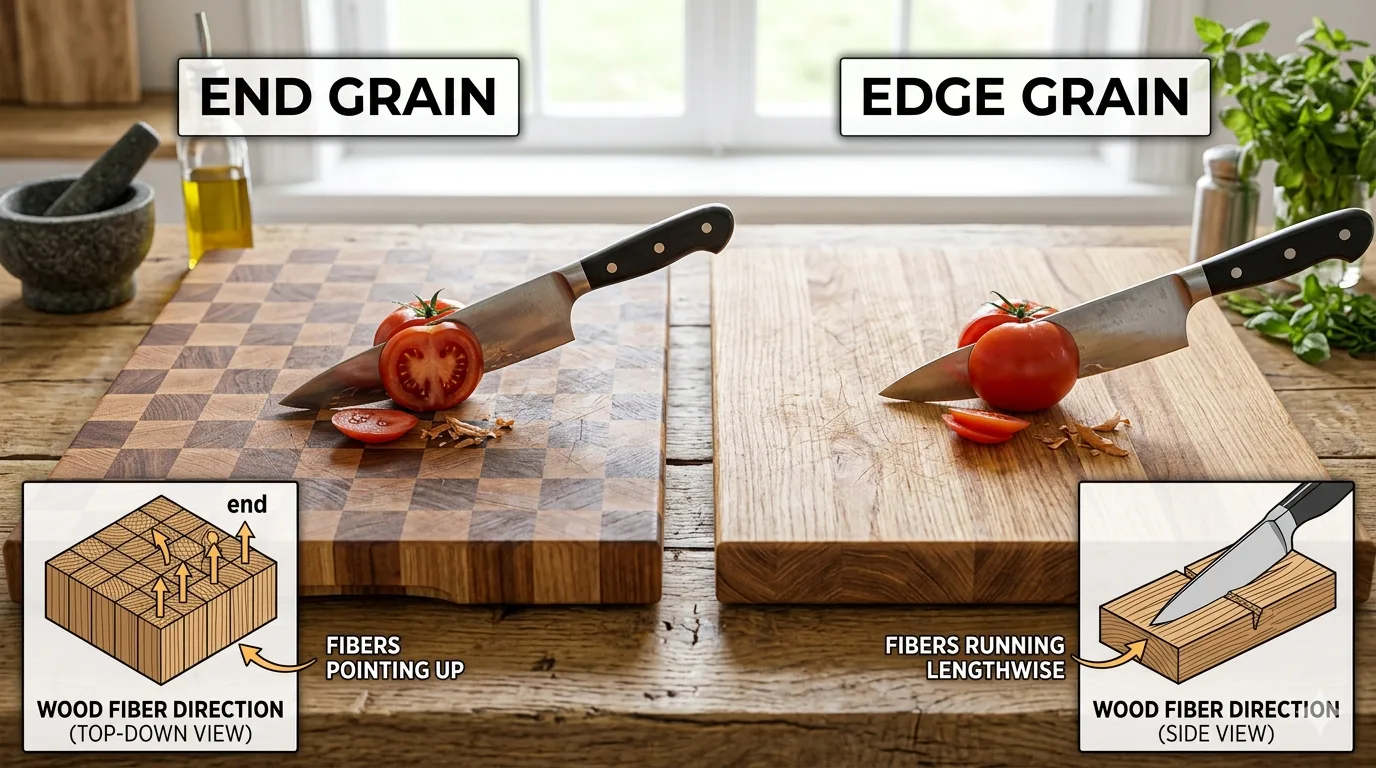
End grain vs edge grain cutting boards aren’t about “which wood type is best”. When comparing end grain vs edge grain, this is about construction method.
You can see a great example of this in the [Bevel & Bond End-Grain Maple Cutting Board]
Want to Go Deeper on Wooden Cutting Boards?
Picking between end grain and edge grain is just the start. Wood type, thickness, and finish all change how your board performs and how long it lasts. For the full breakdown of everything from maple vs walnut to oil types and daily care, check our complete guide to wooden cutting boards.
If you want a second opinion from a woodworking pro, Fine Woodworking has a detailed technical guide on why end grain construction is favored for butcher blocks. Their tests show the same 3x knife-friendliness we mentioned above.
End grain boards are made from wood ends glued together. Edge grain uses the long side of boards. The difference? End grain is 3x more knife-friendly but costs 2x more.
For the full breakdown of maple vs walnut vs cherry wood types, read our guide on the best wood for cutting boards.
Quick Answer: End Grain vs Edge Grain
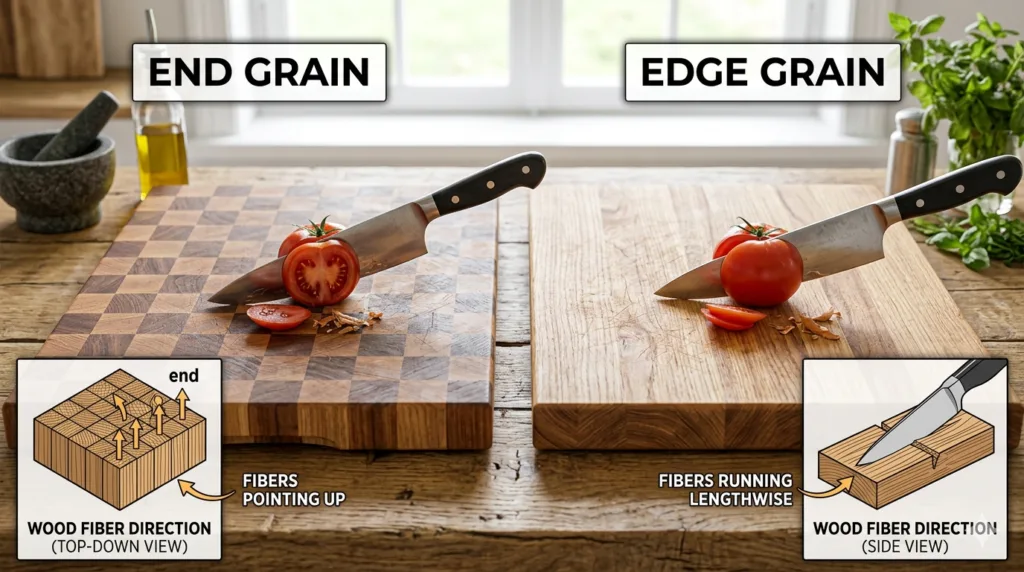
End grain wins for knife care and durability. The wood fibers act like a brush, letting knives slide between them. Edge grain wins for price and easy maintenance. It’s 40-60% cheaper and easier to sand flat. Pick end grain if you own expensive knives. Pick edge grain for best value.
End Grain vs Edge Grain: 5 Key Tests
| Feature | End Grain | Edge Grain | Winner |
|---|---|---|---|
| Knife Friendliness | Best. Fibers close up after cut | Good. Harder on knife edge | End Grain |
| Durability | Self-healing. 10-15 years | Shows cuts. 5-8 years | End Grain |
| Price | $120-$400. Labor intensive | $40-$150. Easier to make | Edge Grain |
| Maintenance | Needs more oiling, warps easier | Simple to oil and sand | Edge Grain |
| Weight | Very heavy, 2-3x thicker | Lighter, easier to move | Edge Grain |
What Is End Grain Cutting Board?
End grain boards are made by gluing wood pieces with the end fibers facing up. Think of it like a bundle of straws. When you cut, the knife goes between the fibers instead of across them. This is why butcher blocks use end grain. It’s self-healing and gentle on knives.
Best for: Professional chefs, expensive knives, heavy daily use.
What Is Edge Grain Cutting Board?
Edge grain boards glue long strips of wood with the grain running lengthwise. It’s the most common type you see on Amazon. The knife cuts across the wood fibers, so it dulls faster. But it’s cheaper, lighter, and won’t warp as easily.
Best for: Home cooks, tight budgets, easy maintenance.
End Grain Pros and Cons
Pros:
- Extremely gentle on knives. Keeps edges sharp 3x longer
- Self-healing surface. Cut marks disappear over time
- Thick and heavy. Won’t slide on counter
- Premium butcher block look
Cons:
-
- 2-4x more expensive than edge grain
- Needs oiling every 2-3 weeks or it cracks
Important: End grain boards trap food particles and bacteria deep between the fibers. You must use a proper deep cleaning and disinfecting routine after cutting raw meat, or the self-healing surface becomes a health hazard. Oiling a dirty board seals in the bacteria.
- Heavy. Hard to wash in sink
Edge Grain Pros and Cons
Pros:
- Best value. 50% cheaper for same size
- Lighter and easier to handle daily
- Less maintenance. Oil once per month
- Won’t warp as easily
Cons:
- Shows knife marks permanently
- Harder on knife edges. Sharpen more often
- Shorter lifespan, 5-8 years vs 15 years
Which Should You Buy?
Buy end grain if: You spent $200+ on chef knives, you cook daily, and you want a board that lasts 15 years. It’s the best long-term investment for serious cooks.
Buy edge grain if: You want the best value, you cook 3-4 times per week, or you need a lighter board. It’s 90% as good for 50% of the price.
Want to choose the right wood too? Read our Walnut vs Maple Cutting Board test and Best Wood for Cutting Boards guide.
FAQs: End Grain vs Edge Grain
1. Is end grain or edge grain better for knives?
End grain is much better. The knife slides between wood fibers instead of cutting them. Tests show knives stay sharp 3x longer on end grain.
2. Why is end grain so expensive?
It uses 30% more wood and takes 4x longer to make. Each piece has to be cut, flipped, and glued carefully to prevent splitting.
3. Can I put an end grain board in dishwasher?
Never. Both types will crack and warp. Hand wash only, then oil. Edge grain survives water better, but dishwashers kill both.
4. Which is more sanitary, end grain or edge grain?
Both are safe if oiled properly. USDA studies show end grain actually traps bacteria in the fibers where they die off, while edge grain scratches hold bacteria on surface.
One of the most annoying kitchen cleaning problems is grime stuck between oven door glass panels. You can’t just wipe it like a normal surface. The safest DIY trick is using a wire hanger wrapped in a microfiber cloth with vinegar and water. We broke down the full method here: how to clean oven door glass between panels.
If your oven model doesn’t have bottom vents or the stains are baked-on, Family Handyman shows how to safely remove the door for a deep clean. Just check your warranty first before taking anything apart.
You can see a great example of this in the [Bevel & Bond End-Grain Maple Cutting Board]
4 thoughts on “End Grain vs Edge Grain Cutting Board: Which Is Better ?”