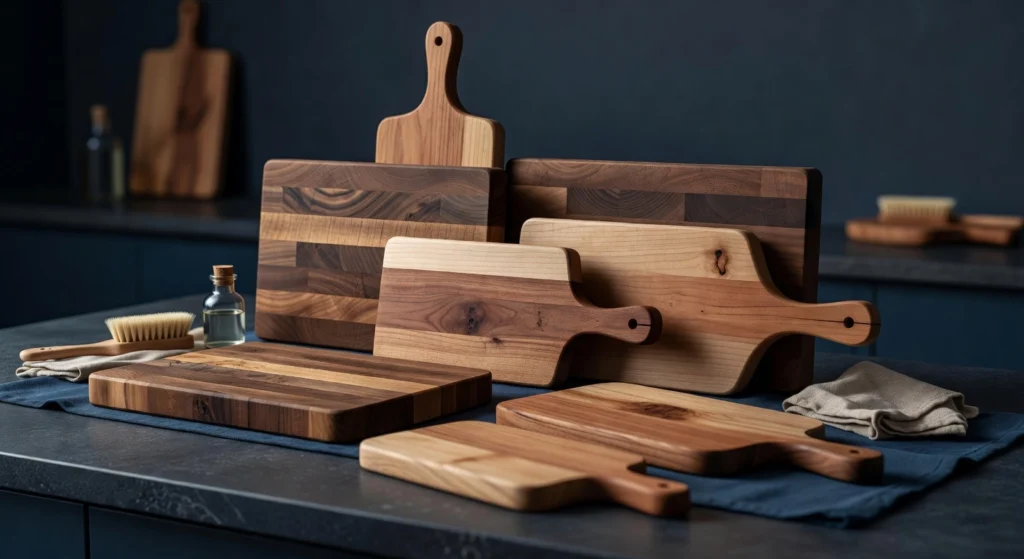

Every great meal starts long before the first ingredient hits the pan. It starts on your cutting surface. If you have ever struggled with a slipping plastic board, dulled your favorite knife on a glass surface, or simply wondered what all the fuss is about, a wooden chopping board might be exactly what your kitchen needs.
A wooden chopping board is one of the most timeless and practical tools a home cook can own. It protects your knife edges, provides a stable cutting surface, and brings a natural warmth to any kitchen setup. But with so many options available, knowing which board to buy and how to care for it properly can feel overwhelming, especially if you are just getting started.
That is exactly why we put this guide together. Whether you are buying your very first board or looking to upgrade, this complete guide covers everything you need to know. From the best wood types and sizes to cleaning tips and maintenance routines, you will walk away with the confidence to choose the right board and keep it in great condition for years to come.
Why Wooden Chopping Boards Beat Plastic in 2026
If you have ever wondered whether it is time to ditch your plastic cutting board, the evidence in 2026 points firmly toward wood. Here are five compelling reasons why wooden chopping boards have earned their place as the superior choice in modern kitchens.
1. Microplastics Concerns Are Pushing Consumers Away from Plastic
Research has shown that plastic cutting boards can shed hundreds of microplastic particles with every knife stroke, with estimates suggesting regular users may ingest grams of microplastics annually just from chopping. The Guardian published a dedicated 2026 guide to plastic-free cutting boards, recommending wood as a top alternative precisely because it does not contaminate your food with synthetic particles. Studies published in peer-reviewed journals confirm that scratched and worn plastic surfaces worsen shedding significantly over time. Switching to a hardwood board eliminates this concern entirely, making it an easy, practical upgrade for health-conscious home cooks.
2. Natural Antimicrobial Properties Work in Your Favor
Closed-grain hardwoods like maple have a dense structure that limits moisture absorption and prevents deep groove formation, both of which are primary hiding spots for bacteria. Research indicates that bacteria introduced onto hardwood surfaces decline notably over time, with well-maintained maple boards performing comparably to or better than plastic in real-world hygiene tests. The key phrase here is “well-maintained,” meaning regular hand-washing and monthly oiling are essential to keeping those natural properties active.
3. Wood Protects Your Knife Edges
A wooden board absorbs the impact of each cut rather than pushing back against the blade. Hard plastic and glass deflect the edge, accelerating dulling. Professional testers consistently confirm that wooden boards, particularly end-grain constructions, preserve sharpness noticeably longer during everyday use.
4. Beauty and Versatility Command Premium Value
Wooden boards double effortlessly as charcuterie and serving boards, a trend driving strong consumer demand and premium pricing in 2026. Personalized and engraved versions command 30 to 50 percent price premiums, reflecting how much buyers value aesthetics alongside function.
5. Market Data Confirms Sustained Consumer Preference
Wood holds approximately 36 to 43 percent of the global cutting board market, estimated at roughly $1.38 billion in 2025. That dominance is not accidental; it reflects decades of home cooks choosing durability, knife-friendliness, and natural beauty over cheaper alternatives.
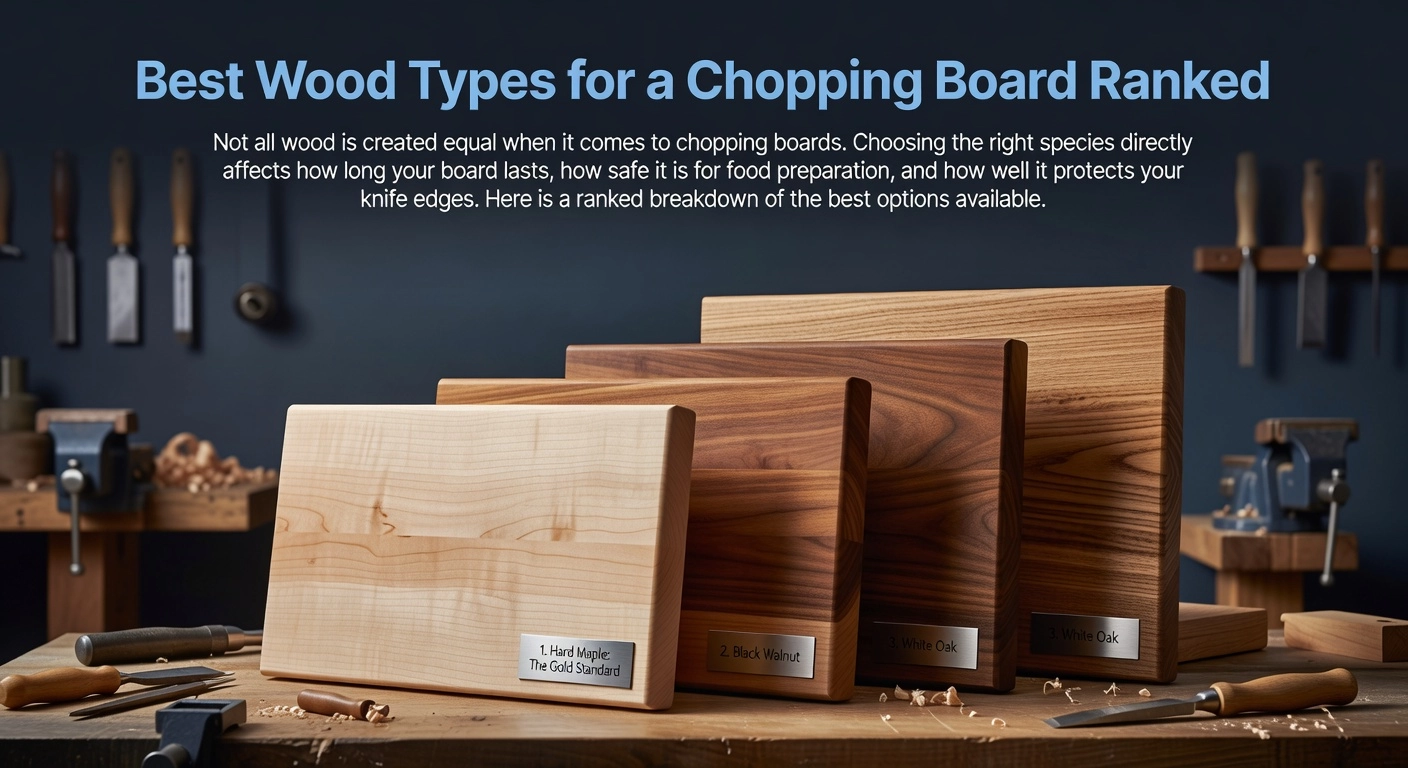
Best Wood Types for a Chopping Board Ranked
Not all wood is created equal when it comes to chopping boards. Choosing the right species directly affects how long your board lasts, how safe it is for food preparation, and how well it protects your knife edges. Here is a ranked breakdown of the best options available.
1. Hard Maple: The Gold Standard
Hard maple earns the top spot for good reason. With a Janka hardness rating of approximately 1,450, it sits in the sweet spot between durability and knife friendliness. It is tough enough to resist deep gouges and scarring from daily use, yet not so hard that it aggressively dulls your blades. Its tight, closed-grain structure is the key feature that sets it apart from softer woods. That dense grain minimizes water absorption, which reduces the risk of warping and makes it far less hospitable to bacteria. Hard maple also exhibits natural antimicrobial properties, which is why it has been the commercial kitchen and butcher-block standard for decades. According to Wirecutter’s 2026 cutting board guide, domestic hard maple boards consistently outperform other materials in real-world testing. For beginners investing in their first quality wooden chopping board, maple is the safest, most reliable choice.
2. Black Walnut: Premium Aesthetics with Performance
Black walnut scores around 1,010 on the Janka scale, making it slightly softer than maple and noticeably gentler on knife edges. If preserving your knife’s sharpness is a priority, walnut offers a real advantage. Beyond performance, its rich, dark grain makes it one of the most visually striking options available, and that deep color does an excellent job of hiding everyday stains and discoloration. Walnut contains natural oils that contribute some moisture resistance, and research has shown it performs comparably to maple in inhibiting bacterial growth. The trade-offs are a higher purchase price and the need for slightly more frequent oiling to keep the wood properly conditioned. As Serious Eats’ wooden cutting board testing confirms, walnut is a top-tier performer that justifies its premium positioning.
3. Cherry Wood: Character and Warmth Over Time
Cherry wood sits at approximately 950 on the Janka scale, placing it firmly in the softer end of suitable hardwoods. It is gentle on knife edges and develops a warm, reddish-brown patina with use that many home cooks find genuinely beautiful. The visual character it builds over time gives cherry boards an appeal that harder woods cannot replicate. The downside is that it shows cut marks more readily and dries out faster than maple or walnut, meaning you should plan to oil it every four to five weeks rather than monthly. For someone who prioritizes aesthetics and treats their board with consistent care, cherry is a rewarding choice.
4. Teak: Water-Resistant but With a Catch
Teak has a Janka rating of around 1,070 and offers exceptional natural water resistance thanks to its high oil content, which historically made it a shipbuilding staple. In a humid kitchen environment, that moisture resistance reduces maintenance demands. However, teak often contains silica within its fibers, and silica dulls knife edges considerably faster than maple or walnut will. It is a genuine trade-off: easier moisture management versus more frequent knife sharpening. Teak is a reasonable choice if water resistance is your primary concern, but it is not the optimal all-around performer.
5. Woods to Avoid: Pine and Oak
Open-grained softwoods and ring-porous hardwoods like pine and oak are poor choices for a wooden chopping board. Their visible pores and open grain structure trap food debris and bacteria, creating hygiene risks that thorough cleaning cannot fully address. Low hardness scores mean knives cut deep grooves into the surface quickly, and those grooves become permanent harbors for pathogens. Pine also contains resins that can affect the flavor of food. Avoid these species entirely for any food-contact cutting surface.
6. Beech: The Budget-Friendly European Option
Beech wood offers a compelling entry point for budget-conscious buyers. With a Janka hardness of around 1,300 and a tight, closed grain, it delivers adequate performance for everyday kitchen tasks. It is the dominant material in European kitchen boards for good reason: it is widely available, affordable, and genuinely functional. Beech is more prone to cracking over time compared to maple, and it lacks the visual appeal of walnut or cherry. However, for a beginner seeking a capable, no-frills wooden chopping board without the premium price tag, beech is a sensible and well-proven starting point.
End-Grain vs. Edge-Grain vs. Face-Grain Boards Explained
Once you understand which wood species to choose, the next decision is how that wood is cut and assembled into your board. The three construction styles available, end-grain, edge-grain, and face-grain, each behave very differently under a knife, and choosing the wrong one for your needs is one of the most common beginner mistakes.
1. End-Grain: The Premium Self-Healing Choice
End-grain boards are built by cutting wood into short blocks and gluing them together so the cross-section of each piece faces upward. Think of wood fibers as a bundle of drinking straws running the length of a tree. With end-grain construction, your knife is slipping down between those straws rather than slicing across them. The fibers part, then spring back closed after each cut, which is why end-grain boards are described as self-healing. This property significantly reduces visible knife marks over time and preserves your blade’s edge far longer than other board types. End-grain is the undisputed premium choice for serious home cooks who prioritize both knife longevity and board lifespan.
There is a meaningful trade-off to understand, however. Because end-grain exposes far more porous wood surface area, these boards absorb conditioning oil much more aggressively than other types. One independent test found end-grain absorbing roughly 26 grams of conditioner compared to just 6 grams for a comparable edge-grain board. That means you will need to oil an end-grain board more frequently, and use more product per session, to prevent drying and cracking. End-grain boards are also noticeably heavier due to their block construction, so handling and storage require a bit more consideration.
2. Edge-Grain: The Best Value for Most Home Cooks
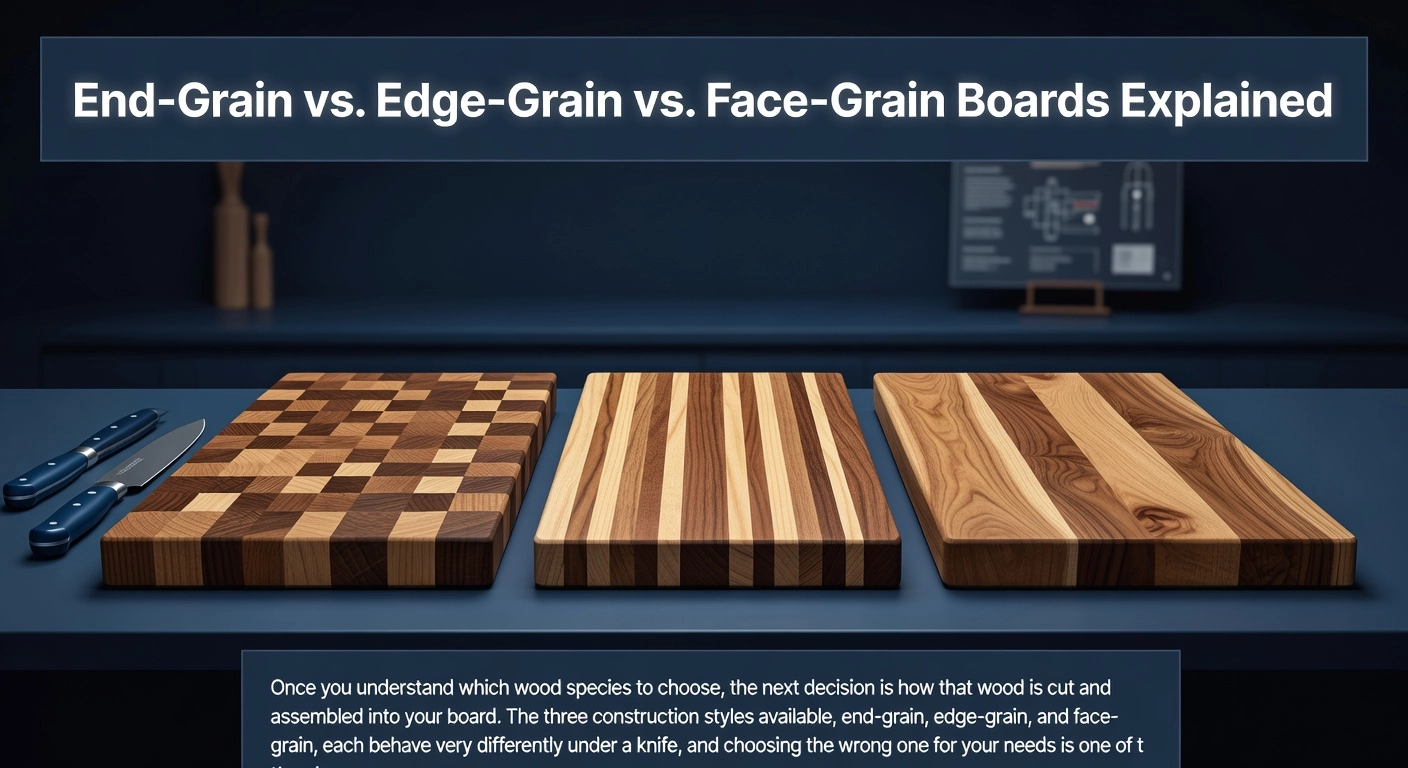
Edge-grain boards are constructed by gluing long planks together so the narrow edge of each plank faces upward. The wood fibers still run parallel to the surface, but you are cutting across a harder, more compact face. This creates a firm and stable cutting surface that handles daily prep work reliably. Edge-grain boards will accumulate knife marks faster than end-grain, but they remain durable, easier to maintain, and considerably more affordable. Quality edge-grain boards regularly fall in the $50 to $150 range, making them the practical sweet spot for everyday kitchen use. Their lower oil absorption also means a simpler monthly maintenance routine.
3. Face-Grain: Reserve This for Serving Only
Face-grain boards, sometimes called flat-grain boards, orient the wide, flat surface of a plank as the cutting face. This is the construction you most often see in thin, inexpensive boards or decorative serving pieces. Because the knife strikes directly across wood fibers rather than slipping between them, cuts accumulate visibly and quickly. Moisture absorption is also highest with face-grain construction, raising the risk of warping and cracking over time. Face-grain boards are genuinely not suited for regular chopping tasks.
4. Matching Board Type to Task
Choosing the right board for the right job makes a real difference in your kitchen workflow. Use this practical breakdown as your guide:
- End-grain boards: Best for daily protein preparation including raw meat, poultry, and fish, plus any knife-heavy work where edge retention matters most.
- Edge-grain boards: The ideal all-purpose board for everyday vegetable chopping, general meal prep, and mixed-use cooking tasks.
- Face-grain boards: Reserved strictly for light serving duty such as cheese, charcuterie, bread, or presentation purposes. Do not use them as your primary cutting surface.
Understanding these three constructions removes much of the confusion when shopping for your first quality wooden chopping board and sets you up to buy something that genuinely suits your cooking habits.
What to Look For When Buying a Wooden Chopping Board
Now that you understand wood types and grain construction, the next step is translating that knowledge into a smart purchase decision. Here are six key factors every beginner should evaluate before buying a wooden chopping board.
1. Choose the Right Thickness for Your Needs
Thickness is one of the most overlooked factors when buying a wooden chopping board, yet it directly determines how well your board resists warping over time. Boards thinner than three-quarters of an inch are particularly vulnerable because the wood has less mass to counteract the expansion and contraction caused by moisture and temperature changes. For daily home use, aim for a minimum of one inch thick, which provides enough rigidity and weight to stay stable on the counter while you work. If you are investing in an end-grain board, go thicker still. The ideal range for end-grain construction is 1.5 to 2 inches, which adds heft, extends the lifespan of the board, and gives you more material to sand down during future restorations.
2. Match Board Size to How You Actually Cook
A board that is too small creates frustration; one that is too large becomes a storage headache. For most home cooks handling everyday prep like vegetables, fruit, bread, and smaller cuts of meat, a 12 by 18 inch board is the sweet spot. It offers enough workspace without dominating a standard kitchen counter. If you regularly break down whole chickens, large roasts, or multiple ingredients at once, step up to an 18 by 24 inch board. According to Food and Wine’s testing of the best wooden cutting boards, larger boards provide the generous workspace that serious home cooks genuinely rely on during ambitious meal prep sessions.
3. Look for FSC Certification, Especially on Teak Boards
Sustainability credentials have become a meaningful purchasing factor in 2026, particularly for teak. FSC (Forest Stewardship Council) certification confirms that the wood was harvested from responsibly managed forests with transparent supply chains. This matters more for teak than for domestic hardwoods like maple because teak sourcing varies widely, with some suppliers using well-managed plantations and others offering far less transparency. When evaluating teak boards specifically, look for clear FSC labeling and information about the country of origin. Brands that volunteer this information upfront are generally a safer and more ethical choice.
4. Understand Which Brands Lead in 2026
If you want a reliable starting point, three brands consistently top expert recommendations. John Boos maple boards appear most frequently across 2026 roundups from Wirecutter, Serious Eats, and Bon Appetit, earning praise for durability, knife performance, and professional-grade quality at accessible prices. For teak specifically, Teakhaus leads the category with FSC-certified boards that balance water resistance with everyday practicality. At the premium end, The Boardsmith crafts thick end-grain hardwood boards that reviewers consistently describe as heirloom-quality investments. According to Yahoo Shopping’s best cutting board guide, these established names repeatedly outperform lesser-known alternatives in real-world testing.
5. Weigh the Pros and Cons of Juice Grooves
Juice grooves are shallow channels carved around the board’s perimeter, designed to catch liquids when you are carving meat or slicing juicy produce. They genuinely reduce mess and make cleanup easier during food prep. However, they introduce a maintenance complication that beginners should understand upfront. Those grooves trap oil unevenly during your monthly conditioning routine, making it harder to apply mineral oil consistently across the entire surface. They also complicate sanding during restoration because the groove requires extra attention to avoid uneven results. Juice grooves are worth having if you prep proteins regularly, but factor in the added care time before deciding.
6. Avoid Paying a Premium for Personalization Alone
Personalized and engraved wooden boards are popular gifts and look beautiful on a kitchen counter. However, they typically command 30 to 50 percent higher prices compared to identical unengravd boards, offering zero functional benefit in return. The wood species, thickness, grain construction, and ongoing maintenance routine are what determine how well your board performs and how long it lasts. If personalization matters to you for gifting or aesthetics, go ahead, but make sure you are first satisfied with the underlying board quality before factoring in the customization cost.
How to Care for a Wooden Chopping Board Step by Step
A quality wooden chopping board is only as good as the care routine behind it. With consistent maintenance, a well-made hardwood board can last 10 years or more, making these six steps one of the best investments of time you can make in your kitchen.
1. Clean It the Right Way Every Day
Wash your wooden chopping board immediately after use with hot, soapy water and a stiff brush or sponge. Do not let food residue sit on the surface, as this allows bacteria to take hold in surface grooves. Critically, wash both sides and all edges every single time, not just the cutting surface. When only one side absorbs moisture, the wood swells unevenly and warps over time, leaving you with a board that rocks on the countertop and becomes unsafe to use. Never soak your board in a sink full of water, and never put it in the dishwasher. The prolonged heat and moisture exposure from dishwasher cycles is one of the fastest ways to crack, split, or delaminate a wooden board beyond repair.
2. Dry It Thoroughly and Evenly
After washing, pat the board down immediately with a clean kitchen towel to remove surface moisture. Then stand the board upright on its edge, either propped against a wall or placed in a drying rack, so that air can circulate freely around both sides at the same time. Laying the board flat on a countertop traps moisture against one face, which creates the same uneven warping risk you were avoiding during washing. Give the board at least an hour of upright air drying before storing it.
3. Follow a Consistent Oiling Schedule
Before you use a new wooden chopping board for the first time, apply food-grade mineral oil generously to all surfaces, including the sides and bottom. Mineral oil in USP or pharmaceutical grade is the correct choice because it is odorless, flavorless, completely food-safe, and will not go rancid inside the wood. Rub it in with a clean cloth or paper towel, allow it to soak in overnight, then wipe away any excess the next morning. After that initial conditioning, oil your board once a month as a standard routine, or more frequently if the board sees heavy daily use or begins to look dry and pale. Never substitute cooking oils such as olive oil, vegetable oil, or coconut oil. These oils oxidize and go rancid inside the wood grain over time, producing unpleasant odors and potentially tainting food flavor.
4. Apply Board Cream After Oiling
Mineral oil alone hydrates the wood, but a beeswax and mineral oil board cream seals that hydration in. After your monthly oil application has been absorbed, apply a thin, even layer of board cream across all surfaces using a cloth or paper towel. The beeswax component forms a light protective barrier that repels moisture, resists staining from food pigments like beet juice or turmeric, and reduces the risk of surface cracking. Let the cream sit for 20 to 30 minutes, then buff away any excess. This two-step combination, oil followed by cream, is widely recommended by woodworking and kitchen authorities as the most effective conditioning method available for home use.
5. Deodorize and Remove Light Stains Naturally
Garlic, onion, raw fish, and deeply pigmented foods all leave their mark on wooden boards over time. To address odors and surface stains without resorting to harsh chemical cleaners, sprinkle coarse kosher salt or sea salt across the board surface, then use the cut face of a halved lemon to scrub in firm circular motions. The salt acts as a gentle abrasive while the lemon juice works to break down odor compounds and lift surface discoloration. Leave the mixture on the board for around five minutes before scraping it off, rinsing the board, and drying it straight away. For additional odor neutralization, wipe the board down with a solution of equal parts white vinegar and water. Both methods are gentle enough for regular use and will not strip the oil conditioning you have already applied.
6. Store It Away From Heat
Where and how you store your wooden chopping board matters more than most beginners realize. Store the board flat on a clean, dry countertop surface or upright in a ventilated rack. The single most important storage rule is to keep it away from heat sources. Positioning a board next to a stovetop burner, directly above a dishwasher vent, or near a radiator exposes the wood to repeated cycles of rapid drying that accelerate cracking and splitting significantly. Consistent temperature and low ambient humidity are the ideal conditions for long-term storage, and following this principle alone can add years to your board’s lifespan.
Common Mistakes That Damage Wooden Chopping Boards
Even with the right wood species and a quality board in hand, the way you treat it day to day determines whether it lasts a decade or falls apart within a year. These six mistakes are the most common reasons wooden chopping boards warp, crack, smell, and fail prematurely.
1. Using Cooking Oils Instead of Food-Grade Mineral Oil
Reaching for the olive oil or coconut oil sitting on your counter might seem like a logical way to condition your board, but it is one of the most damaging habits you can develop. Cooking oils contain organic compounds that oxidize when exposed to air and warmth inside the wood fibers. Over time, this oxidation turns the oil rancid, producing sour, stale odors that no amount of scrubbing will fully eliminate. The degraded oil also breaks down the structural integrity of the fibers themselves and creates an environment where bacteria can thrive. Always use food-grade mineral oil, which is completely inert, odorless, and does not spoil. Understanding how to treat and protect your wood cutting board starts with choosing the right oil, and mineral oil is the only correct answer.
2. Soaking the Board or Leaving It Submerged
Wood is hygroscopic, meaning it actively pulls moisture from its surroundings. When you leave a board sitting in a sink full of water, even for 20 to 30 minutes, the fibers on the submerged face absorb significantly more moisture than the opposite side. As the board dries, that uneven expansion creates internal stress that causes warping, bowing, and cracking along glue joints. Quick hand-washing with warm, soapy water followed by immediate towel drying is all your board needs. Never let it sit in standing water under any circumstances.
3. Putting the Board in the Dishwasher
A single dishwasher cycle can permanently ruin a wooden chopping board. Dishwashers combine prolonged water exposure, temperatures that often exceed 140 degrees Fahrenheit, pressurized steam, and harsh detergent chemistry. Together, these forces strip every trace of protective oil from the wood, force rapid and extreme swelling of the fibers, and then hit the board with intense dry-cycle heat. The result is almost always irreversible warping, splitting along the grain, or delamination of glued joints. According to common cutting board mistakes you are probably making, the dishwasher is consistently cited as the fastest way to destroy an otherwise quality board. Hand-washing is mandatory, not optional.
4. Oiling Only One Side
This mistake surprises many beginners because the logic of “I only cut on the top” seems reasonable. In reality, wood absorbs and releases moisture through all of its surfaces simultaneously. When you oil only the top face, that side stays hydrated and stable while the untreated bottom dries out and contracts. The resulting difference in moisture content between the two faces causes the board to cup, curving upward at the edges like a shallow bowl. The three mistakes that warp wooden cutting boards consistently include uneven oiling as a primary culprit. Always oil all surfaces evenly, including the bottom, sides, and any handle areas.
5. Using Bleach or Abrasive Chemical Cleaners
Bleach and harsh chemical sanitizers are too aggressive for wood. They strip the natural oils that keep the grain tight and compact, essentially opening up the surface at a microscopic level. An open grain is a more porous grain, which means bacteria, food stains, and excess moisture can penetrate more deeply on the very next use. Bleach can also discolor hardwoods and weaken the surface fibers over repeated applications. For sanitizing, a diluted white vinegar solution or a salt-and-lemon scrub provides effective, gentle cleaning without the structural damage.
6. Skipping the Initial Seasoning Before First Use
A new board shipped from a manufacturer is typically very dry and highly porous. Putting it straight to work without seasoning means the first time you rinse it, water and food juices absorb unevenly into the bare wood. This uneven moisture uptake from the very first wash sets the stage for warping and cracking that becomes progressively worse with each use. Before you cut anything, apply two to three generous coats of food-grade mineral oil, allowing each coat to absorb fully before adding the next. This initial seasoning creates the protective foundation that all future maintenance builds upon.
Are Wooden Chopping Boards Actually Safe? The Bacteria Question Answered
The safety of wooden chopping boards is one of the most misunderstood topics in home kitchens, and the science here is worth knowing. Research from UC Davis food scientist Dean Cliver and colleagues established a foundational finding that changed how food safety experts think about cutting surfaces. When bacteria were applied to hard maple boards, including boards that already had knife cuts, the bacteria were drawn into the wood fibers through capillary action. Once inside, they did not multiply. They gradually died off as the board dried. The same pathogens tested on plastic surfaces, including E. coli O157:H7, Salmonella, and Listeria, told a very different story.
Why Wood Species and Grain Type Are the Critical Variables
Not every wooden board offers this protection, and this is where beginners often get confused. The antimicrobial behavior described above applies specifically to closed-grain hardwoods like hard maple. The tight, dense grain structure creates fine channels that pull bacteria inward and trap them, where desiccation eventually kills them. Open-grain woods like pine or oak behave differently. Their larger pores and tendency to develop surface grooves mean bacteria are not trapped and neutralized in the same way. This is one more reason why choosing the right wood species, as covered earlier in this guide, directly affects food safety and not just durability.
The Problem With Plastic Boards Over Time
Plastic boards appear clean and clinical when new, but every knife stroke leaves a micro-scar on the surface. Over months of use, these grooves accumulate into channels deep enough to trap food particles and bacteria in spaces that ordinary washing with hot soapy water cannot fully reach. This is a core finding from the Cliver research and is a key driver behind the growing consumer shift toward wood in 2025 and 2026. Standard home washing simply cannot sanitize heavily scarred plastic the way it can a smooth hardwood surface.
Practical Safety Habits That Matter More Than Material
Regardless of which board you use, cross-contamination is the most common real-world kitchen risk. Use separate boards for raw meat and ready-to-eat produce. This practice eliminates the most significant food safety hazard in home cooking, no matter what your board is made of.
When a plastic board becomes heavily scarred, standard food safety guidance is to replace it entirely. A well-maintained wooden board offers a different option: sanding the surface removes the worn layer, and re-seasoning with food-grade mineral oil restores a clean, protected surface. This is both more economical and more sustainable over time.
Proper drying remains the single most important step for wooden board safety. Bacteria require moisture to survive on any surface. After washing, stand your board upright or prop it at an angle to allow full air circulation on both sides. A board left flat and wet is the only condition in which bacteria can persist, and eliminating that moisture eliminates the risk.
How Long Does a Wooden Chopping Board Last with Proper Care
Quality hardwood boards earn their reputation through longevity. A well-maintained hard maple, walnut, or cherry board, oiled monthly and washed by hand, routinely lasts 10 years or more. Many home cooks report boards lasting 20 to 30 years, and some family heirlooms pass between generations still in excellent condition. Plastic boards, by contrast, typically need replacement every one to two years as knife grooves accumulate, surfaces stain permanently, and the material degrades. That difference in lifespan transforms what looks like a higher upfront cost into a genuinely economical long-term choice.
Recognizing When to Resurface Rather Than Replace
Before you consider throwing out an aging board, check whether it simply needs resurfacing. The three clearest signs are deep knife grooves that trap food and resist cleaning, persistent dark staining or discoloration that soap and salt scrubs cannot lift, and raised grain that stays rough and uneven even after a thorough oiling session. These problems look serious but are almost always fixable at home without professional tools.
The resurfacing process is straightforward. Start with 80-grit sandpaper to cut through the damaged surface layer, always moving with the wood grain rather than across it. Progress to 120-grit to smooth the roughness left by the coarser paper, then finish with 220-grit for a clean, kitchen-ready surface. Wipe away all dust between each grit change. Once sanding is complete, apply multiple coats of food-grade mineral oil, allowing each coat to absorb fully, ideally overnight, before adding the next. The board should receive at least three to four oil applications before returning to use. This process can restore a board to near-new condition and is typically only needed every year or two with consistent routine care.
Fixing Warps and Understanding Their Limits
Warping is another problem that looks worse than it often is when caught early. If your board has developed a cup shape, wet the concave side thoroughly with a damp cloth, then place the board concave-side down and stack weight evenly across it while it dries. The moisture differential gradually coaxes the wood back toward flat. Severe warps in laminated or glued boards, however, may be structurally irreversible. Prevention remains the best strategy: always dry both sides evenly, store the board upright or flat with airflow on all surfaces, and maintain consistent oiling so the wood never dries unevenly in the first place.
The Long-Term Cost and Sustainability Case
The financial argument for investing in quality is straightforward. A hard maple end-grain board priced between $100 and $150, maintained properly, outlasts five to ten $20 plastic boards over the same period. Beyond cost, a 2023 study published in Environmental Science and Technology estimated that plastic cutting boards release millions of microplastic particles annually into food during normal use, a problem that wooden boards simply do not create. Wood can be sanded, re-seasoned, and returned to service rather than sent to landfill.
The sustainability picture reinforces this further. A single hardwood board sourced from FSC-certified forests, maintained for a decade or more, carries a substantially lower lifetime environmental footprint than repeatedly manufacturing, distributing, and disposing of plastic alternatives. FSC certification ensures the timber comes from responsibly managed forests that protect biodiversity and limit deforestation. At the end of its life, a wooden board is biodegradable. Sanding dust and wood scraps can even be composted. Choosing quality wood and committing to basic maintenance is one of the simplest ways to make a kitchen more sustainable without sacrificing performance.
Wooden Chopping Board FAQs
Here are the most common questions beginners ask about wooden chopping boards, answered clearly and directly.
Can you put a wooden chopping board in the dishwasher?
No, and this applies to every wooden board without exception. The combination of high heat cycles, prolonged water exposure, and harsh detergents will warp, crack, or split any wooden board regardless of whether it is maple, walnut, teak, end-grain, or edge-grain construction. Wood absorbs moisture unevenly, and the intense conditions inside a dishwasher cause rapid expansion and contraction that the wood simply cannot withstand. Always hand-wash your board with hot soapy water immediately after use, rinse quickly, and dry upright so both sides are exposed to air equally. Never submerge a wooden board or leave it sitting in pooled water.
What oil should I use on a wooden chopping board?
Food-grade mineral oil at USP grade is the correct and recommended choice. It is completely odorless, flavorless, food-safe, and most importantly, it does not go rancid inside wood fibers over time. Many beginners reach for olive oil, coconut oil, or other cooking oils because they are already in the kitchen, but this is a mistake. Cooking oils break down and turn rancid within the wood, creating unpleasant odors and potentially affecting the flavor of food prepared on the board. Food-grade mineral oil is inexpensive, widely available at pharmacies and kitchen stores, and it penetrates deeply to condition the wood from the inside out.
How often should I oil my wooden chopping board?
Apply mineral oil before the very first use, and repeat monthly during regular use. A simple visual cue tells you when it is time: if the wood surface looks dull, feels dry, or water no longer beads on the surface, the board needs oil. For a brand-new board, apply several thin coats over the first week to properly saturate the wood before putting it into service. Apply the oil generously, allow it to soak in overnight, then wipe away any excess with a clean cloth.
Why is my wooden chopping board warping?
Uneven moisture exposure is the cause in nearly every case. Washing only one side, drying the board flat on a counter, or applying oil exclusively to the top surface all create moisture imbalances that cause the wood to cup or twist. To prevent warping, wash both sides, oil both sides, and always dry the board standing upright or on its edge so air circulates evenly around all surfaces.
Which is better, end-grain or edge-grain?
End-grain boards are superior for knife preservation because the blade slides between wood fibers rather than cutting across them, which reduces dulling and allows the board to self-heal minor cuts over time. However, end-grain boards cost significantly more and require more frequent oiling because they absorb moisture faster. Edge-grain boards are the practical choice for most home cooks, offering solid durability, easier maintenance, and a lower price point, making them the better starting board for beginners.
Is teak a good wood for a chopping board?
Teak is durable and genuinely water-resistant due to its natural oils, which makes it appealing for humid kitchens. However, teak contains silica, a naturally occurring mineral compound that dulls knife edges considerably faster than harder, silica-free alternatives like hard maple or black walnut. For home cooks who prioritize keeping their knives sharp, maple or walnut are the stronger choices. Teak is a reasonable compromise if moisture resistance is your primary concern, but it is not the optimal choice when knife performance matters.
Choosing and Keeping a Wooden Chopping Board Worth the Investment
For most home cooks, a hard maple edge-grain board is the smartest starting point: dense enough to resist deep scarring, closed-grain enough to stay hygienic, and priced reasonably for everyday use. If you cook heavily every day and want the ultimate knife-friendly surface, upgrading to a hard maple end-grain board is worth the extra investment for its self-healing properties and superior edge preservation.
The core care routine is straightforward. Hand-wash both sides after every use, dry the board upright to allow even airflow, and apply food-grade mineral oil monthly or whenever the surface looks thirsty. Follow the oil with a beeswax-based board cream to seal and protect. Never put your board in the dishwasher; the heat and prolonged moisture exposure will warp and crack it beyond repair.
A board that looks worn is rarely a board worth discarding. Progressive sanding followed by a full re-seasoning session restores most surfaces to near-new condition, easily adding five or more years of reliable service.
For the deeper science behind wood selection, including Janka hardness ratings, toxicity profiles, and grain porosity comparisons, visit the best wood for cutting boards guide on WoodStuffHQ.
Maintained properly, a quality wooden chopping board outperforms plastic on both kitchen safety and long-term cost. You avoid repeated plastic board replacements and sidestep the microplastics concern entirely, making proper care one of the most practical investments your kitchen can hold.
Conclusion
A wooden chopping board is more than just a kitchen tool; it is an investment in better cooking. To recap the essentials: choose the right wood species for your needs, select a size that suits your cooking style, and commit to a simple but consistent care routine. With proper oiling and cleaning habits, a quality wooden board will serve you faithfully for years, even decades.
Now it is time to put this knowledge to work. Browse your options with confidence, knowing exactly what to look for. Pick up a food-safe oil and make board maintenance a regular part of your kitchen rhythm.
Great cooking deserves great tools. A well-chosen wooden chopping board will protect your knives, elevate your prep work, and bring a touch of craftsmanship to every meal you create. Your kitchen is ready. Are you?