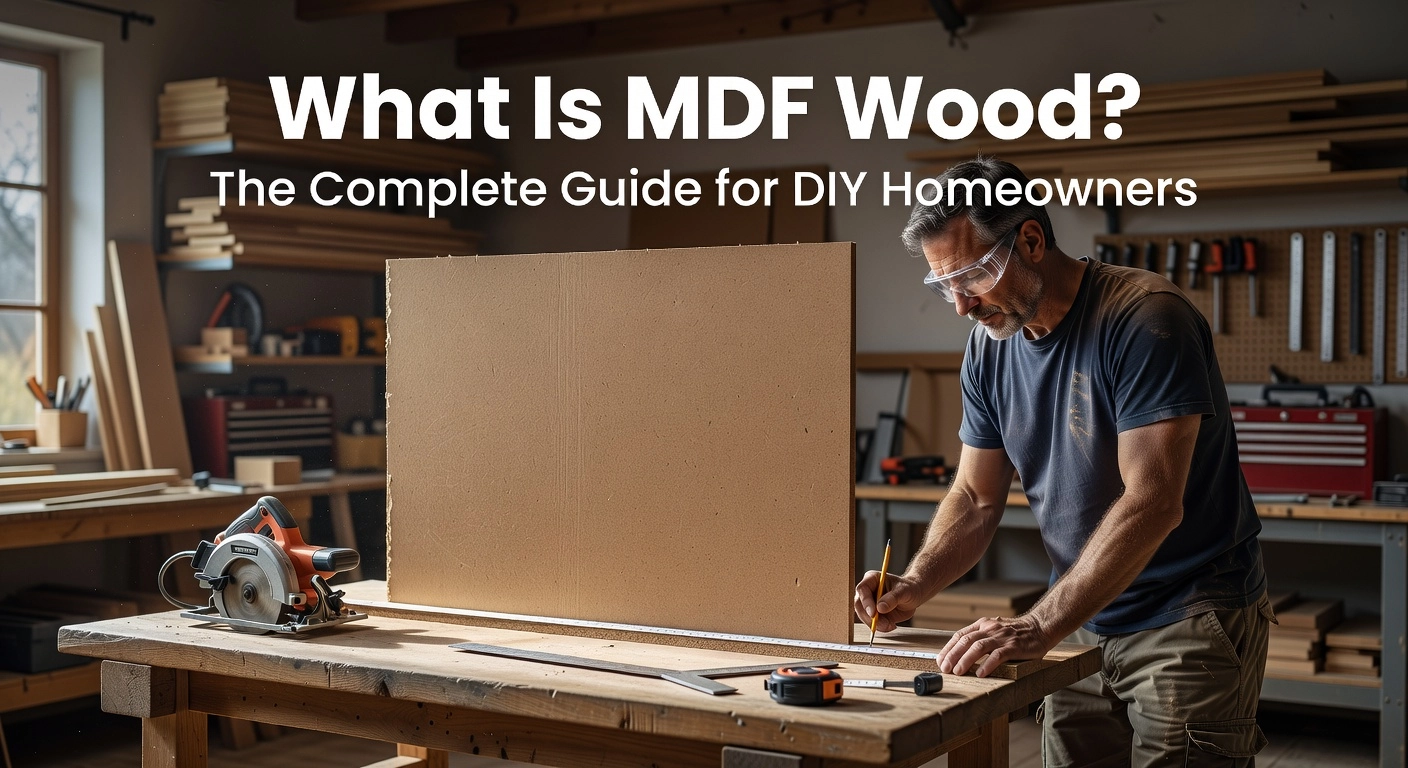
What Is MDF Wood have you ever walked through a furniture store and wondered what that smooth, perfectly uniform material is inside most shelves, cabinets, and flat-pack furniture pieces? Chances are, you were looking at MDF wood, one of the most popular and versatile building materials used in homes today.
If you are new to DIY projects, MDF wood might sound like something only professionals work with, but the truth is it is incredibly beginner-friendly once you understand the basics. Whether you are thinking about building custom shelving, upgrading your trim work, or tackling a weekend furniture project, MDF could be exactly what you need.
In this complete guide, we are going to break everything down in simple, easy-to-follow terms. You will learn what MDF wood actually is, how it is made, and where it works best in your home. We will also cover its pros and cons, how to cut and paint it, and some helpful tips to avoid common beginner mistakes. By the end, you will feel totally confident choosing and working with MDF on your next project. Let’s dive in!
What Does MDF Stand For?
MDF stands for Medium-Density Fiberboard, and if you’ve never heard that term before, don’t worry. It sounds more technical than it really is. Simply put, MDF is an engineered wood product, meaning it’s manufactured in a factory rather than cut directly from a tree like solid lumber.
So what actually goes into it? Manufacturers start with hardwood or softwood residuals, things like sawmill chips, shavings, and other wood byproducts that would otherwise go to waste. Those materials get broken down into extremely fine wood fibers, then blended with wax and a resin binder (most commonly urea-formaldehyde) to hold everything together. That mixture gets pressed under intense heat and pressure until it forms a solid, consistent panel. You can learn more about the detailed manufacturing process on Wikipedia’s MDF overview.
The “medium-density” part of the name is actually pretty descriptive. MDF panels typically fall in the density range of 500 to 1,000 kg per cubic meter, which places them right in the middle ground between lighter particleboard and denser hardboard. According to EPA documentation on composite wood panels, this density level gives MDF its notably smooth, uniform surface.
One important thing to clear up: MDF is not a wood species. It’s a manufactured composite material, similar to how concrete is engineered rather than naturally occurring. That’s why MDF has no grain, no knots, and no natural variation from panel to panel.
How MDF Is Made (In Plain Language)
Now that you know what MDF is, it helps to understand how it actually gets made. The manufacturing process isn’t just interesting background information; it directly explains why MDF behaves the way it does when you cut it, paint it, or accidentally get it wet.
It all starts with wood waste. Sawmills and wood manufacturing facilities produce a huge amount of leftover material, including chips, shavings, and sawdust. Rather than throwing that material away, manufacturers collect it and put it to work. Those wood residuals get cleaned, screened for contaminants, and then softened using steam and heat. From there, the softened chips go into a machine called a defibrator, which uses two spinning discs under high pressure to tear the wood apart into individual fibers. Think of it like pulling apart a piece of cooked chicken until you have a pile of fine, fluffy strands. That process is called defibration, and it’s the foundation of everything that makes MDF unique.
Those loose fibers don’t stay fluffy for long. They get dried down to a precise moisture level, then blended with urea-formaldehyde resin (the binder that holds everything together) and a small amount of wax for basic moisture resistance. The coated fibers are then spread out into a thick, loose mat on a conveyor belt, almost like a giant pile of fluffy wood cotton.
That mat then gets fed into a large industrial press, where intense heat and pressure fuse everything together into a solid, dense panel. You can read more about this step-by-step manufacturing process to see just how precise and controlled it really is. The result is a board with no grain, no knots, and no voids anywhere throughout its structure.
That last part is really important for DIYers to understand. Because MDF is built from randomly oriented individual fibers pressed into a uniform mass, it behaves very differently from solid wood or plywood. It cuts cleanly and predictably, takes paint beautifully on flat surfaces, and won’t surprise you with a hidden knot mid-project. But those same compressed fibers act like a sponge when water gets involved, which is why moisture protection matters so much with this material.
How to Tell If Your Furniture or Cabinets Are MDF
Not sure if your furniture is MDF or solid wood? The good news is that MDF has some pretty telling signs once you know what to look for. Here are five simple checks you can do right now without any special tools.
Start with the surface. Run your hand across the flat face of the panel or door. MDF has a completely smooth, grain-free surface that feels almost paper-smooth to the touch. Solid wood has natural texture, subtle ridges, and a visible grain pattern. If the surface feels uniformly flat with no variation whatsoever, you’re very likely looking at MDF or an MDF core covered in paint or laminate.
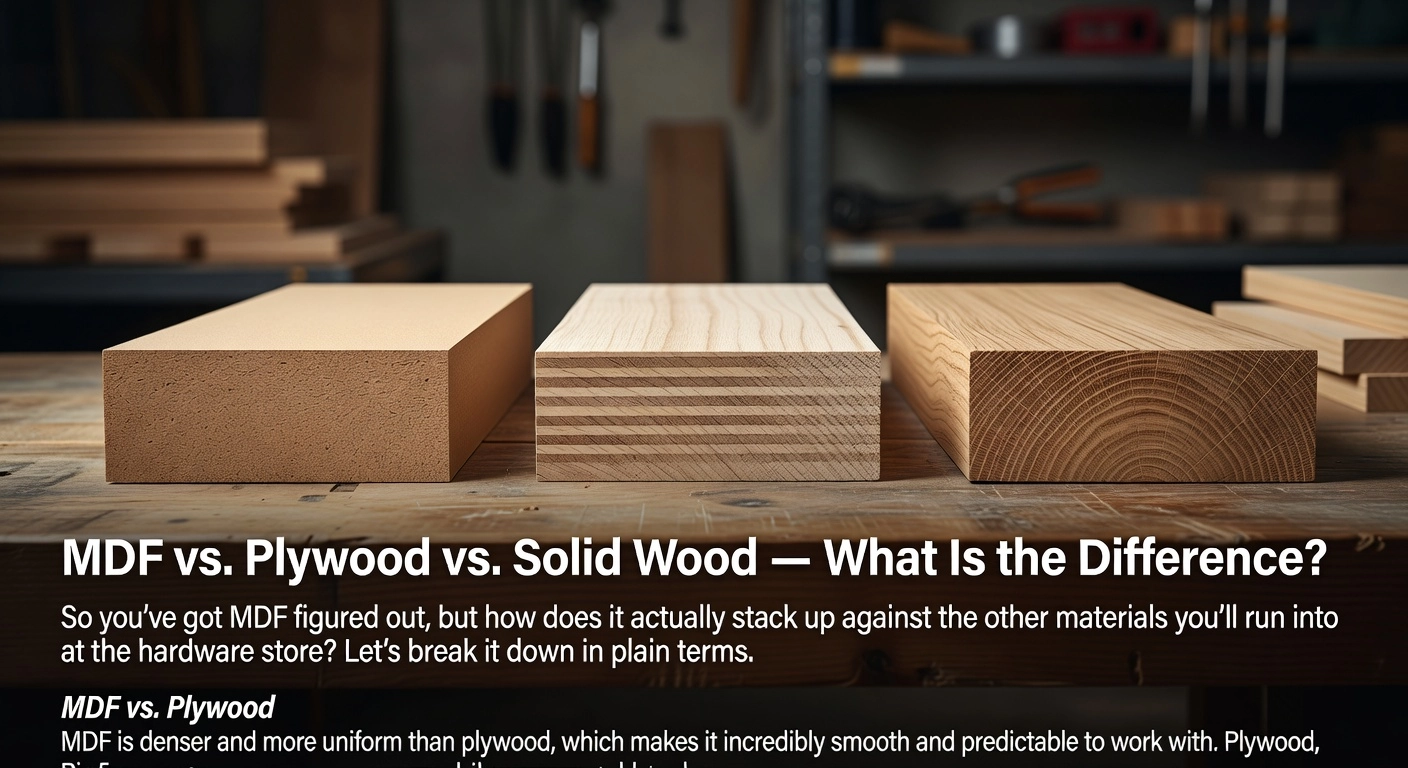
Check the edges next. This is honestly the biggest giveaway. Look at the raw edges of a shelf, drawer side, or cabinet panel. MDF edges show a fine, fibrous texture that looks a bit like compressed cardboard or felt, with zero grain lines. You’ll often spot edge banding (a thin strip of laminate or veneer) applied to cover those edges. If a corner is chipped or damaged, that exposed interior will confirm it quickly. Solid wood shows actual end grain; plywood shows distinct layers. This detailed furniture identification guide walks through the visual differences really clearly.
Pick it up and feel the weight. MDF is noticeably heavy for its size. If a shelf or cabinet door feels surprisingly dense compared to what you’d expect, that’s a clue worth noting alongside your other checks.
Look at any damaged or cut spots. Chipped corners or cut edges on MDF reveal a consistent brownish-gray fibrous texture all the way through, with no growth rings, no color variation, and no natural grain pattern at all.
Consider when your kitchen was built. Cabinet doors in kitchens installed after the mid-1990s are very commonly MDF, especially painted flat-panel and routed-profile styles. MDF cabinets became the go-to choice for painted cabinetry because the smooth surface takes paint beautifully without telegraphing any grain underneath. If your kitchen has painted flat doors, there’s a solid chance they’re MDF.
MDF vs. Plywood vs. Solid Wood — What Is the Difference?
So you’ve got MDF figured out, but how does it actually stack up against the other materials you’ll run into at the hardware store? Let’s break it down in plain terms.
MDF vs. Plywood
MDF is denser and more uniform than plywood, which makes it incredibly smooth and predictable to work with. Plywood, on the other hand, is built from thin wood veneers glued together in alternating grain directions. That cross-grain layering is what gives plywood its real muscle. It resists bending, holds screws better (especially along edges), and handles stress without splitting. MDF lacks that layered structure entirely, so while it looks great on the surface, it simply can’t match plywood’s strength. For structural jobs like subflooring, load-bearing shelves, or cabinet boxes in a laundry room, plywood is the stronger, more reliable choice. MDF tends to swell and crumble when moisture gets in, while plywood holds up considerably better.
MDF vs. Solid Wood
Solid wood brings something neither MDF nor plywood can offer: natural beauty. The grain patterns are unique, it accepts stains beautifully, and you can sand and refinish it multiple times over the years. That repairability alone makes it a favorite for high-end furniture. The downsides are real though. Solid wood costs significantly more, sometimes two to five times the price of comparable MDF pieces. It also expands and contracts with seasonal humidity changes, which can cause warping or cracking if the project isn’t designed carefully. MDF stays much more dimensionally stable in that regard.
Where MDF Actually Wins
MDF earns its place when you need a smooth, paint-ready surface at a budget-friendly price. Painted cabinet doors, interior trim, baseboards, and decorative moldings are perfect examples. As noted in comparisons between common wood materials, MDF’s consistent density means no grain telegraphing through your paint finish, giving you that clean, factory-smooth look.
That demand is clearly reflected in the numbers. The global MDF market was valued at roughly $44 to $53 billion in 2025, with a projected growth rate of 5 to 8 percent annually through the early 2030s. That kind of sustained growth speaks to how deeply embedded MDF has become in furniture and cabinetry manufacturing worldwide. The simple rule of thumb: use plywood or solid wood where strength and moisture matter, and reach for MDF when a flawless painted finish and cost savings are the priority.
Types of MDF and Which One Your Project Needs
Not all MDF is created equal, and picking the right type for your project can make the difference between something that lasts for years and something that swells, warps, or fails within months. Here’s a quick breakdown of the five main types you’ll encounter.
Standard MDF is what you’ll find at most home improvement stores, and it’s the go-to choice for the majority of indoor projects. It works beautifully for furniture, shelving, interior trim, and cabinetry in dry living spaces like bedrooms and living rooms. The key word there is dry. Standard MDF has no moisture protection built in, so keep it away from bathrooms, laundry rooms, or anywhere that sees regular humidity. For a bookshelf or a painted cabinet in your living room, though, it’s a cost-effective and reliable option.
Moisture-resistant MDF is easy to spot because it usually has a green tint along its edges. It’s made with modified binders that help it hold up better in humid environments, which makes it a smarter pick for kitchen and bathroom cabinet projects. One important note: moisture-resistant does not mean waterproof. You still need to seal the edges, especially any cut edges, to get the full benefit.
Fire-retardant MDF is treated with chemicals that slow ignition and reduce flame spread. Most homeowners won’t need this type, but it’s required in commercial buildings, schools, and some code-specific residential installations. If your project involves meeting local fire codes, this is the one to ask for at the lumber yard.
Ultralight MDF uses a lower-density fiber blend that significantly reduces the overall weight of the panel. This matters a lot when you’re building large cabinet doors or working on overhead installations where heavy panels become awkward and tiring to handle.
Flexible or bendy MDF comes in thin sheets that can curve around shapes without cracking. It’s designed for decorative millwork, column wraps, and curved furniture details where a standard flat panel simply wouldn’t work. You can learn more about the many practical uses of MDF and how each type fits specific applications before you head to the store.
A quick rule of thumb: match the MDF type to the conditions your project will live in, and you’ll avoid the most common mistakes beginners make when working with this material.
Advantages of MDF for Home Projects
Once you understand what MDF is and how it’s made, it becomes pretty clear why so many DIYers reach for it when starting a home project. Here are the key advantages that make it such a popular choice.
It takes paint beautifully. Because MDF has no natural grain, knots, or voids, its surface is perfectly smooth and consistent right out of the sheet. You don’t have to worry about wood grain telegraphing through your topcoat or resin from knots causing bleed-through. A light sand and a good primer are typically all the prep you need before painting. The result is a flat, clean finish that looks polished and professional. For anyone painting cabinets or built-in shelving, this is a genuine time-saver. The advantages of MDF for painted surfaces make it the go-to substrate for cabinet doors and interior trim.
It stays stable through the seasons. Solid wood expands and contracts noticeably as humidity rises and falls throughout the year. MDF handles those changes much more evenly, which matters a lot for fitted wardrobes, built-in shelving, and cabinet doors that need to stay flat and gap-free year-round.
It is genuinely affordable. MDF costs significantly less than solid wood and comes in standard 4×8 foot sheets in various thicknesses, so you can plan your cuts and budget upfront without surprises. For larger projects like a full wall of cabinetry, those savings add up fast.
It cuts and routes cleanly. With sharp carbide-tipped tools, MDF produces crisp edges and detailed routed profiles consistently. Solid wood can splinter along the grain; MDF simply does not have that variable. Learning how to get smooth edges when working with MDF is straightforward once you understand the material.
The numbers back it up. Furniture accounts for roughly 51 percent of global MDF volume, which tells you something important. Manufacturers and DIYers alike keep choosing it for cost-effective, paint-grade furniture and cabinetry because it simply delivers consistent results.
Disadvantages of MDF You Need to Know Before You Start
MDF is a genuinely useful material, but it comes with some real trade-offs you need to understand before you commit to a project. Knowing these drawbacks ahead of time will save you from some very frustrating surprises down the road.
Water is MDF’s biggest enemy. When MDF gets wet, even from high humidity, it swells up, softens, and eventually crumbles or delaminates. The edges are the most vulnerable spot because cutting exposes raw, porous fibers that soak up moisture even faster than the flat faces. Once swelling starts, it is usually irreversible without significant repairs or outright replacement. This is why sealing every surface and every edge with primer, paint, or edge-banding before installation is not optional; it is essential.
Screws and fasteners do not behave the same way in MDF as they do in solid wood. On the face of a panel, MDF holds screws reasonably well. At the edges, though, it is a different story. The fibers can crumble and split around a screw, especially under load. Always pre-drill your holes, use coarse-thread screws designed for engineered wood, and consider threaded inserts for any joints that will carry real weight.
If you are hoping to stain MDF to look like wood, go ahead and change that plan now. Because MDF has no natural grain, it soaks up liquid stain unevenly and turns out blotchy and patchy. Paint or laminate are your practical finishing options here, and honestly, MDF takes a smooth painted finish beautifully.
Weight is a real physical challenge with MDF. A standard three-quarter-inch full sheet can tip the scales around 100 pounds. For large cabinet doors or multi-shelf units, that weight adds up fast. Have a helper on hand for installation and consider adding extra shelf supports to prevent sagging over time.
Safety is non-negotiable when cutting or sanding MDF. The process releases extremely fine dust along with formaldehyde gas from the resin binder. Always wear an N95 respirator at minimum, work in a well-ventilated space, and use dust collection if you have it. This is one area where cutting corners is simply not worth the risk.
Where You Will Find MDF in Your Home
Once you know what MDF is and how it behaves, you start noticing it everywhere around your home. It shows up in more places than most people realize, often hiding in plain sight behind a coat of paint.
Cabinet doors in your kitchen and bathrooms are probably the single most common place you’ll find MDF. Those flat-panel slab doors you see in modern kitchens? Almost certainly MDF. The same goes for painted Shaker-style doors with routed profiles around the edges. MDF works beautifully for these because its smooth, grain-free surface accepts paint evenly without all the extra prep that raw wood requires. If your cabinet doors are painted rather than stained, there’s a very good chance they’re MDF underneath.
Your interior trim and molding is another big one. Baseboards, door casings, crown molding, chair rails, and wainscoting panels are routinely made from MDF because it machines so cleanly. Manufacturers can cut crisp, detailed profiles without splintering, and the surface is ready to paint right away. Run your hand along your baseboards at home; if they feel perfectly smooth and uniform, you’re likely touching MDF.
Freestanding furniture is full of MDF too, especially ready-to-assemble pieces. Bookshelves, TV stands, wardrobes, and flat-pack storage units commonly use MDF for shelves, door fronts, and side panels because it stays flat and takes paint or laminate beautifully.
Interior doors often use thin MDF skins stretched over a lightweight hollow frame, which keeps costs down while providing a paintable, warp-resistant surface.
Finally, decorative millwork like fireplace surrounds, built-in shelving, and coffered ceiling panels frequently uses MDF to replicate the look of expensive solid wood millwork at a fraction of the price.
Working With MDF Safely at Home
MDF is a fantastic material for home projects, but it does come with some safety considerations you’ll want to take seriously before you make your first cut. The good news is that a few simple precautions make working with it completely manageable, even for beginners.
Always wear an N95 or P100 respirator whenever you’re cutting, routing, or sanding MDF. This is the single most important rule. Standard paper dust masks are not enough here. MDF dust contains extremely fine particles, smaller than what basic masks are designed to filter, and those particles carry formaldehyde off-gas from the resin binders used during manufacturing. Formaldehyde is classified as a known human carcinogen, so this isn’t something to take lightly. Pick up a proper N95 or P100 respirator from your hardware store before your project starts.
Ventilation matters just as much as your respirator. Whenever possible, take your cuts outside or set up near an open garage door with a fan pushing air outward. If you’re working indoors, attach a shop vacuum directly to your saw or router to capture dust at the source. Even on quick, small cuts, this step makes a real difference in how much dust ends up floating around your workspace.
Use sharp carbide-tipped blades and bits. MDF is incredibly hard on standard high-speed steel tools, dulling them faster than natural wood would. A dull blade generates more heat and friction, which means more airborne dust and rougher, messier edges. Carbide-tipped blades stay sharper longer and give you cleaner results with less mess.
Pre-drill every fastener hole near the edges of your board using a drill bit slightly smaller than your screw diameter. MDF crumbles under pressure at the edges when you skip this step, and a split board is frustrating to fix.
Finally, put on safety glasses before every single cut. MDF dust irritates your eyes just as aggressively as it does your lungs, and eye protection takes two seconds to put on.
Finishing MDF: Why Paint Works and Stain Does Not
Here’s something that surprises a lot of beginners: MDF is actually one of the best materials you can paint, but it’s one of the worst materials you can stain. Understanding why makes all the difference when you’re planning a project.
Why stain simply doesn’t work on MDF comes down to what the material is made of. Real wood has natural grain, with distinct areas that absorb stain at different rates, creating that beautiful depth and character you see on oak or pine. MDF has none of that. It’s a uniform mat of fine fibers, so when you apply oil-based or water-based stain, it soaks in unpredictably and produces a blotchy, muddy, flat result. There’s no grain to bring out, so you’re left with a dull, uneven surface that looks nothing like wood. Save yourself the frustration and skip the stain entirely.
Priming the faces correctly is your first real step toward a great painted finish. The flat faces of MDF are relatively smooth, but they still soak up that first coat of primer heavily. For best results, apply two coats of a quality solvent-based or shellac primer. The first coat gets absorbed deeply into the fibers; the second coat creates the even, sealed base your topcoat needs. Sand lightly between coats with 220-grit paper to keep things smooth.
The edges deserve extra attention. Cut MDF edges are dramatically more absorbent than the faces, almost like painting bare cardboard. Apply two to three coats of solvent-based primer to edges specifically, sanding lightly between each coat. This builds up the surface gradually, fills in the fibrous texture, and prevents the fuzzy, rough result you’d otherwise get.
Once your priming is done right, MDF rewards you with a genuinely impressive finish. Both latex and oil-based topcoats go on beautifully, and sanding between coats with 220-grit paper produces a smooth, furniture-grade result you’d be proud to display anywhere in your home.
For kitchens, bathrooms, or other high-wear spots, consider laminates, thermofoil wraps, or edge-banding tape as practical alternatives to painting. These options provide a durable, moisture-resistant surface that holds up better where paint might struggle long-term.
Protecting MDF From Moisture — The Most Important Step
If there’s one thing you absolutely cannot skip when working with MDF wood, it’s moisture protection. Water is MDF’s biggest enemy, and a little prevention before installation goes a very long way.
Seal all six sides before anything else. Both flat faces and all four edges need to be coated with a primer or dedicated MDF sealer before your panel goes anywhere near its final home. This matters because once a panel is installed, the back face or hidden edges become impossible to reach. A shellac-based primer or an oil-based sealer works especially well here; apply multiple thin coats rather than one thick one, and let each coat dry fully before adding the next.
Pay extra attention to the edges. Cut edges are where moisture sneaks in fastest because the raw fiber ends act almost like a sponge, pulling in water almost instantly. A diluted PVA glue mixture (roughly 50/50 with water) makes a great first coat to seal those thirsty fibers before you prime. Iron-on edge banding is another solid option that creates a physical barrier on exposed edges. Plan on three or more coats before an edge truly stops soaking up whatever you put on it.
For kitchens and bathrooms, upgrade to moisture-resistant MDF. MR-grade boards are manufactured with water-repellent resins and are usually identifiable by their green-tinted core. They handle humidity much better than standard MDF. That said, MR MDF is still not waterproof; it still needs full sealing on all sides and should never sit in standing water or be placed directly in splash zones.
Caulk every gap at joints. Any space between MDF trim, baseboards, or cabinet panels and the surrounding wall or floor is an open invitation for water infiltration. A flexible paintable caulk fills those gaps while still allowing for minor seasonal movement.
Finally, if a panel has already swollen from moisture exposure, resist the urge to grab sandpaper right away. Let the piece dry out completely first. Sanding or filling wet MDF removes weakened fibers and leaves the surface even more porous than before, making future damage worse rather than better.
When to Repair MDF and When to Replace It
The good news is that not every piece of damaged MDF needs to head straight to the trash. Knowing what’s fixable and what isn’t will save you both time and money.
Minor surface damage is almost always worth repairing. Small scratches, shallow dents, and chipped paint on the flat face of an MDF panel are easy fixes. Clean the area, press in a small amount of lightweight spackle or wood filler, let it dry fully, sand it smooth with 120-grit sandpaper, apply a primer coat, and repaint. Because MDF faces are dense and stable, the surrounding material stays solid while you work on the damaged spot. The result looks clean and seamless when done carefully.
Swollen edges are trickier but often still salvageable. Cabinet door edges and furniture corners are the spots that absorb moisture fastest, because raw MDF edges soak up water like a sponge. If the edge has puffed up but hasn’t fully separated or crumbled, you can stabilize it using a penetrating wood hardener. The hardener soaks into the softened fibers and firms them back up. Once it cures, fill the area, sand smooth, prime, and repaint. This repair works especially well for localized damage on a single cabinet door or a furniture corner.
Full waterlogging or delamination is a different story entirely. When MDF has been thoroughly saturated, the fibers expand permanently and the internal resin bonds break down. No amount of drying, sanding, or patching will restore the panel to its original strength. At that point, replacement is the honest answer.
Cost and accessibility matter in the final decision. If matching replacement doors are available and reasonably priced, a clean replacement often beats a visible patch job.
Finally, never patch a load-bearing MDF panel like a shelf support that shows signs of moisture damage or sagging. The repaired area won’t recover its original strength, and failure under load is a real risk. Replace structural pieces without hesitation.
Frequently Asked Questions About MDF Wood
Got some great questions covered here. Let’s work through the most common ones beginners ask about MDF wood.
Is MDF stronger than plywood? No, it isn’t. MDF is denser and more uniform, which makes it great for smooth painted finishes, but plywood wins when it comes to structural strength, screw holding, and moisture resistance. Plywood’s cross-layered construction lets it handle heavier loads without sagging and grip screws far better, especially at the edges. Think of it this way: MDF is your go-to for cabinet doors and decorative panels, while plywood is better suited for shelves carrying real weight or structural frames.
Can you use MDF outdoors? Standard MDF should never go outside. It soaks up moisture quickly and will swell, warp, or crumble. Even moisture-resistant MDF is only designed for indoor humid spaces like kitchens and bathrooms with decent ventilation. It is not rated for rain, direct sun, or outdoor weather exposure of any kind.
Does MDF off-gas formaldehyde forever? No. Off-gassing is highest when panels are brand new and decreases significantly over time. The best thing you can do is seal all surfaces, including edges, with paint or a low-VOC primer. Sealing dramatically cuts down on ongoing emissions and is something you should be doing anyway for moisture protection.
Is MDF safe for kitchen cabinets? Yes, absolutely. Most factory-painted cabinet doors you see in stores are already made from MDF. When you use moisture-resistant MDF for the doors and seal everything properly, it performs reliably under normal kitchen conditions for years.
How long does MDF furniture last? Well-sealed, painted MDF furniture kept in a dry interior space can realistically last 10 to 20 years with basic care and occasional touch-up painting. Moisture is the biggest threat to longevity, so keeping it dry is the single most important thing you can do.
The Bottom Line on MDF Wood for DIY Homeowners
MDF is a genuinely capable material that belongs in every beginner’s toolkit, as long as you go in with a clear understanding of what it needs from you. It delivers smooth, paint-ready surfaces at a fraction of the cost of solid wood, making it a smart choice for cabinets, trim, shelving, and decorative projects throughout your home.
The habits that separate successful MDF projects from frustrating ones come down to a short list. Seal every edge before or during installation. Use a quality primer designed for MDF surfaces. Choose moisture-resistant grades any time your project lives near a kitchen or bathroom. These three steps alone will dramatically extend the life of whatever you build or restore.
Skip the stain, always. And no matter how small the cutting or sanding job, put on your respirator before you start. Fine MDF dust carries resin particles you do not want in your lungs.
When damage shows up, act quickly. A small soft spot or chipped edge is a beginner-friendly fix today, but a much bigger problem if moisture gets in first.
This guide gives you the foundation. From here, explore the dedicated tutorials on painting MDF cabinets, repairing water-damaged MDF, and sealing MDF edges for step-by-step guidance on your specific project. The more you work with MDF, the more intuitive its quirks become, and the better your results will be.
Conclusion
MDF wood is one of the most practical, budget-friendly materials you can add to your DIY toolkit. It cuts cleanly, paints beautifully, and delivers a smooth, professional finish that natural wood often cannot match at the same price point. Yes, it has limitations, including its sensitivity to moisture and its heavier weight, but knowing those weaknesses helps you use it wisely and confidently.
The key is choosing the right project, preparing your surfaces properly, and sealing your edges before painting. Do those three things, and your results will speak for themselves.
Now it is time to put this knowledge to work. Head to your local hardware store, grab a sheet of MDF, and start that project you have been putting off. Every skilled DIYer started exactly where you are standing right now. Your best build is just ahead.
1 thought on “What Is MDF Wood? The Complete Guide for DIY Homeowners”