
There is something incredibly satisfying about building your own furniture, especially when it is a piece you will use every single day. A wooden bedside table might seem like a small project, but it is the perfect starting point for any beginner looking to flex their DIY muscles without feeling overwhelmed.
Whether you want to save money, match a specific bedroom aesthetic, or simply enjoy the process of creating something with your own hands, building a bedside table from scratch is one of the most rewarding weekend projects you can take on. The best part? You do not need a garage full of fancy tools or years of woodworking experience to pull it off.
In this guide, we are breaking down 11 essential things every beginner should know before picking up a saw or sanding block. From choosing the right wood and understanding basic joinery to finishing techniques that make your piece look professionally crafted, we have got you covered. By the end, you will feel confident, prepared, and genuinely excited to start building your very own bedside table.
Why Wood Is Still the Best Material for Bedside Tables
Wood isn’t going anywhere. The global side table market hit $13.63 billion in 2025, and wood holds nearly 49% of that market share across all segments. That’s almost half the market, despite competition from metal, glass, rattan, and engineered alternatives. There’s a reason for that, and it comes down to a few qualities no other material can quite match.
Wood brings warmth and character that other materials simply don’t have. Metal looks sleek but feels cold. MDF is uniform and predictable. Rattan has texture, but it’s limited in what you can do with it. Wood, on the other hand, has grain patterns, natural variation, and a richness that makes a bedroom feel lived-in and welcoming. For anyone building or restoring a piece at home, wood is also far more forgiving to work with. You can sand it, stain it, carve it, paint it, or finish it in dozens of ways with basic tools.
Bedrooms are tough environments for furniture. Humidity goes up and down with the seasons. A bedside lamp radiates heat for hours every night. You set down water glasses, scratch the surface reaching for your phone at 2am, and bump it with your knee every single morning. Wood handles all of this better than most people expect, because minor damage like scratches, water rings, or worn finishes can be repaired with sandpaper and a fresh coat of finish. Laminate chips and won’t bond back. Metal scratches show permanently or rust. Wood lets you fix it and move on.
There’s also a sustainability argument worth taking seriously. A solid wood bedside table can be refinished, repaired, and upcycled almost indefinitely. Particleboard and laminate alternatives usually end up in a landfill after a few years when the surface degrades. Solid wood, especially FSC-certified species like oak or walnut, lasts decades and can be completely transformed with a weekend project.
This article walks you through the full lifecycle of a wood bedside table, from choosing your lumber and building your first piece, to restoring a thrifted find, to keeping it looking great for years with simple ongoing care.
Best Wood Species for a Bedside Table
Picking the right wood species is one of the most important decisions you’ll make for your bedside table build. The good news? You have plenty of solid options at every budget level. Here’s a breakdown of the most popular choices and what makes each one worth considering.
1. Pine: The Beginner’s Best Friend
Pine is the go-to starting point for most first-time builders, and for good reason. It’s inexpensive (often in the $2 to $5 per board foot range), widely available at any home improvement store in familiar sizes like 1x4s and 1x6s, and easy to cut, sand, and join with basic tools. It takes stain reasonably well, making it a flexible option for rustic, farmhouse, or casual bedroom styles. The one real trade-off is softness. Pine has a relatively low Janka hardness rating (roughly 380 to 690 lbf depending on the variety), which means it dents and scratches more easily than hardwoods. For a bedside table, where heavy daily impact is unlikely, that’s a manageable trade-off. Just make sure to finish it with a protective topcoat to give it some extra durability.
2. Oak: Durable and Dependable
If you want something that holds up better over time, oak is a natural upgrade. Red oak sits around 1,290 lbf on the Janka scale, and white oak comes in slightly harder at around 1,360 lbf. Both resist everyday dents and scratches far better than pine. According to this wood species guide for furniture, oak is one of the most popular choices for quality furniture builds, and it works well in traditional, transitional, and even modern styles. One thing to keep in mind: oak has an open grain structure, which means you’ll want to apply a grain filler before staining if you’re after a smooth, even surface. Skipping this step often results in a blotchy or uneven finish. White oak also has better natural moisture resistance thanks to its cellular structure, making it a smart pick for bedrooms in humid climates.
3. Poplar: The Underrated Paint-Friendly Option
Poplar doesn’t get enough credit. It’s a hardwood (technically), affordable, and machines incredibly cleanly, meaning fewer tearouts and smoother surfaces right off the saw. It’s the top recommendation for any bedside table you plan to paint rather than stain, because it holds paint exceptionally well and gives you a crisp, clean result. The downside is that poplar lacks visual character in its grain, making it a poor choice for natural or stained finishes. It also dents fairly easily at around 540 lbf, so a painted protective finish isn’t just decorative; it’s practical. If you’re building a white or colorful bedside table for a kid’s room or a modern bedroom, poplar is hard to beat for the price. As noted in this furniture species comparison, it consistently outperforms pine for painted projects.
4. Walnut and Maple: Step-Up Choices
When you’re ready to invest a bit more, walnut and maple both deliver. Walnut brings rich, chocolate-brown tones and a flowing grain that looks stunning with minimal finishing. It’s softer than oak or maple (around 1,010 lbf), so it will develop character marks over time, but many woodworkers consider that part of its charm. Expect to pay $12 to $20 or more per board foot, and availability can be spottier depending on your region. Hard maple goes the other direction: it’s one of the toughest domestic hardwoods available at around 1,450 lbf, with a tight, clean grain that suits modern and minimalist builds perfectly. It’s more available than walnut but still pricier than oak or pine. Both are excellent choices when appearance and longevity are the priority.
5. Humidity and Wood Movement in the Bedroom
Bedrooms typically maintain indoor humidity levels between 30% and 50%, and that seasonal fluctuation causes wood to expand and contract across the grain. This isn’t a reason to panic, but it does affect how you should build and finish your piece. Avoid rigid cross-grain constructions that fight natural movement; instead, use floating panels or slot-and-screw fasteners for wider tops. Penetrating oil finishes handle minor movement better than thick, brittle film finishes. Always acclimate your lumber to the room before building, targeting a moisture content of around 6% to 8% for most indoor environments. Keeping bedroom humidity stable between 35% and 45% is ideal and helps protect your finished piece for years to come.
The 4 Most Popular Styles and Which Wood Suits Each
Now that you know which wood species to use, the next step is matching your material to the right style. This is where a lot of beginners go wrong: they pick a wood they like, then try to force a style around it. A much better approach is to decide on your style first, then let that choice drive everything else, including your species, your finish, and even your joinery method.
Here are the four most popular bedside table styles and exactly which wood works best for each one.
1. Modern and Minimalist
This style is all about clean lines, flat panels, and a calm, clutter-free look. Think handleless drawers, slim profiles, and nothing that distracts the eye. For this style, maple or poplar are your go-to choices. Both have a tight, fine grain that disappears nicely under a water-based matte finish, giving you that smooth, almost furniture-store look without fighting the wood’s natural texture. Maple is harder and more durable; poplar is cheaper and great for painted or matte applications. Avoid heavily grained woods like oak here since the grain will compete with the clean aesthetic you’re going for.
2. Rustic and Farmhouse
Rustic style thrives on character, warmth, and a little imperfection. Knots, visible grain, and natural texture are features here, not flaws. Knotty pine or reclaimed wood are perfect fits. Pine is affordable, easy to work with, and its natural knots give it that authentic farmhouse feel right out of the gate. A warm stain or beeswax finish enhances the grain without covering it up, letting the wood’s personality shine through. Current 2026 design trends also point to reclaimed timber as a rising choice for sustainability-minded builders who want character and eco-credentials in one material.
3. Mid-Century Modern
Mid-century modern is defined by tapered legs, low profiles, and rich, warm wood tones. Walnut or teak veneer with an oil finish nails this look. Walnut’s deep, chocolatey grain is practically synonymous with the style, and an oil finish brings out that warmth beautifully while letting the wood age gracefully over time. For beginners nervous about the tapered legs, start with pre-made tapered leg inserts available at most hardware stores; you simply screw them into threaded inserts on the underside of your cabinet box. It gives you the full MCM look without complex joinery. Modern nightstand trend reports confirm that walnut continues to dominate this style category heading into 2026.
4. Shaker Style
Shaker is the style that rewards patience and precision. It uses framed panel construction, clean proportions, and zero unnecessary decoration. Oak or cherry with a clear or lightly tinted finish is the classic combination. Oak is strong, widely available, and its grain adds subtle visual interest without going overboard. Cherry is smoother and develops a gorgeous reddish patina over time. The construction itself is beginner-friendly once you understand the basics; a simple face-frame with flat-panel drawer fronts is manageable for anyone with a few builds under their belt.
The biggest takeaway here is simple: choose your style before you choose your wood. Trying to retrofit a dark oil finish onto light pine or coax a rustic look out of perfectly smooth maple creates extra work and usually disappoints. Start with the style, pick the species that naturally suits it, then select a finish that complements both. That order of operations will save you time, money, and a lot of sanding.
What Tools and Materials You Actually Need to Build One
Good news for beginners: you don’t need a fully stocked workshop to build a great bedside table. A surprisingly short tool list covers almost everything you’ll encounter on a first build.
Your core toolkit looks like this:
- Circular saw or miter saw for cutting boards and plywood to length
- Drill/driver for pocket holes, pilot holes, and driving screws
- Pocket-hole jig for fast, clean joinery (more on this in a moment)
- Random orbital sander for smoothing surfaces before finishing
- Tape measure and a speed square for accurate layout and 90-degree checks
- Clamps to hold pieces together while glue dries or screws go in
That’s genuinely it. Those six tools handle roughly 90% of a standard nightstand build from start to finish.
For materials on a typical two-drawer nightstand (around 22 inches wide by 18 inches deep by 26 inches tall), plan on three to five 1×4 pine boards at 8 feet each, plus one half-sheet of 3/4-inch plywood for the carcass, top, and drawer fronts. Add a small piece of 1/4-inch plywood or hardboard for drawer bottoms. In 2026, expect to spend roughly $15 to $30 on the lumber, $20 to $35 for the plywood, and $30 to $50 on hardware. Your total material cost for a solid pine build typically lands between $65 and $120 before finish.
Pocket-hole joinery is the method we recommend for your first build, and for good reason. You drill angled holes with the jig, add a bead of wood glue, and drive a specialized screw that pulls both pieces tight. The joint is strong enough for furniture that sees daily use, and it’s forgiving when your cuts are off by a small fraction. A lot of beginner woodworkers are surprised by how solid pocket-hole joints feel once the glue cures. This beginner-friendly nightstand plan from Kreg uses exactly this method and walks you through the whole process step by step.
For hardware, you’ll need two sets of drawer slides sized to your drawer depth (14 to 16 inches is typical), two drawer pulls, and a box of 1-1/4-inch pocket-hole screws. Drawer slides run about $10 to $25 per pair at most home improvement stores. Pre-drill your mounting holes to avoid splitting the wood, and use a scrap spacer to keep both slides perfectly level during installation. Soft-close mechanisms are completely optional but add a nice touch; add-on soft-close dampers clip onto standard slides for around $10 to $15 extra and install in minutes.
Here’s what you can confidently skip: biscuit joiners, routers, mortise-and-tenon joinery, and dovetail setups are all overkill for a first nightstand. They add complexity, cost, and learning curve without meaningfully improving the finished piece. Shanty 2 Chic’s beginner nightstand plans and This Old House’s DIY nightstand guide both prove you can build something genuinely attractive using nothing more than the basic toolkit above. Keep it simple on your first build, get comfortable with the process, and add complexity later if you want to.
Basic Build Steps: How a Beginner Can Build a Bedside Table
Now that your tools are ready, it’s time to actually build something. These steps walk you through a simple box-frame nightstand with one drawer and a lower shelf, roughly 26 inches tall, 18 to 20 inches wide, and 16 to 17 inches deep. Follow each step in order and you’ll avoid most of the mistakes beginners run into.
Step 1: Choose and Cut Your Parts
Start with ¾-inch plywood for your main panels, top, shelf, and drawer box sides. Pick up some 2×2 lumber for legs and frame rails, and grab a small piece of ¼-inch plywood for the drawer bottom. A single 4×8 sheet of ¾-inch plywood is usually enough for one nightstand with material to spare.
Here’s a simple cut list to get you started:
- Legs: 4 pieces of 2×2 at 25½ inches
- Side rails: 6 pieces of 2×2 at roughly 13 inches
- Front and back rails: 6 pieces of 2×2 at roughly 17 inches
- Top panel: ¾-inch plywood at 16 by 20 inches
- Lower shelf: ¾-inch plywood at 13 by 17 inches
- Drawer box sides: ¾-inch plywood, sized to your opening minus slide clearance
- Drawer bottom: ¼-inch plywood
Always label every piece after cutting and account for your saw blade’s kerf. Measure twice, cut once is not just a saying. Check out this detailed one-drawer nightstand plan for exact diagrams if you want a visual reference.
Step 2: Drill Pocket Holes and Dry-Fit First
Set your pocket-hole jig to the ¾-inch setting and drill two to three holes on the ends of every rail and panel edge that will join another piece. The magic of pocket-hole joinery is that the screws hide themselves inside the joint. Before you reach for the glue, assemble the entire nightstand with screws only. Check that corners are square by measuring diagonally from corner to corner. Both measurements should match. If they don’t, gently rack the frame until they do. This dry-fit step catches alignment problems before they become permanent.
Step 3: Assemble the Carcass
Glue and screw the two side frames together first, connecting your legs with the side rails. Then connect the two side assemblies with your front and back rails, including a dedicated drawer rail just below the drawer opening. Add your lower shelf next, then attach the top last. Work in stages and keep a square handy at every step. Use 1¼-inch pocket screws with wood glue for a strong, clean joint.
Step 4: Build and Fit the Drawer Box
Cut your drawer box sides, front, and back from ¾-inch plywood, sizing them to fit the opening minus about 1 inch total for your drawer slides. Join the pieces with butt joints using brad nails and glue, or use pocket holes if you prefer. Slide the ¼-inch plywood bottom in and fasten it. For slides, mount the cabinet-side tracks inside the carcass first, aligned level and set back about 1 inch from the front. Attach the drawer-side tracks flush with the front edge of the box. Test the fit and adjust until it glides smoothly. The Angela Marie Made nightstand tutorial has a great walkthrough on getting drawer slides right the first time.
Step 5: Sand Through the Grits
Start with 80-grit to knock down rough spots, machine marks, and any dried glue squeeze-out. Move to 120-grit, then 150 or 180, and finish with 220-grit. Each grit removes the scratches left by the previous one. Skipping grits is one of the most common beginner mistakes; coarser scratches left behind absorb stain unevenly, which shows up as blotchy, splotchy color that no amount of extra coats will fix. Work with the grain, not against it, and use an orbital sander to save your arms.
Finishing and Hardware
Once sanded to 220, apply your chosen finish. Stain first if you want color, let it dry fully, then apply two or more coats of polyurethane for protection. Lightly sand with 220-grit between coats for a silky result. Install your drawer pull last using a hardware jig for consistent placement. A back panel of ¼-inch plywood is optional but gives the piece a clean, finished look from every angle.
How to Restore an Old or Thrifted Bedside Table
Not every great bedside table starts as new lumber. Sometimes the best find is a beat-up solid wood nightstand sitting on a thrift store shelf for $20. After a weekend of work, that same piece can outperform a $200 flat-pack option in both durability and character. Solid wood can be refinished repeatedly over decades, while most affordable new furniture uses particleboard or MDF that swells, chips, and can’t be sanded down. The math strongly favors restoration, and in 2025 and 2026, so does the design world, with upcycling and sustainable furniture choices appearing consistently across DIY content, interior design publications, and social media.
Before You Buy: What to Check
Not every thrifted piece is worth the effort, so a quick inspection saves you a lot of frustration. First, check whether it’s solid wood or veneer. Run your finger along an edge and look for consistent grain patterns that wrap around corners; that’s a good sign of solid wood. A thin layer that looks slightly different from the main surface suggests veneer, which can still be refinished but requires a lighter touch with sandpaper. Next, check the joinery. Grab the piece and gently wobble it. Dovetail corners and mortise-and-tenon joints are worth fixing; a piece that’s essentially falling apart may not be. Finally, pull the drawers out and slide them back in. Sticky or broken drawer slides are usually easy to fix, but heavily damaged runners can be a time sink.
Stripping and Sanding the Right Way
Once you’ve got your piece home, the prep work is everything. For thick paint or multiple old layers, a gel chemical stripper is your best friend. Apply it, let it sit according to the label, then scrape the softened finish away. It’s faster than sanding through heavy buildup and creates less dust. For thinner finishes or as a final step after stripping, dry sanding does the job. Start with 80 to 120 grit to remove residue, then move up to 220 grit for a smooth surface. The most important rule: always sand with the grain, never across it. Cross-grain scratches show up clearly under stain and are tough to hide.
Fixing Damage Before You Finish
Before any new finish goes on, deal with the surface problems. For scratches and small gouges, a stainable wood filler works well. Press it into the damaged area, let it dry completely, then sand it flush with the surrounding surface. For loose joints, disassemble the affected area if you can, scrape off the old dried glue, apply fresh wood glue, clamp the joint firmly, and let it cure overnight. Trying to refinish over a wobbly joint just delays the inevitable.
Picking Your New Finish Direction
Here’s where beginners often get tripped up. Going from a painted surface to a stained one requires fully stripping back to bare wood; otherwise the stain won’t absorb evenly. If you’re working with a porous wood like pine, apply a pre-stain wood conditioner before staining to prevent blotchy results. Also keep in mind that going darker is almost always easier than going lighter. A darker stain covers minor imperfections and sanding marks, while lighter finishes reveal everything. Finish with two to three coats of polyurethane or a durable wax for a nightstand that holds up to daily use. Swap the hardware last, and you’ve got a piece that looks custom-built for a fraction of the cost.
Choosing the Right Finish for a Bedside Table
Your bedside table works harder than almost any other piece of furniture in the room. Think about everything that lands on that surface every night: a sweating water glass, a lamp radiating heat for hours, your hand reaching over half-asleep, and moisture drifting in from an open window or bedroom humidifier. All of that adds up to a surprisingly demanding environment, and the finish you choose needs to hold up to every bit of it.
1. Polyurethane: The Most Protective Option
If durability is your top priority, polyurethane is your best friend. It forms a hard film over the wood surface that resists water rings, scratches, and heat better than most other options you’ll find at a hardware store. You have two main choices here: oil-based and water-based. Oil-based polyurethane is tougher and longer-lasting, but it adds a warm amber tone over time and takes longer to dry between coats. Water-based dries faster, stays clearer, and has much less odor, making it friendlier for indoor projects. For sheen, satin is a popular middle ground that looks natural and hides small scratches better than gloss.
2. Hardwax Oil: Best for Grain and Easy Repairs
Hardwax oil is a penetrating finish, meaning it soaks into the wood rather than sitting on top like a film. The result is a surface that looks and feels genuinely natural, with the grain front and center. The biggest practical advantage for beginners is spot repair: if you scratch or wear through one area, you can simply reapply the oil to that spot without sanding down the whole piece. The tradeoff is that hardwax oil needs periodic reapplication every year or two depending on use, and it offers less scratch resistance than polyurethane overall.
3. Paste Wax Over Stain: Beautiful but Delicate
Paste wax gives a soft, hand-rubbed look that works beautifully on farmhouse or rustic-style builds. Apply it over a stained surface, buff it out, and you get a warm, low-sheen glow that no other finish quite matches. The honest downside is protection: paste wax offers very little resistance to spills or heat. Reserve this option for nightstands that mostly hold a lamp or a book rather than a daily water glass.
4. Application Tips That Make a Real Difference
Regardless of which finish you choose, thin coats are the rule. Multiple thin coats bond better and dry more evenly than one thick coat that drags and pools. When brushing polyurethane, use a quality synthetic brush and maintain a wet edge by working quickly across the surface without going back over areas that have started to dry. That prevents lap marks. Hardwax oil is rubbed in with a cloth or pad, then buffed off after a short dwell time. Less product on the surface means fewer streaks.
5. Match Your Finish to Your Wood Species
Pine deserves a special mention here because it behaves differently than most other woods. Pine absorbs stain unevenly due to its inconsistent grain density, creating blotchy patches that look unintentional. Applying a pre-stain wood conditioner before your stain coat helps the color go on more uniformly. Just know that conditioning can lighten the final stain color slightly, so always test on scrap wood first before committing to your actual piece.
How to Protect Your Wooden Bedside Table from Daily Damage
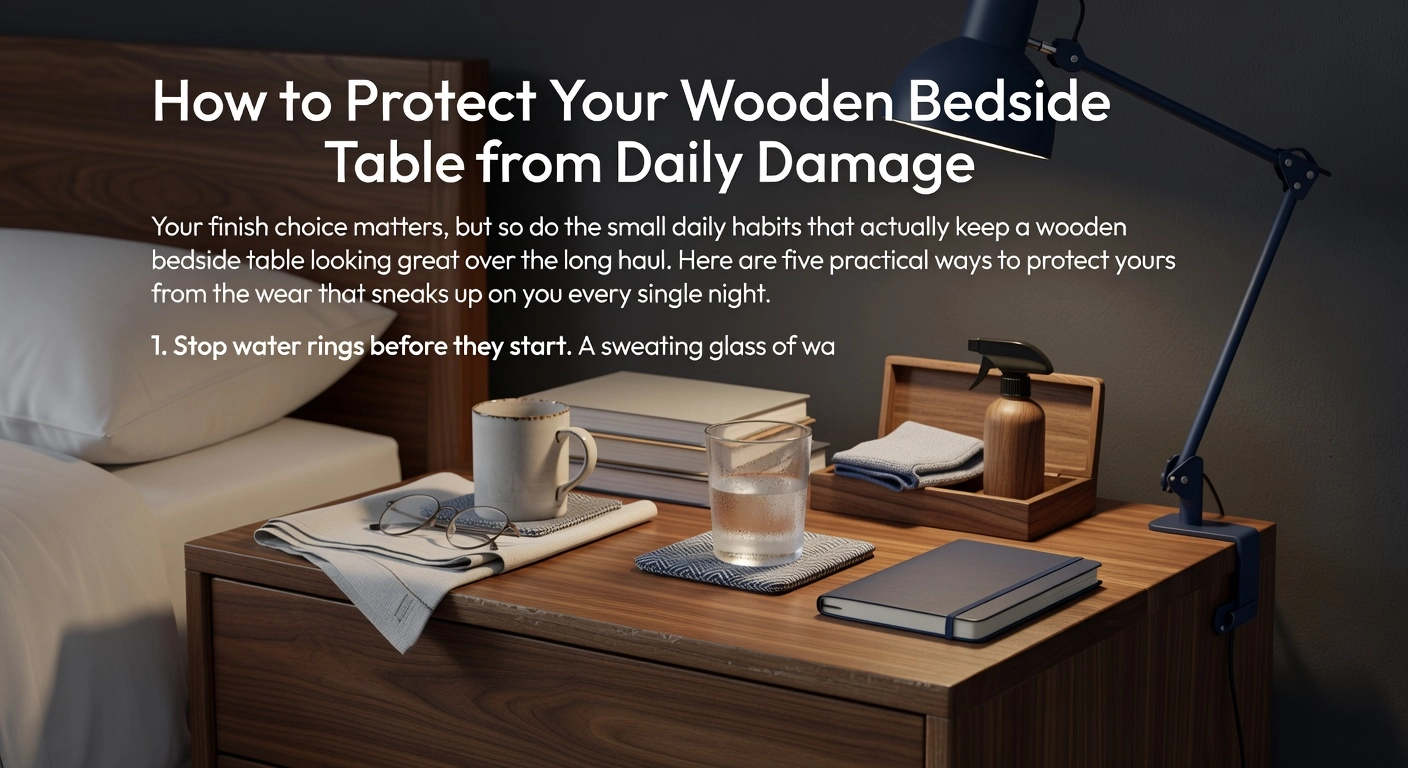
Your finish choice matters, but so do the small daily habits that actually keep a wooden bedside table looking great over the long haul. Here are five practical ways to protect yours from the wear that sneaks up on you every single night.
1. Stop water rings before they start. A sweating glass of water or a humidifier sitting directly on bare or lightly finished wood is one of the fastest ways to ruin the surface. White rings form when moisture gets trapped under or within the finish layer. The fix is simple: always use a coaster. Cork and stone options work especially well because they absorb condensation rather than redirecting it. Felt pads under your lamp base add a second layer of protection by catching any drips that migrate across the surface. If you want full coverage, a clear protective mat sits flat on top without hiding the wood grain underneath. Pairing these habits with a durable finish like water-based polyurethane gives you a moisture-resistant barrier that backs up your coaster routine.
2. Protect the surface from lamp heat. A bedside lamp running for several hours creates localized heat that can cause finishes to yellow, bubble, or lift right where the base sits. Stick a thin cork or felt pad under the lamp base to insulate the wood from direct heat transfer. Oil-based polyurethane and conversion varnish handle this kind of focused warmth better than basic lacquer, which tends to soften and discolor more quickly under heat sources.
3. Manage bedroom humidity through the seasons. Wood expands in humid summers and contracts in dry winters, and that constant movement stresses both the finish and the joints. Aim to keep your bedroom between 40 and 45 percent relative humidity year-round. A small humidifier in winter and your air conditioning in summer will do most of the work. Keep the table away from heating vents and drafts, which create uneven drying that cracks finishes and loosens drawer joints faster than almost anything else.
4. Prevent scratches from everyday items. Phones, chargers, books, and keys all leave fine scratches over time, especially on satin or matte finishes. A thin clear mat on the tabletop handles this almost invisibly. Inside the drawer, adhesive-backed felt liners cushion everything and stop items from sliding around and scratching the interior. Lifting objects rather than dragging them sounds obvious, but it makes a real difference over months of daily use.
5. Stick to a simple maintenance schedule. Every six to twelve months, give the surface a light treatment to keep the finish supple and the wood hydrated. For sealed finishes like polyurethane or varnish, apply a thin coat of paste wax and buff it out with a soft cloth. For oiled finishes, reapply a compatible furniture oil such as tung or linseed. In between, a quick wipe with a dry microfiber cloth removes dust before it acts as an abrasive. These small, regular habits prevent the kind of dullness and dryness that eventually leads to bigger refinishing jobs.
Smart and Multifunctional Features Worth Adding
Once your bedside table is built and finished, you have a real opportunity to make it work harder for you. Smart features are trending in 2026 for good reason: a nightstand that charges your phone, lights up the floor at 2 a.m., and hides your valuables beats one that just holds a lamp.
Built-In Wireless Charging
Routing a recess for a Qi charging pad is easier than it sounds. Trace the pad’s outline on the underside of your top panel, then use a plunge router to cut a shallow pocket, leaving roughly 1/8 inch of wood above the pad so the signal still passes through. Drill a small cord-routing hole toward the back panel and feed the cable down through the carcass interior. Secure the pad with a dab of hot glue, sand the top smooth, and apply your finish as normal. The result looks completely intentional because the surface stays flat and uninterrupted.
USB Port Integration
Surface-mount USB outlet blocks are the beginner-friendly option here. Route a shallow rectangular pocket into the side panel or inside a drawer back, drop the block in flush, and drill a rear exit hole for the power cord. No major structural work required. Many builders simply tuck the unit inside a drawer with a small cutout at the back, so the ports are hidden when the drawer closes but accessible when it opens.
Motion-Sensor Under-Lighting
Stick a low-voltage LED strip along the underside of the base, facing downward. Pair it with an adhesive-backed PIR motion sensor and a small 12V power supply. Route the wires along the inside of the carcass to avoid surface channels that would weaken the wood. The light activates when you get up at night and shuts off automatically, adding safety without any visible hardware when the table is in use.
Hidden Storage and Charging Channels
A false bottom drawer takes about an hour to add. Cut a thin plywood panel to fit inside your existing drawer box, support it on small routed ledges or glued wood strips, and you have a concealed compartment below. For cord management, route narrow channels along drawer sides or the carcass interior to keep charging cables completely invisible from the outside.
Keeping Everything Looking Intentional
The difference between a polished build and a retrofitted mess is flush mounting. Route every pocket with a depth stop so modules sit level with the surrounding surface. Cover cord holes with matching wood plugs: drill a counterbore, press in a tapered plug, trim it flush with a chisel, and sand smooth. Match your plug species to the surrounding wood before staining. When every element sits flush and every cord disappears inside the carcass, the finished piece looks factory-designed rather than assembled from afterthoughts.
Sustainable and Reclaimed Wood Options
If sustainability matters to you, there are five solid ways to make your bedside table build more eco-friendly without sacrificing quality or style.
1. Choose FSC-Certified Lumber
FSC stands for Forest Stewardship Council, an international nonprofit that certifies wood sourced from responsibly managed forests. When you see the FSC label, it means the wood was harvested without contributing to deforestation, biodiversity loss, or unfair labor practices. For DIYers in 2026, that third-party verification matters because it takes the guesswork out of sourcing. You can find FSC-certified lumber at many big-box hardware stores (look for the label on the board end tag), specialty lumber yards, and online suppliers. When in doubt, ask the supplier for their chain-of-custody certificate number, which you can verify directly on the FSC website.
2. Use Pallet Wood Safely
Free pallet wood sounds great until you realize not all pallets are safe to bring indoors. The key is finding the IPPC stamp on the pallet stringer. Look for “HT” (heat-treated), which means the wood was sterilized with heat rather than chemicals. Never use pallets stamped “MB,” which stands for methyl bromide, a toxic fumigant. Unmarked pallets are also a hard pass. For disassembly, a pallet buster or reciprocating saw with a metal-cutting blade makes quick work of the boards without excessive splitting. Expect warped boards and inconsistent widths; embrace the variation for a rustic look or sort carefully for matching pieces.
3. Source a Live-Edge Slab for the Top
A live-edge slab from a local sawmill turns a simple nightstand frame into something genuinely striking. Contact sawmills, arborists, or urban tree services in your area for kiln-dried or air-dried options. If the slab isn’t flat, a router sled (a shop-built jig with a flattening bit) handles the job without a planer. Finish with a penetrating oil or hardwax oil to enhance the natural grain without burying it under a thick film.
4. Try Reclaimed Barn Wood or Salvaged Flooring
Reclaimed wood diverts material from landfills and adds character no new board can replicate. The biggest prep challenge is nail removal; use a metal detector to find hidden fasteners, then work through them with a pry bar and nail puller before any milling. Run boards through a planer for consistent thickness, or skip-plane for a more textured, rustic result.
5. Pick an Eco-Friendly Finish
Water-based polyurethane is the easiest sustainable swap: low odor, low VOCs, and durable enough for a nightstand surface. Natural oil and wax finishes, like hardwax oil blends, penetrate the wood and offer a beautiful matte look with minimal environmental impact, though they need periodic reapplication. Look for products labeled zero-VOC (under 5 g/L) or low-VOC (under 200 g/L) to keep your workspace and bedroom air clean.
Build vs. Restore: Which Makes More Sense for You
So you’ve read through the build steps and the restoration guide. Now comes the real question: which path is actually right for you? Here’s a straightforward comparison across four factors that matter most for beginners.
Cost
Building a basic pine nightstand from scratch typically runs $40 to $80 in materials, covering lumber, pocket screws, sandpaper, stain, and finish. A thrifted solid wood piece needing refinishing usually costs $15 to $50 total, including the piece itself plus strippers, sandpaper, and a fresh coat of finish. Restoration wins on budget almost every time. That said, the thrifted route requires some patience in hunting down the right piece.
Time
A first-time build realistically takes a full weekend, spread across two days of cutting, assembling, sanding, and finishing. Restoration can often be wrapped up in four to six hours on a single Saturday. If you need a functional bedside table this weekend without clearing two full days, restoration is the faster route by a wide margin.
Skill Level
Building demands accuracy: your cuts need to be square, your dimensions need to be consistent, and your joinery needs to hold. Restoration skips all of that. Instead, it asks you to get comfortable with chemical strippers, thorough sanding, and clean finish application. Neither path is harder than the other; they just call on different skills.
When Each One Wins
Building makes more sense when you need custom dimensions for a tight space, have a specific style in mind that you can’t find secondhand, or simply want the satisfaction of making something from raw lumber. Restoration wins when you want solid wood quality on a tight budget, need to finish faster, or care about keeping good furniture out of landfills. The U.S. discards an estimated 12 million tons of furniture annually, and a restored nightstand is one small way to push back against that.
Both paths lead to the same result: a wooden bedside table built to last. The build tutorials earlier in this guide give you everything you need to go the from-scratch route, while the restoration and finishing sections above cover the refinishing side in full detail. Pick the path that fits your weekend, your budget, and your skill comfort zone.
Your Next Step: Build, Restore, or Simply Maintain Better
You’ve covered a lot of ground in this guide, from picking the right wood species to choosing a finish that holds up to nightly wear. Here’s a quick way to find your starting point based on where you are right now.
If you’re a beginner builder, grab some pine boards and a pocket-hole jig. Pine is forgiving, affordable, and widely available at any home center. A pocket-hole jig handles the joinery without requiring advanced skills, so your first build feels rewarding rather than frustrating.
If you’re a restorer, head to a thrift store or browse local listings for a solid wood nightstand, then pick up assorted sandpaper grits and wood glue. Start with cleaning and minor repairs before anything else.
If you already own a wooden bedside table, simply apply a fresh coat of maintenance wax this weekend. It takes under an hour and meaningfully extends the life of your piece.
The bigger reminder here is that solid wood bedside tables, built or restored properly, can last decades with basic periodic care. That upfront effort pays off far longer than any flat-pack alternative.
Don’t try to tackle everything at once. Pick the one section most relevant to your situation right now and start there. When you’re ready to go deeper, WoodStuffHQ has detailed guides on wood finishing techniques, species comparisons, and restoration methods waiting for you.
Conclusion

Building your own wooden bedside table is more achievable than you might think. By choosing the right wood, mastering basic joinery, and applying proper finishing techniques, you can create a piece that looks professional and lasts for years. The process also saves money and gives you a custom result that store-bought furniture simply cannot match.
Now it is time to stop reading and start building. Sketch out your design, gather your materials, and make your first cut with confidence. Every expert woodworker started exactly where you are right now, with a simple project and a willingness to learn.
Your bedroom deserves furniture that tells a story. Why not make that story one you built yourself? Grab your tools, follow these 11 steps, and turn a few planks of wood into something you will be proud of for years to come.