
Every meal shared around a table becomes more memorable when the seating feels just right. If you are furnishing your home for the first time or simply looking to upgrade your space, choosing the right dining chairs can feel overwhelming with so many options available.
Wood dining chairs have stood the test of time for good reason. They bring warmth, durability, and timeless style to any dining room, making them one of the most popular choices among homeowners at every budget level. But not all wood chairs are created equal, and knowing what to look for can save you from costly mistakes.
This complete guide was designed with beginners in mind. We will walk you through everything you need to know, from the different types of wood and construction quality to comfort considerations and style matching. By the time you finish reading, you will have the confidence to choose dining chairs that perfectly suit your home, your lifestyle, and your budget. Let us get started.
Why Wood Dining Chairs Dominate the Market
Wood is the undisputed leader in the global dining chairs market, and the numbers back this up clearly. According to DataIntelo’s dining chairs market report, wood holds 32.8% of the global market share, making it the top-performing material ahead of metal, upholstered options, and plastic composites. That dominance is not accidental. Wood delivers a combination of durability, visual warmth, and perceived heirloom value that no synthetic material has managed to replicate at scale.
The broader market tells the same story. The global dining chairs market was valued at $12.9 billion in 2025 and is projected to climb to $22.72 billion by 2034, growing at a compound annual growth rate of 5.8%. That sustained trajectory reflects genuine, long-term consumer demand rooted in home renovation activity, rising disposable incomes, and a cultural shift toward quality furnishings that last.
The majority of that demand comes directly from homeowners. Residential buyers account for 62.4% of the market, meaning most dining chair purchases are made by everyday families outfitting their dining rooms, not commercial operations. That matters for beginners making a first furniture investment, because it confirms that wood dining chairs are the mainstream choice, not a niche preference.
For DIY-minded homeowners, one of wood’s most practical advantages is repairability. A scratched metal chair often requires professional intervention, and cracked plastic is typically destined for the landfill. A solid wood chair, however, can be sanded, refinished, or re-glued at home with basic tools and materials. This makes wood the smarter long-term investment.
Solid hardwood chairs, when properly maintained, can realistically last 20 to 50 years or more. Simple habits like wiping spills promptly, conditioning the wood periodically, and avoiding prolonged sun exposure extend their lifespan significantly. Evaluated over a 10 to 20 year horizon, the cost-per-year of a quality hardwood chair is often lower than repeatedly replacing cheaper alternatives.
Best Wood Species for Dining Chairs: Oak, Walnut, Maple, and More
Not all wood species perform equally in a dining chair. The stress a chair endures daily, including being dragged across floors, leaned back on, and loaded with shifting weight, demands that you match the right species to the right part of the chair. Here is a breakdown of the five most important species to know, whether you are buying, building, or restoring.
1. White Oak: Best for Steam-Bent Parts and Curved Components
White oak is the gold standard when a chair design calls for curved backs, bent rails, or crest pieces. According to Fine Woodworking’s guide on choosing wood for chairs, traditional chairmakers specifically favored split-out white oak for bent elements because it handles the steam-bending process without fracturing. Its Janka hardness rating of approximately 1,290 to 1,360 lbf means it resists the daily stress of being pushed, pulled, and leaned against. White oak also contains tyloses, a natural cellular structure that makes it unusually water-resistant compared to red oak. For buyers, quartersawn white oak is easy to identify by its distinctive ray fleck pattern, and it is widely available at mid to upper-mid price points.
2. Hard Maple: Best for Legs and Stretchers
When structural integrity matters most, hard maple (also called sugar maple) is the species to reach for. With a Janka rating of approximately 1,450 lbf, it outperforms most domestic hardwoods in compression resistance and abrasion tolerance. This makes it especially well suited for chair legs and stretchers, the parts that absorb the most concentrated force and contact the floor repeatedly. Its fine, tight grain resists denting and splintering, which is a significant advantage in high-traffic family dining rooms. Hard maple machines cleanly and holds mortise-and-tenon joinery reliably, two qualities that matter enormously for long-term chair stability.
3. Walnut and Cherry: Best for Visual Impact
Walnut and cherry occupy the premium aesthetic tier. Walnut delivers deep chocolate-brown tones with flowing, dramatic grain and a Janka hardness of around 1,010 lbf. Cherry begins with a light pinkish tone and deepens into a warm reddish-brown over time through light exposure, a process called patination that makes heirloom pieces genuinely more beautiful with age. Both species handle normal dining use well, but neither offers the steam-bending resilience of white oak. They are best reserved for formal dining rooms or lower-traffic settings where visual richness takes priority over brute structural performance. Expect to pay premium prices, generally in the $$$ to $$$$ range.
4. Hickory: Best Left to Factory Production
Hickory is one of the hardest domestic hardwoods available, with Janka ratings often cited around 1,820 lbf, and its shock resistance is exceptional. However, as steam-bending specialists at Bogg’s Bench note, hickory’s density makes it punishing to work with hand tools, dulling edges quickly and increasing the risk of grain tearout. For DIY builders, this translates to a frustrating and time-consuming build process. Hickory chairs are better purchased from manufacturers who use industrial machinery. If you spot a secondhand hickory chair, it will likely be extremely durable, but inspect the joints carefully since its hardness can make repairs more difficult.
5. Quick Comparison at a Glance
| Species | Janka (lbf) | Durability | Workability | Aesthetics | Price | Best Use |
|---|---|---|---|---|---|---|
| White Oak | 1,290-1,360 | High | Good for bending | Ray flecks, open grain | $$-$$$ | Bent parts, everyday chairs |
| Hard Maple | ~1,450 | Very High | Excellent structural | Fine, uniform, modern | $$-$$$ | Legs, stretchers |
| Walnut | ~1,010 | Good | Limited bending | Rich, dramatic grain | $$$-$$$$ | Formal, aesthetic pieces |
| Cherry | ~950 | Good | Good overall | Warm, fine grain | $$$-$$$$ | Heirloom, formal settings |
| Hickory | ~1,820 | Exceptional | Difficult by hand | Bold, rustic contrast | $$-$$$ | Store-bought rugged chairs |
6. Prioritize Sustainably Sourced and FSC-Certified Wood
Consumer preference is shifting firmly toward responsibly harvested lumber, and the supply chain has responded. FSC-certified versions of all five species listed above are now available through major retailers and specialty lumber suppliers. If you are purchasing new dining chairs or sourcing wood for a build, look for FSC certification or traceable North American hardwood sourcing. Many Amish furniture makers and specialty woodworking suppliers already highlight this as a standard practice. Beyond the environmental benefit, sustainably managed forests often produce more consistent, higher-quality lumber, which directly impacts the finished chair’s stability and longevity.
What to Look for When Buying Wood Dining Chairs
Knowing which wood species to choose is only half the equation. Once you understand your material options, you need to evaluate the construction details that determine whether a chair will hold up for five years or fifty. Here are the six most important factors to assess before you buy.
1. Joint Construction Comes First
Joint construction is the single most important structural factor in any wood dining chair. Mortise-and-tenon and dowel joints create mechanical interlocks between wood pieces, meaning the connection relies on physical geometry rather than adhesive alone. These traditional joinery methods resist the loosening that comes from repeated sitting, weight shifting, and daily movement. Stapled or glue-only connections, which are common in flat-pack and budget chairs, often fail within a few years under normal household use. When evaluating a chair, look for corner blocks reinforcing the seat frame, stretchers (horizontal supports between the legs), and joints that feel tight with zero play. A chair that wobbles in the showroom will only get worse at home.
2. Solid Hardwood Versus Veneer Over Engineered Core
Solid hardwood chairs can be sanded, refinished, and repaired repeatedly, which makes them a smart long-term investment for any household that cares about maintenance and longevity. Veneer chairs use a thin decorative wood layer bonded over an engineered core such as MDF or particleboard. That construction reduces cost but limits your repair options significantly. Once a veneer surface wears through, chips, or peels, refinishing becomes difficult because you risk cutting through the thin layer and exposing the core. For daily-use dining chairs, solid hardwood is the practical choice. If you are considering a veneer chair, reserve it for light-use situations where heavy sanding will never be necessary.
3. Seat Construction for Long-Term Repairability
Drop-in upholstered seats, also called slip seats, are removable padded frames that sit inside the chair’s seat opening and attach with a few screws from below. They are the most beginner-friendly option for home repair and refreshing because you can reupholster them with basic tools in an afternoon. Fixed seats or fully integrated upholstery require dismantling more of the chair and often need professional reupholstery. When shopping, look for high-density foam in the cushion, typically rated D25 to D30, which holds its shape over years of use without compressing flat.
4. Finish Type Affects Your Ongoing Care Routine
An oiled or waxed finish penetrates the wood fibers and preserves a natural, low-sheen appearance. More importantly for DIY homeowners, spot repairs are straightforward: you apply fresh oil or wax to the damaged area and blend it in without stripping the whole chair. Catalyzed lacquer and polyurethane create a harder film-based surface that resists moisture and heat better, but scratches and chips in those finishes are difficult to repair invisibly. Matching the sheen, blend point, and chemistry requires more skill and the right products. For beginners who want a low-maintenance care routine, chairs with oiled or waxed finishes are the smarter starting point.
5. Hybrid Designs Offer Comfort Without Sacrificing DIY Maintenance
Wood frames paired with upholstered drop-in seats, cane back panels, or woven rush accents are one of the strongest design trends heading into 2026. These hybrid chairs deliver seating comfort and visual texture while keeping the structural wood components fully accessible for standard wood care and refinishing. Cane back panels, for example, add airflow and a lighter visual profile without compromising the frame’s repairability. If the cane ever needs replacing, it is a straightforward DIY repair involving pre-woven cane sheets and basic hand tools. Hybrid designs also make it easier to refresh a chair’s look by simply reupholstering the seat in a new fabric.
6. Chair Weight and Leg Spread Signal Stability
Two quick physical checks reveal a lot about a chair’s stability. First, lift it. A heavier chair typically indicates denser solid wood and more substantial joinery throughout the frame. Second, look at the legs. Quality chairs often feature a slight outward flare or extended rear legs that widen the base, distributing weight more evenly and reducing the risk of tipping. For households with children or high daily foot traffic, these stability indicators are especially worth prioritizing. A narrow, lightweight chair may look sleek, but it introduces unnecessary risk in active environments.
How to Evaluate Used Wood Dining Chairs Before Buying
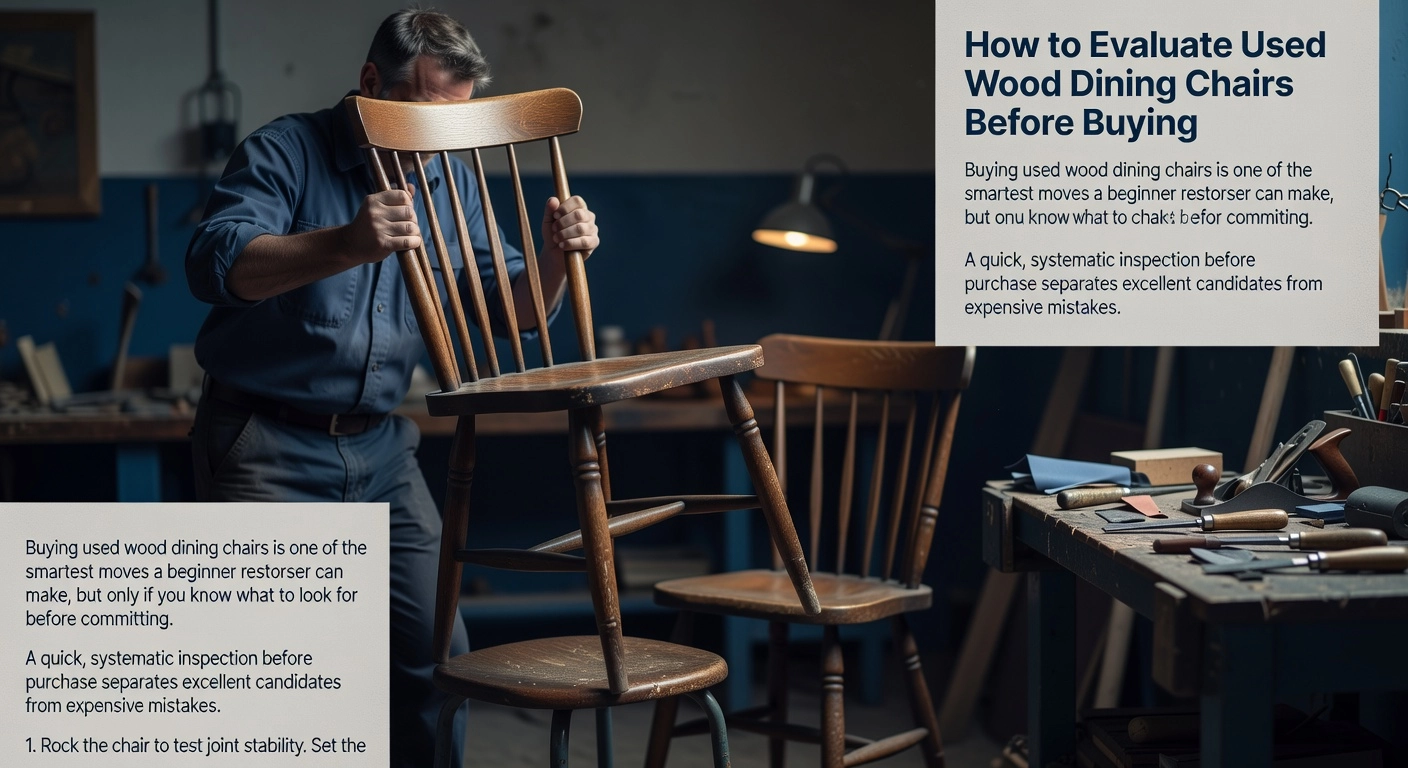
Buying used wood dining chairs is one of the smartest moves a beginner restorer can make, but only if you know what to look for before committing. A quick, systematic inspection before purchase separates excellent candidates from expensive mistakes.
1. Rock the chair to test joint stability. Set the chair on a level floor and gently push it side to side, then front to back. Any wobble, creaking, or play in the joints signals loose joinery. This is not automatically a deal-breaker. Loose joints caused by dried or failed glue are among the most common and most repairable issues in older furniture. A chair that wobbles but remains structurally intact is often a strong restoration candidate, since regluing and clamping can restore decades of solid use. According to restoration specialists at Mumford Restoration, many antique pieces simply need routine regluing as part of their normal lifecycle.
2. Inspect every joint closely for glue condition versus wood damage. Crumbling, powdery, or dried glue around a joint signals a repairable problem. Cracked or split wood at the joint itself is a different matter entirely, as it can compromise the structural integrity of the frame in ways that require more advanced skills to address. Use a flashlight and press gently on each joint to test for movement. Tight mortise-and-tenon or dowel construction is ideal. Experts who specialize in regluing furniture note that clean joint surfaces respond well to fresh adhesive when the wood itself is sound.
3. Check the seat for irreversible compression or broken webbing. Press firmly on the seat center. Foam that has flattened completely and does not spring back, or webbing that has snapped or sagged heavily, will require full seat replacement. This adds material costs, time, and upholstery steps to your project, which can overwhelm a first-time restorer. Minor sagging or soft spots are manageable; a seat that bottoms out entirely is a red flag worth factoring into your budget.
4. Flip the chair and examine the underside carefully. Previous owners often reveal a chair’s history on its underside. Look for added corner blocks, metal bracket reinforcements, filled screw holes, or mismatched wood patches. A few careful, well-executed repairs can indicate a well-maintained piece. A cluster of makeshift fixes using nails, staples, or misaligned hardware suggests recurring structural problems. Pre-owned furniture inspection guides consistently recommend this step as one of the most revealing parts of any evaluation.
5. Distinguish surface scratches from deep gouges before committing. Surface scratches and light finish wear are beginner-friendly to fix with sanding and a fresh topcoat. Deep gouges that penetrate into the wood fiber, however, require aggressive material removal that beginners can easily overdo, resulting in uneven surfaces or altered profiles on shaped legs and rails. Check under natural light by tilting the chair to catch the grain at an angle, which makes damage depth far easier to read.
6. Prioritize solid hardwood chairs from thrift stores and estate sales. Secondhand solid hardwood dining chairs, especially oak, maple, or walnut frames from earlier decades, are consistently excellent restoration candidates when joints are sound and the wood shows no cracks or active pest damage. These older pieces were typically built with construction quality that outperforms much of what is available in the mid-range market today. Weigh the asking price against your estimated material costs for glue, sandpaper, finish, and any upholstery supplies to confirm the project makes practical sense before you commit.
Building vs. Buying Wood Dining Chairs: An Honest Assessment
Dining chairs are widely regarded as one of the most technically demanding projects in all of furniture making. Unlike a table or bookshelf, a chair must survive constant dynamic stress: weight shifting, leaning, scraping across floors, and years of repeated impact on every joint. Rear legs typically require compound angles that change on two planes simultaneously, and every mortise-and-tenon connection in the assembly must hold under forces far greater than what a static table ever experiences. This introduction to chairmaking from Fine Woodworking reinforces what experienced builders consistently say: chairs are “a whole other world” compared to simpler casework.
That said, not every chair design carries the same difficulty level. A basic ladderback or straight-leg dining chair is genuinely achievable for a confident beginner who has access to a miter saw, a drill, and clamps. These designs rely on single-plane joinery and straightforward geometry. Windsor-style chairs, by contrast, require a lathe for turned spindles, spokeshaves for sculpting the seat, and specialized jigs to maintain consistent angles across a matching set. Beginners are strongly advised to build a prototype in pine or poplar first before committing to expensive hardwood, since ergonomics and seat angles are nearly impossible to evaluate on paper alone.
The Cost Comparison
On materials alone, building wins. A set of six solid oak chairs built from scratch typically costs $300 to $600 in lumber, depending on your region, wood grade, and whether you choose red or white oak. Comparable retail sets in solid hardwood generally run $800 to $2,000 or more. However, materials are only part of the equation. Once you account for time, tool investments, jig-building, and the inevitable prototype, the savings narrow considerably.
When Building Makes Sense and When It Does Not
Reddit’s r/woodworking community is consistent on this point: dining chairs demand a significant time investment, and for most beginners, buying secondhand solid-wood chairs and restoring them is the more practical starting point. A single well-built chair can take dozens of hours; multiplying that across a matching set of six is a serious commitment. The build path earns its place when you need a specific wood species to match an existing table, a non-standard seat height, or a style unavailable at retail. It also makes sense when your primary goal is developing joinery skills rather than simply furnishing a room.
For everyone else, the restoration route offers better value and a more forgiving learning curve. WoodStuffHQ’s repair and finishing guides cover exactly the problems beginners encounter on used chairs: loose joints, worn finishes, scratched surfaces, and water stains. Working through a real restoration project builds hands-on skills with wood without requiring the precision that a full build demands from the very first cut.
How to Care for Wood Dining Chairs Day to Day
Wood dining chairs are a long-term investment, and protecting that investment comes down to simple, consistent daily habits. The good news for beginners is that most damage to wood chairs is preventable with routines that take less than a minute to perform.
1. Wipe spills immediately with a dry or slightly damp cloth.
When liquid sits on a wood surface, even for a few minutes, it begins working its way beneath the finish and into the grain. This trapped moisture is what causes those familiar white rings and, over time, leads to grain swelling and warping that compromises both appearance and structure. Keep a soft microfiber cloth within easy reach of your dining area. Blot the spill rather than rubbing it, then follow immediately with a dry cloth to pull away all remaining moisture. Coasters and placemats add a useful layer of proactive protection for everyday use.
2. Use a pH-neutral cleaner for routine cleaning, not all-purpose household sprays.
Products like general kitchen sprays frequently contain ammonia, alcohol, or other solvents that gradually strip the protective finish from wood chairs. Over repeated use, this dulls the surface and leaves wood vulnerable to staining and moisture penetration. For weekly cleaning, a dry microfiber cloth wiped with the grain removes dust and light debris effectively. When deeper cleaning is needed, a cloth barely dampened with water or a few drops of mild dish soap in water is sufficient. Always dry the surface thoroughly and immediately afterward. According to Tip Top Furniture’s wood care guide, avoiding silicone-based polishes and abrasive products is equally important for preserving finish integrity long-term.
3. Apply a wood conditioner or paste wax every six to twelve months.
Wood is hygroscopic, meaning it continuously absorbs and releases moisture from the surrounding air. In heated interiors or dry climates, this cycle causes wood to dry out, leading to surface cracks and weakened joints. A quality paste wax or wood conditioner applied every six to twelve months replenishes that moisture balance and reinforces surface protection. Apply in thin coats working with the grain, allow to dry fully, then buff to a low sheen. Always test any product in a hidden area first, since different finishes respond differently to conditioning treatments.
4. Use felt pads on all chair feet and lift rather than drag.
Every time a chair is dragged across hardwood or tile, the feet grind against the floor and absorb the friction as wear on both surfaces. Self-adhesive felt pads placed on all four feet cushion this contact and protect your floors and chair legs simultaneously. Make a habit of checking and replacing worn pads every few months, since a compressed or missing pad offers little protection. Training every household member, including children, to lift chairs rather than slide them is one of the highest-impact habits you can build.
5. Keep chairs away from direct sunlight and heating vents.
UV exposure fades and breaks down wood finishes unevenly, which is especially visible across a matched set of chairs where some receive more light than others. Heat sources like vents and radiators accelerate drying, which leads to shrinking, surface cracking, and loosened joints over time. Position chairs away from south-facing windows and use curtains or UV-filtering window film where direct sun is unavoidable. A humidifier during winter months helps stabilize indoor humidity and reduces stress on the wood considerably.
6. Never drape wet towels or damp cushions over chair backs.
This habit is one of the most overlooked causes of finish breakdown in dining chairs. Sustained contact with moisture softens the finish, seeps into joints, and can lead to mold in confined areas. Because wood naturally absorbs moisture from its environment, prolonged dampness causes swelling and weakens the glue bonds holding joints together. If moisture does land on a chair back, wipe it away immediately and ensure the area dries completely with good airflow before the chair is used again.
Consistent attention to these six practices will preserve the finish, structural integrity, and appearance of your wood dining chairs for decades. The effort involved is minimal; the protection they provide is substantial.
The Most Common Wood Dining Chair Repairs and How to Fix Them
Even well-built wood dining chairs develop problems over time, and most of those problems are far more fixable than they appear. Understanding the most common issues gives you the confidence to restore rather than replace, saving money while keeping quality furniture in service.
1. Wobbly Joints: The Most Common Complaint
A wobbly chair almost always comes down to dried-out glue rather than broken wood. Mortise-and-tenon, dowel, and rung joints rely entirely on adhesive bonds that degrade over years of stress and humidity changes. The wood itself is typically fine. This means the repair is within reach for any beginner with wood glue and a few clamps.
The key mistake to avoid is simply injecting glue into a loose joint without disassembly. Old glue residue blocks fresh adhesive from bonding properly, and the repair fails quickly under load. According to Popular Woodworking’s guide on regluing doweled chairs, full disassembly and thorough surface cleaning is the reliable method.
2. How to Reglue a Loose Rung or Stretcher
Remove the loose piece completely using a rubber mallet and careful pressure. Clean all dried glue from both mating surfaces using a chisel, scraper, or 120-grit sandpaper, working carefully to avoid reshaping the wood or creating gaps. Apply fresh PVA or Titebond-style wood glue to all contact surfaces, reassemble the joint, and clamp firmly. Hold the clamp for at least one hour, though stress-bearing joints benefit from a full 24-hour cure. Keep the chair on a flat surface during clamping to avoid locking in a twist.
3. Sagging Drop-In Seats
Drop-in upholstered seats sag when foam compresses or degrades over time. The fix is straightforward: remove the seat panel, pull out the old staples with pliers, replace the foam layer with high-density upholstery foam, and re-staple the fabric using a basic staple gun. Materials cost between $5 and $20 depending on seat size and foam density. Adding a thin layer of Dacron batting over the foam before stapling gives the seat a smoother, fuller shape. No specialized upholstery tools are required.
4. Surface Scratches
Light scratches on oiled or waxed finishes respond well to paste wax buffed along the grain with a soft cloth or 0000 steel wool. For color matching, a wood touch-up marker or wax crayon blended into the scratch keeps the repair nearly invisible. Deeper gouges may need wood filler before waxing.
5. White Water Stains
White rings indicate moisture trapped in the finish layer. Sand lightly with 220-grit paper along the grain, then reapply the original finish type, whether oil, wax, or lacquer, to restore an even surface. Black stains signal deeper damage and require more extensive refinishing.
6. Repair vs. Replace: A Quick Checklist
Before buying a replacement, run through these three checkpoints. If the joints can be reglued, the wood frame is uncracked, and surface damage is shallower than 2mm, restoration will almost always cost less than replacement. Solid construction, sentimental value, and sustainability all favor repair. A Furniture Today survey found that 68% of furniture owners now prefer repairing quality pieces over replacing them, up from 47% in 2020, driven largely by rising furniture costs and environmental awareness.
Refinishing Wood Dining Chairs to Match 2026 Design Trends
Refinishing an existing wood dining chair is one of the most rewarding projects a beginner can take on, especially right now when the design direction strongly favors exactly what a well-restored vintage chair delivers. Understanding which trends are driving 2026 dining room aesthetics helps you make smart finishing decisions rather than guessing.
1. Embrace the Warm, Low-Sheen Wood Finish That Defines 2026
The dominant material story in 2026 dining rooms is warm wood with visible grain and a matte or lightly oiled surface. Design reports from multiple sources highlight honey oak, walnut, and mid-brown tones as the preferred palette, with ultra-matte and penetrating oil finishes replacing the high-gloss polyurethane coats that defined furniture finishing in previous decades. A vintage oak chair that you strip back to bare wood and treat with a penetrating oil is not a compromise or a budget workaround. It is precisely what current design direction calls for. The goal is authenticity: a surface that looks touched, honest, and natural rather than sealed under plastic.
2. Restore Mismatched Chairs Intentionally
Multiple 2026 trend reports confirm that uniform matching dining sets have given way to intentional mix-and-match seating as the preferred aesthetic. This is excellent news for anyone restoring secondhand chairs, because you no longer need to find six identical chairs to achieve a cohesive look. Finishing two or three different chair styles in complementary wood tones, or pairing a natural oil finish with a lightly waxed surface, creates the layered and collected feeling that designers are actively recommending. The key is maintaining cohesion through consistent seat height, a shared color palette, or a repeated material like a matching upholstered pad.
3. Convert a Polyurethane Finish to an Oiled Surface
To move a polyurethane-coated chair into 2026 finish territory, you need to remove the existing film-forming coat entirely before applying oil. Use a chemical stripper or sand progressively to 120-grit until the surface is bare and open-pored. Penetrating oils, including tung oil and hardwax oil, do not bond reliably over existing finishes because they need to soak into the wood fiber rather than coat over a sealed surface. Once bare, apply two to three thin coats, wiping each coat on and then wiping off the excess before it becomes tacky. Allow full curing time between coats following the product label, and work in a ventilated space.
4. Reupholster the Seat Pad to Hit 2026 Upholstery Trends
Replacing a worn seat pad fabric is a low-skill, high-impact update that requires no structural work on the chair itself. In 2026, velvet, bouclé, and textured weave fabrics in warm neutrals are the materials that designers are consistently recommending for dining seating. These fabrics add tactile depth, pair naturally with oiled wood frames, and support the comfort-first direction that is shaping dining room design. For families, performance versions of these fabrics offer stain resistance without sacrificing the soft, upholstered look. Remove the seat panel, pull the old fabric taut over fresh foam or batting if needed, and staple the new fabric to the underside.
5. Soften a Boxy Frame Without a Full Rebuild
Sculptural and curved organic forms are among the most cited 2026 chair trends, but replicating those shapes from scratch is genuinely difficult even for experienced woodworkers. The practical approach for a beginner working with an older, more angular chair is to soften what is already there. A hand plane or a router with a roundover bit can ease sharp corners on legs, rails, and arm edges. A spokeshave, which is a small hand tool designed for curved surfaces, lets you refine and slightly hollow chair back uprights to read as less rigid. These modest changes shift the silhouette toward a gentler profile that reads as intentional rather than dated.
6. Choose Sustainable Finishing Products
Low-VOC oils, water-based lacquers, and natural waxes are not just environmentally responsible choices; they also produce genuinely beautiful results on oak, walnut, and cherry. Experts note that water-based systems have improved dramatically in clarity and durability, and they dry faster with minimal odor, which matters in a home setting without spray equipment or a dedicated shop. Hardwax oils are especially valued for their repairability: a scratched section can be spot-treated without refinishing the entire piece. Choosing these products supports a sustainable restoration narrative that aligns with what a growing segment of consumers and designers are prioritizing heading into 2026.
Sustainable Wood Choices and Why They Matter for Dining Chairs
Sustainability is no longer a niche concern in furniture buying; it has become a genuine purchasing priority for a growing segment of homeowners. Wood already holds a 32.8% share of the global dining chairs market, and the direction consumers are pushing that market toward is increasingly responsible sourcing, material reuse, and lower-impact finishing. Here are five sustainable choices worth understanding before you buy, build, or restore your next set of dining chairs.
1. Choose FSC-Certified Wood When Buying New
FSC certification, issued by the Forest Stewardship Council, verifies that lumber was harvested from forests managed to protect biodiversity, workers’ rights, and long-term forest health. For beginners, it is the simplest, most reliable way to confirm that a new wood dining chair was not sourced through destructive logging practices. The good news is that FSC-certified options have become widely accessible. Major home improvement retailers and specialty lumber dealers now stock certified hardwoods, and many furniture brands prominently label FSC products. When shopping, look for the FSC logo on product listings or ask suppliers directly about their chain-of-custody certification.
2. Consider Reclaimed Wood for Character and Lower Carbon Impact
Reclaimed wood dining chairs have shifted from niche curiosity to mainstream appeal. Wood salvaged from old barns, factories, and structural timbers often comes from older-growth trees with tighter grain patterns and greater density than most newly harvested lumber. That density translates to durability, and the aged surface, knots, and natural imperfections deliver visual warmth that new wood simply cannot replicate. Beyond aesthetics, reclaimed wood avoids the emissions associated with harvesting and processing new timber, making it a genuinely lower-carbon material choice.
3. Restore Secondhand Solid-Wood Chairs Instead of Replacing Them
Buying a solid-wood chair secondhand and restoring it rather than purchasing new is one of the most practical forms of circular furniture ownership available to homeowners. Every restored chair represents one fewer chair manufactured, reducing raw material consumption and production emissions at the source. Previous sections of this guide have covered what to inspect before buying used chairs and how to handle the most common repairs; that knowledge directly supports this sustainability practice. The secondhand furniture market is growing rapidly, driven by exactly this combination of cost savings and environmental awareness.
4. Switch to Low-VOC or Water-Based Finishes
Finishing products have improved dramatically, and there is no longer a meaningful performance trade-off when choosing low-VOC or water-based options for dining chairs. Water-based polyurethanes, hardwax oils, and plant-based varnishes now deliver scratch resistance and durability comparable to traditional solvent-based finishes in most household applications. They also dry faster, produce far less odor, and support healthier indoor air quality. For a beginner refinishing dining chairs at home, these products are genuinely easier to work with while being better for both the environment and your household.
5. Source Locally Milled Hardwoods When Possible
Choosing hardwoods milled within your region cuts the transport emissions embedded in lumber that has traveled thousands of miles before reaching a workshop. Local sourcing also supports smaller sawyers and family-operated woodlots, keeping forestry revenue in regional economies. Many sustainability-conscious buyers find that locally sourced wood carries a transparency and traceability that large commodity supply chains rarely offer, which adds its own value alongside the reduced carbon footprint.
Choosing, Caring For, and Restoring Your Wood Dining Chairs

Here is a consolidated summary of everything covered across this guide, distilled into five actionable principles every beginner should carry forward.
- Choose white oak or maple for high-use family settings. Both species combine Janka hardness ratings above 1,360 with joinery that holds up to years of daily stress. Their structural integrity means repairs stay simple rather than becoming full replacements.
- Buy secondhand first, then restore. Quality used chairs with sound joints and intact wood offer the best value entry point. A thorough pre-purchase inspection protects your investment before a single dollar is spent on materials.
- Keep daily care simple and consistent. Blot spills immediately, condition the wood periodically, and install felt pads on chair feet. These three habits prevent the vast majority of wear problems beginners encounter.
- Tackle common repairs with confidence. Loose joints, sagging seats, and surface scratches all respond well to basic tools and modest material costs. Each repair you complete extends chair life and builds your skills.
- Refinish with penetrating oil or a matte finish. This single step protects the wood structurally while delivering exactly the warm, low-sheen aesthetic that defines the most popular 2026 dining room interiors, making restoration both practical and a genuine design upgrade.
Conclusion
Choosing the right wood dining chairs does not have to feel overwhelming. By understanding the different types of wood, prioritizing solid construction, considering everyday comfort, and matching your chairs to your existing style, you can make a decision you will feel confident about for years to come.
Wood dining chairs are more than just furniture. They are the foundation of shared meals, meaningful conversations, and lasting memories. Investing the time to choose wisely means you will end up with seating that fits your home, your lifestyle, and your budget perfectly.
Now it is time to put this knowledge to work. Visit a few local furniture showrooms, compare options online, and trust what you have learned here. The perfect dining chairs are out there waiting for you.