If you have ever held a piece of balsa wood in your hands, you already know there is something almost magical about it. It feels impossibly light, like you could blow it away with a gentle breath, yet it holds together surprisingly well. That combination is exactly why so many crafters, hobbyists, and model builders absolutely love working with it.
But here is the thing: balsa wood can be a little tricky to finish. Because it is so soft and porous, it absorbs stains and paints in unpredictable ways, which can leave beginners feeling frustrated when their project does not turn out the way they imagined.
The good news? Finishing balsa wood beautifully is totally achievable once you understand a few key steps. In this tutorial, we are going to walk through exactly what balsa wood is, why it behaves the way it does, and how to prep and finish it like a pro. Whether you are working on a model plane, a school project, or a fun craft, you will walk away with the confidence and know-how to get a smooth, polished result every single time.
What Is Balsa Wood?
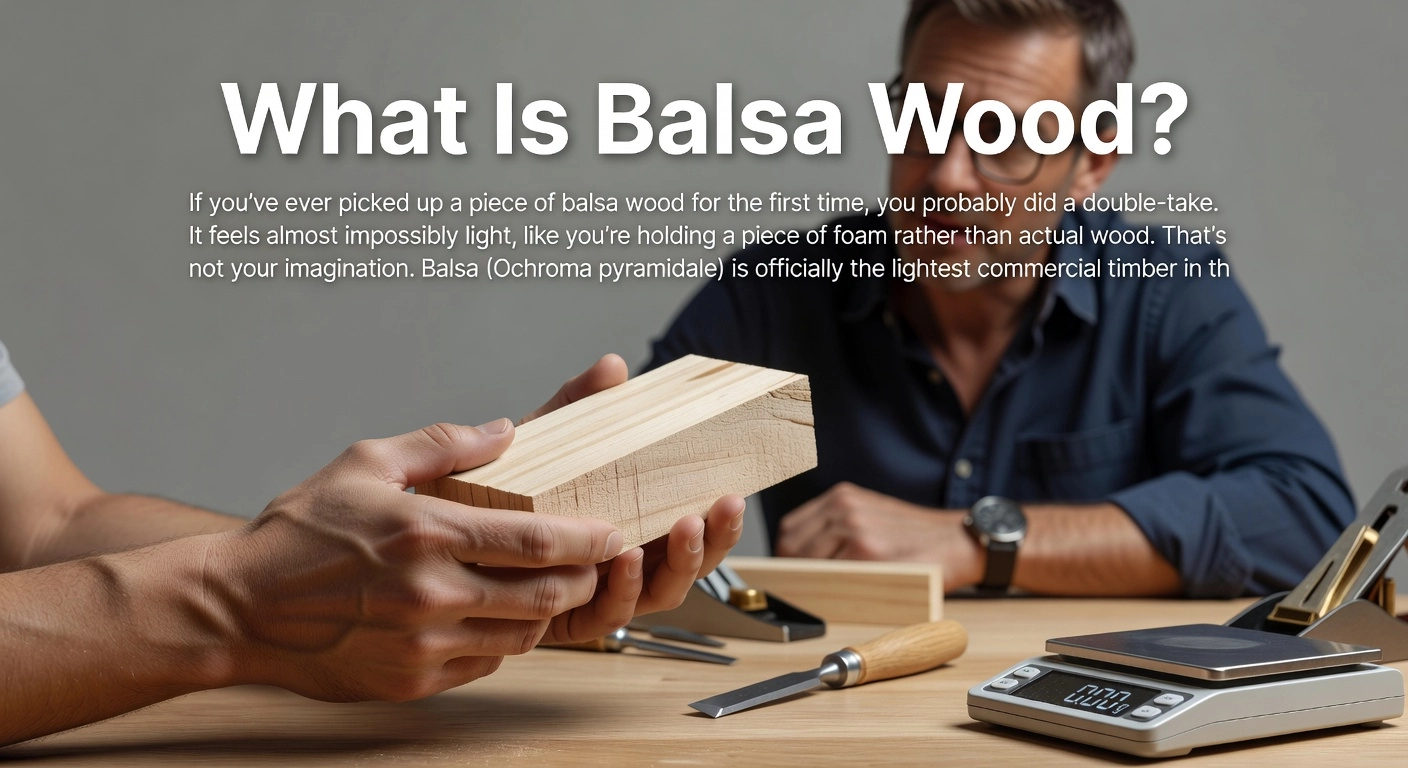
If you’ve ever picked up a piece of balsa wood for the first time, you probably did a double-take. It feels almost impossibly light, like you’re holding a piece of foam rather than actual wood. That’s not your imagination. Balsa (Ochroma pyramidale) is officially the lightest commercial timber in the world, with a density that typically falls between 120 and 220 kg/m³. To put that in perspective, most hardwoods you’d find at a lumber yard clock in at 600 kg/m³ or higher. Its Janka hardness rating sits at just 67 lbf, which is about as soft as commercial wood gets.
Here’s something that trips up a lot of beginners: balsa is technically classified as a hardwood. That label comes from its botanical family, not its physical properties. Hardwoods come from flowering, broad-leaved trees, while softwoods come from conifers. So despite feeling nothing like oak or maple, balsa earns the hardwood title purely on a botanical technicality. In practice, it cuts like butter, dents easily, and requires a completely different approach than traditional hardwoods.
Visually, balsa is easy to spot. It ranges from bright white to a pale oatmeal color, with a smooth, almost silky surface texture that looks and feels refined for such a lightweight material.
One reason balsa stays relatively affordable and accessible is its remarkable growth rate. These trees shoot up to 18 to 28 meters in just 10 to 15 years, making plantation-grown balsa one of the more sustainable timber options available. Ecuador has long dominated global production, but Papua New Guinea has steadily grown into a meaningful secondary source in recent years, helping diversify supply for buyers worldwide.
Why Balsa Behaves So Differently From Other Woods
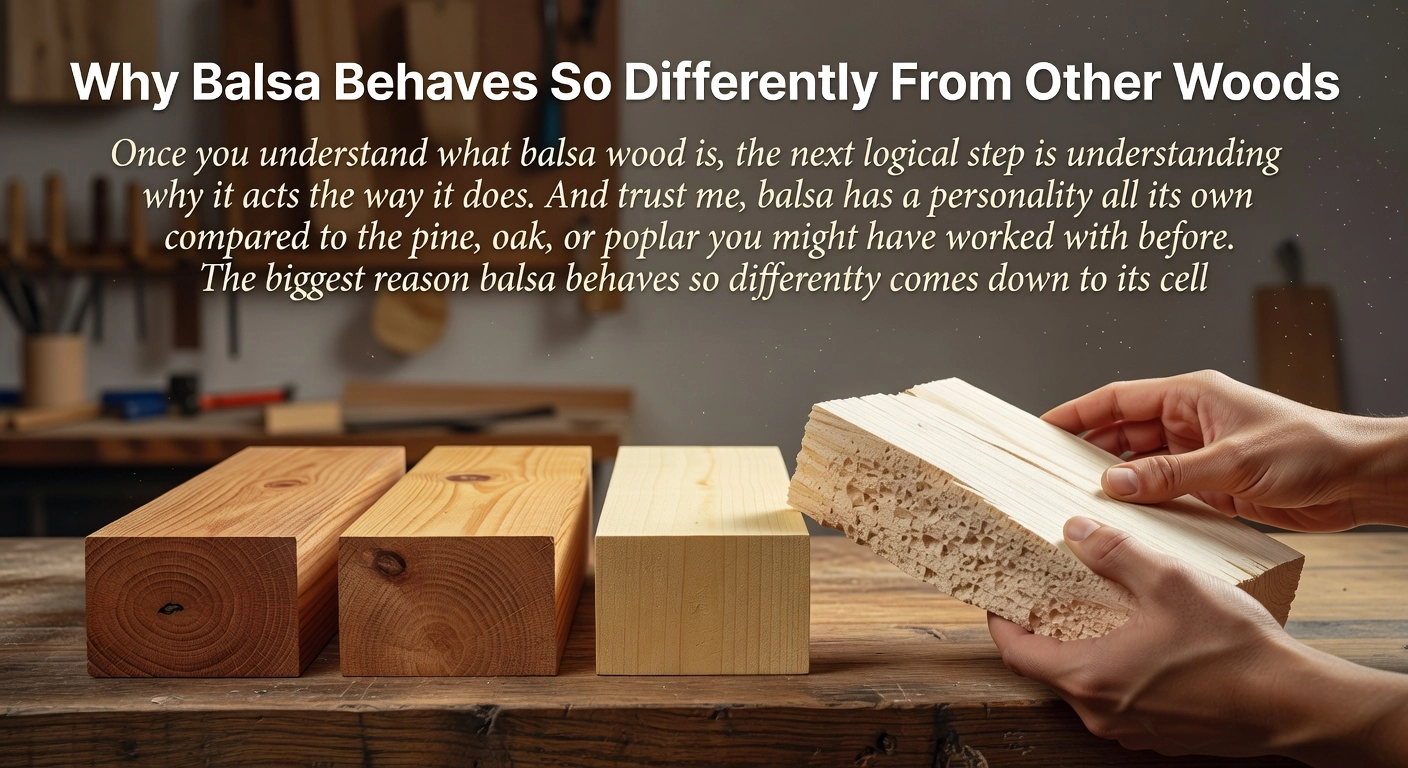
Once you understand what balsa wood is, the next logical step is understanding why it acts the way it does. And trust me, balsa has a personality all its own compared to the pine, oak, or poplar you might have worked with before.
The biggest reason balsa behaves so differently comes down to its cell structure. Balsa has an open, highly porous cellular makeup where the cells are large, thin-walled, and packed with air. In fact, in lower-density specimens, porosity can exceed 90%, meaning most of what you’re holding is literally empty space. When you apply any liquid finish, paint, or glue, it doesn’t sit on the surface the way it would on a denser wood. It gets pulled straight in, almost like a sponge. This is why jumping straight to paint without a sealer first almost always produces a blotchy, uneven result with balsa. The deeper pores absorb more liquid than the shallower ones, creating patchy, inconsistent coverage. A thin sanding sealer or primer coat applied first fills those pores and gives your finish an even base to work with.
Density also plays a huge role in how you physically handle balsa. With a Janka hardness rating of just 67 lbf (compared to around 900 lbf for hard maple), balsa crushes and dents far more easily than typical craft or furniture woods. When sanding, a light touch with fine-grit paper is all you need. Pressing too hard will compress the surface or leave visible grooves. The same rule applies when cutting; let the blade do the work rather than forcing it through. According to wood shrinkage data from Woodbin, balsa also shrinks roughly 2.3% radially and 6.0% tangentially as moisture levels change, which means thin sheets can warp or crack surprisingly fast if humidity shifts and they aren’t sealed properly.
Here is the encouraging flip side, though. While balsa’s absolute strength is low, its specific strength, meaning how strong it is relative to its weight, is genuinely impressive. Research on balsa’s cellular composition from MIT highlights how its cellulose microfibrils are tightly aligned with very low microfibril angles, making the cell walls surprisingly efficient at bearing loads for their mass. The lesson for beginners is this: don’t try to muscle through balsa with brute force. Work with its properties using sharp tools, light pressure, and proper prep, and it will respond beautifully.
It Is Technically a Hardwood That Acts Like Neither
Here’s something that trips up almost every beginner: balsa wood is technically classified as a hardwood. That sounds wild, right? But the hardwood label has nothing to do with how hard or dense a wood actually is. It’s purely a botanical thing. Hardwoods come from flowering broadleaf trees, called angiosperms, while softwoods come from cone-bearing trees like pine or spruce. Balsa happens to be a tropical broadleaf species, so botanically speaking, it earns the hardwood title, even though it would lose a staring contest with wet cardboard.
The numbers tell the real story. Most true hardwoods like ash or hickory score somewhere between 1,200 and 1,800 lbf on the Janka hardness scale, which measures how much force it takes to dent a wood’s surface. Balsa scores just 67 lbf. For comparison, Western red cedar, which most people think of as a soft, lightweight softwood, clocks in around 350 lbf. That means balsa is genuinely softer than many woods that carry the “softwood” label. You can read more about how hardwood and softwood are actually defined to see just how misleading the terminology gets.
For beginners, this classification confusion causes real problems. Someone reads “hardwood” and reaches for techniques meant for oak or maple. They apply heavy varnish, sand aggressively, or press too hard with tools, and the balsa either gets crushed, drinks up the finish unevenly, or falls apart. Those techniques were built around woods with completely different density and surface structure.
The fix is simple but important: stop trying to fit balsa into either box. Treat it as its own unique material category, and your results will improve immediately.
The Open Cell Structure Problem Every Finisher Needs to Know
Think of balsa’s interior like a bundle of drinking straws packed loosely together. The cells are large, thin-walled, and leave a tremendous amount of open space between them, with only about 40% of a typical piece being actual solid material. This is what makes balsa so featherlight, but it also means the wood behaves more like a sponge than a solid surface when you try to finish it.
That sponge-like quality creates a real headache at the painting stage. Paint, stain, and even watered-down glue absorb at wildly different rates depending on where they land on the grain. End grain soaks up finish almost instantly, while flatter sections drink it in more slowly. The result is a blotchy, uneven appearance that no amount of extra coats will completely fix once it sets in. This uneven absorption is, hands down, the single most common reason beginner balsa projects end up looking rough or patchy, and the frustrating part is that the wood itself is not to blame at all.
The good news is that this problem is entirely preventable with one simple step: applying a grain sealer or sanding sealer before any decorative finish. The tricky part is that balsa’s open cell structure is not obvious just by looking at it. Raw balsa looks smooth and almost silky, so many beginners jump straight to paint, completely skipping the sealer step without realizing it matters.
A few thin coats of sanding sealer, with a light sand between each one, fills and stabilizes those open pores before paint ever touches the surface. Once that sealed base is in place, balsa actually takes paint beautifully, producing a smooth, even, almost professional-quality finish that is totally achievable by hand.
Common Uses for Balsa Wood and Why Each One Matters
Balsa wood shows up in more places than most beginners expect, and knowing where it gets used helps you make smarter decisions about how to work with it on your own projects.
Model making and RC aircraft are probably the first things that come to mind, and for good reason. Balsa has been the go-to material for model planes, boats, and architectural prototypes since the late 1920s. Its combination of low weight and easy cutting means you can shape an entire wing frame with nothing more than a craft knife and a cutting mat. Lighter balsa stock works beautifully for non-load-bearing parts like wingtips, while slightly denser pieces handle structural roles like spars and stringers. The result is a model that’s both rigid and light enough to actually fly well.
Craft and school projects are where balsa really shines for beginners. You can score it, bend it gently along the grain, carve it, and paint it without a single power tool involved. That forgiving quality makes it ideal for STEM bridge-building contests, miniature dioramas, and creative art projects where the focus should be on the design process, not fighting the material.
At an industrial scale, balsa plays a surprisingly large role. It serves as a core material sandwiched between fiberglass or carbon fiber skins in wind turbine blades, boat hulls, and aerospace panels. The wind and renewable energy segment accounts for roughly 51% of global balsa demand, driven by the need for longer, lighter turbine blades.
Musical instrument makers use balsa in a more niche but interesting way, incorporating it into internal bracing and resonance components where shaving off weight can improve a soundboard’s responsiveness and projection.
The practical takeaway here is straightforward: your end use should drive every finishing and adhesive decision you make. A hobby RC plane calls for lightweight sealers and flexible finishes, while a moisture-exposed marine application demands epoxy and edge sealing to prevent balsa’s notoriously porous cells from absorbing water. Match the approach to the application, and you’ll get far better results every time.
Buying Balsa Wood: What to Look For Before You Start
Walking into a craft store or browsing an online supplier without knowing what to look for can leave you overwhelmed fast. Balsa comes in sheets, strips, and blocks, and each form serves a different purpose. Thin sheets work beautifully for wing surfaces and flat panels. Strips and sticks are your go-to for building frames, stringers, and structural edges. Blocks suit carving projects or any component that needs solid mass. Matching the right form to your project from the start saves you money and keeps frustration to a minimum.
When it comes to grade, Grade A balsa is the clear winner for most beginners and hobby builders. It features low density and a uniform cell structure that makes cutting, sanding, and gluing far more predictable. Grade A holds approximately 52.7% of the commercial balsa market, which tells you it’s the industry standard for good reason. Lower grades exist and cost less, but they often lack the consistency that makes finishing so much easier.
One thing that surprises many beginners is that density can vary within a single sheet. A piece that looks uniform might feel noticeably stiffer in one corner compared to another. When shopping in person, gently squeeze or flex the wood along its length to check for even resistance. Online buyers should look for suppliers who provide density specs or sell pre-sorted, weighed stock. Checking supplier product details before purchasing can save you from getting stuck with inconsistent material.
It is also worth paying attention to weight relative to size. If a piece of balsa feels heavier than expected, that is usually a sign of higher moisture content or a lower-quality grade. Wood like that is harder to finish evenly and more prone to warping as humidity changes.
Finally, keep an eye out for FSC-certified balsa when you can find it. Certified options are increasingly available and support responsible forestry practices, which matters more and more to both hobbyists and the industry as a whole.
How to Prepare Balsa Wood Before You Apply Any Finish
Good preparation is what separates a smooth, professional-looking balsa project from one that looks rough and patchy no matter how carefully you painted it. Because balsa is so soft and porous, the steps you take before applying any finish matter more here than with almost any other wood.
Start with 150 to 180 grit sandpaper, and use a lighter touch than you think you need. Balsa has a Janka hardness of only around 67 lbf, which means it compresses and dents under very little force. If you press too hard while sanding, you will actually push the fibers down rather than smooth them away, leaving you with an uneven surface that is harder to fix than what you started with. Use a sanding block to keep pressure distributed evenly across the surface, and let the paper do the work rather than your arm strength.
Once the surface feels smooth and any rough spots are gone, switch to 220 grit for a final pass. Always sand in the direction of the grain, never across it. Balsa fibers are fragile enough that cross-grain sanding can tear them, leaving a fuzzy or damaged texture that shows right through paint. Short, consistent strokes following the grain will give you a clean, uniform surface that is ready for the next step.
After sanding, wipe the entire surface with a barely damp cloth to remove all the fine dust. Do not let it get wet, just lightly damp. Then set the wood aside and let it dry completely before you do anything else. Even a small amount of leftover moisture can cause the grain to raise, which means you will end up with a rough surface again right after you thought you were done.
Now comes the step that most beginners skip and almost always regret skipping: sealing. Apply a thin coat of sanding sealer or a 50/50 mix of PVA glue and water across the entire surface. This fills balsa’s open pores and creates a stable base for paint or any decorative finish. Let it dry fully, then sand lightly one more time with 220 grit. You will immediately notice the difference in how smooth the surface feels. According to WikiHow’s guide on painting balsa wood, this grain-filling step is essential for getting an even, attractive result.
Never skip the sealing step, even if you are short on time. As the Rocket N00b blog on balsa grain fillers points out, skipping it almost always results in a blotchy, textured finish because the raw wood soaks up paint unevenly across its pores. Of all the preparation steps, sealing makes the single biggest visible difference to how your finished project looks.
The Sanding Sequence That Prevents Crushing and Tearing
Sanding balsa wood without crushing or tearing it comes down to one rule above everything else: never sand with bare fingers on a flat surface. Your fingertips create uneven pressure points that push directly into balsa’s soft fibers, leaving dips and low spots that are nearly invisible until your finish goes on and suddenly every flaw jumps out. Instead, use a simple sanding block to spread that pressure evenly across the whole surface. You can buy one or just wrap your sandpaper around a small scrap piece of firm material. Either way, the flat face of the block keeps the wood flat while you work.
For curved or shaped pieces, the flat block actually becomes the problem. Pressing a rigid block against a curved surface creates its own kind of point loading at the edges. Wrap your sandpaper around a dowel for concave curves, or use foam-backed sandpaper that flexes and conforms naturally to the shape without concentrating force in one spot.
One habit that will save you a lot of frustration is checking your work frequently with a raking light. Hold the piece at a low angle toward a window or angled lamp and watch how the shadows fall across the surface. Dents, ridges, and uneven patches that feel invisible to your fingertips show up clearly this way. The AMA Flight School sanding guide emphasizes this kind of inspection at every stage, not just at the end.
After you apply your sealer and re-sand with 220 to 320 grit, run your hand across the surface. It should feel noticeably stiffer and smoother than raw balsa, almost like a different material entirely. That change in texture is your confirmation that the sealer soaked in and did its job properly.
Best Finishes and Adhesives for Balsa Wood Projects
Once you’ve prepped your surface, the next decision is which glue and finish to reach for, and getting this right makes a bigger difference than most beginners expect.
PVA glue is your best starting point for both light bonding and sealing. When you dilute it with a small amount of water (roughly one part glue to three or four parts water), it brushes onto balsa like a thin primer coat, sealing the porous surface without adding significant weight. It’s affordable, widely available, and completely beginner-friendly. Once it cures, you can sand it smooth without much effort, and it won’t clog your sandpaper the way some heavier products do. For non-critical joints where you need a little repositioning time, full-strength PVA gives you a workable window to adjust pieces before the bond sets.
CA glue, also called cyanoacrylate or super glue, is the go-to choice for speed and strength in RC aircraft building. Thin CA wicks instantly into tight balsa joints through capillary action, creating a bond that’s often stronger than the wood itself. Medium or thick versions fill small gaps without much fuss. The major trade-off is that you get almost no repositioning time once parts touch, so dry-fit everything carefully before you apply a single drop. Work in a ventilated area and keep a cloth nearby, because it bonds skin just as eagerly as balsa.
Two-part epoxy delivers the strongest possible joint for high-stress areas like wing roots, landing gear blocks, or structural repairs. The downside is real weight gain, which matters significantly in any flying model. Most experienced builders limit epoxy to a handful of critical spots rather than using it throughout a build.
For decorative work, water-based acrylic paints applied in thin coats over a sealed surface dry quickly and add minimal weight. Lacquer is a better choice for projects that get handled often, since it cures into a harder, more protective film. Avoid oil-based varnishes and heavy solvents entirely on lightweight projects, as they soak deep into balsa’s open cells and add surprising weight. Whatever product you plan to use, test it on a scrap piece first to see exactly how your specific balsa absorbs it before committing to your actual project.
Primers and Sealers That Actually Work on High-Porosity Wood
Your best all-around option is a dedicated sanding sealer, which you can find at any hardware store, craft supplier, or hobby shop. These products are specifically formulated to fill the open grain of highly porous wood before you apply paint or a topcoat. They go on thin, sand back easily, and add minimal weight to your project, which matters a lot if you’re building a model aircraft or rocket where even a few extra grams can affect performance. Two or three light coats, sanded lightly between each one, will give you a noticeably smoother surface to work with.
If you’re painting your balsa project, shellac-based primer is another excellent choice. It dries in minutes rather than hours, soaks into the grain without raising it significantly, and creates a solid seal against paint absorption. This makes your topcoats look more even and reduces the number of paint layers you need to get good coverage.
On a tighter budget, diluted PVA works surprisingly well. Mix one part white wood glue with two or three parts water, then brush on two or three thin coats, letting each one dry completely before adding the next. It’s beginner-friendly, easy to find, and costs almost nothing.
Two things to avoid: thick automotive or masonry primers, which add unnecessary weight and can bury fine details in your work, and the temptation to slap on one heavy coat of anything. Thin balsa sheet stock warps easily because one side absorbs liquid faster than the other. Always apply sealers in thin, balanced coats, and your pieces will stay flat.
Protecting Balsa from Moisture, Brittleness, and Insects Over Time
Balsa is only mildly rot-resistant on its own, and without a protective finish, moisture will find its way in fast. Because of that open cell structure we talked about earlier, unsealed balsa acts almost like a sponge, pulling in humidity from the air and swelling, warping, or discoloring over time. Any project you plan to keep, display, or store for more than a few weeks really does need a proper topcoat to hold up. Think of the finish not just as something that makes your project look polished, but as a barrier that keeps environmental moisture from slowly destroying the wood from the inside out.
Insects are another threat that beginners often overlook entirely. Untreated balsa stored in boxes or on shelves in garages and basements is surprisingly vulnerable to termites and wood-boring beetles, partly because its soft structure is easy to penetrate. Sealed and finished pieces create a physical barrier that makes the wood far less accessible. If you have unfinished sheets or strips sitting in storage, keeping them in a sealed container adds an extra layer of protection beyond just the material itself.
Brittleness is a slower problem, but it sneaks up on you. In low-humidity environments, balsa gradually loses its natural moisture content and becomes noticeably more fragile, especially in thin strips or sheets. A light coat of a wood conditioner worked into the surface can moderate that moisture exchange and preserve a bit of flexibility before things get too dry and snappy.
For unfinished stock you haven’t gotten to yet, store it flat on a stable surface away from windows, heat vents, and direct sunlight. Stacking sheets with small spacers between them allows air to circulate without trapping moisture unevenly.
For anything going outdoors or into a damp space, apply an exterior-grade water-based topcoat in multiple thin layers rather than one heavy coat. Thin layers add protection without significantly weighing down the piece, which matters a lot when you’ve chosen balsa specifically for its lightness.
Repairing Damaged Balsa: Holes, Cracks, and Clean Breaks
Balsa gets dinged, cracked, and broken more than almost any other wood you’ll work with, so learning to repair it is just as important as learning to cut and finish it. The good news is that most damage is totally fixable with a few simple materials you probably already have on hand.
For small holes and dings, the best approach is a paste made from fine balsa sanding dust mixed with thin CA glue. Collect the dust by sanding a scrap piece of matching balsa, pack the dust into the defect, then wick thin CA glue over it. The glue pulls into the porous wood through capillary action, binds the dust instantly, and cures into a fill that’s hard, lightweight, and sands down smooth. Lightweight wood filler works too if you don’t have CA glue nearby, but the balsa dust method tends to blend more naturally with the surrounding surface.
Clean breaks are probably the most common repair you’ll make, especially if you’re working on model aircraft after a rough landing. Align the broken pieces carefully, apply thin CA glue along the break line, and hold the joint firmly together for 30 to 60 seconds. The glue wicks into both sides of the break and creates a surprisingly strong bond without adding noticeable weight or bulk. For breaks in high-stress spots, follow up with a small fillet of medium CA or epoxy along the seam for extra reinforcement.
Larger holes or missing chunks call for a patch cut from balsa stock that matches the density of the original piece as closely as possible. Shape the patch to fit snugly, glue it in place with PVA for non-critical areas or epoxy where structural strength matters, then fill any small gaps with the dust-and-CA method before sanding flush.
Once any repair is complete, re-seal that area before you repaint. Patched sections absorb finish at a different rate than the surrounding wood, which creates blotchy spots or visible patches under your topcoat. A coat of sanding sealer brushed over the repair and blended into the surrounding area fixes this completely.
Before you apply that final finish, hold a bright light at a low angle across the repaired surface. This raking light technique reveals any high or low spots that would otherwise be invisible under direct lighting. Aim for a slight overfill when applying any filler because sanding back excess is straightforward, while underfilled spots require going back through the entire fill-and-cure cycle again.
Why Balsa Makes an Excellent Practice Wood Before Bigger Projects
If you’ve put in the work learning how to prep and finish balsa through the earlier steps in this guide, you’re actually sitting on a bigger advantage than you might realize. All of that practice has been quietly training you for something much more valuable: tackling real furniture, cabinets, and wood surfaces without making expensive beginner mistakes.
Balsa is one of the cheapest woods you can buy. Small sheets and strips cost a fraction of what you’d pay for oak, maple, or walnut, which means you can run through a full finishing sequence, mess it up, sand it back, and try again without feeling like you wasted anything. That low financial risk is exactly what makes it such a smart practice material. You get genuine, hands-on repetition with sealing, priming, and painting techniques before you ever commit those same methods to a countertop or a piece of heirloom furniture.
Here’s the part that really pays off over time. Because balsa is so demanding, it forces you to develop good habits. Sealing thoroughly, sanding with light and even pressure, applying thin coats rather than thick ones; these aren’t just balsa-specific tricks. They’re the same fundamentals that prevent blotching, peeling, and rough finishes on any wood you’ll ever work with. Mastering the hard version first makes the easier version feel straightforward.
You can also use small balsa test pieces to see exactly how a product behaves on porous wood before using it anywhere important. Does that water-based sealer raise the grain? Does that spray paint go on evenly with one coat or two? Balsa answers those questions fast and cheaply.
Best of all, a full practice cycle on a small balsa piece, prep through final coat, takes just an afternoon. That quick turnaround means you can evaluate results the same day and adjust your approach immediately. The guides here on WoodStuffHQ covering sealing and surface preparation map directly onto everything you’ve been practicing with balsa, so cross-referencing those techniques as you move into larger projects is a natural next step.
Frequently Asked Questions About Balsa Wood
Is balsa wood waterproof?
Not on its own. Raw balsa absorbs moisture quickly because of that open cell structure we covered earlier, and unprotected wood will swell, weaken, and eventually rot if exposed to damp conditions regularly. The good news is that a properly sealed and topcoated piece resists water well enough for most indoor projects and light outdoor use, like a model boat finished with resin or an RC plane coated with paint and primer. Just don’t expect raw balsa to handle standing water or prolonged outdoor exposure without protection.
Can you stain balsa wood?
Yes, but you absolutely need to seal the grain first. Skipping that step means the stain soaks in at wildly different rates across the surface, leaving you with dark blotches next to pale patches. Apply a sanding sealer or wood conditioner before your stain, let it dry fully, then proceed. That one extra step makes the difference between a consistent, attractive finish and something that looks like it went wrong halfway through.
What is the best glue for balsa?
It depends on what you’re building. CA glue (cyanoacrylate) is the go-to for model work because it bonds fast and wicks neatly into joints. PVA works well for general crafts where you have time for the joint to cure properly. Two-part epoxy is worth reaching for only when a joint needs to carry real stress or load, like a structural wing connection on an RC plane.
Why does my balsa warp after I paint it?
One-sided finishing is almost always the culprit. When liquid finish soaks into only one face, that side expands slightly while the dry side stays put, and the whole piece curls. Always seal and finish both sides in the same session to keep moisture absorption balanced across the wood.
Is balsa wood strong enough for furniture?
No. With a Janka hardness of just 67 lbf and densities as low as 120 kg/m3, balsa dents under light pressure and has no realistic place in functional furniture. It belongs in models, crafts, and composite core applications where low weight matters far more than load-bearing strength.
Final Thoughts on Working With Balsa Wood
Balsa wood is genuinely one of the most rewarding materials to work with once you stop fighting its nature and start working with it. The single biggest mindset shift is accepting that sealing comes first, always. That open cell structure means no finish, paint, or coating will look right unless you close the grain before anything decorative goes on.
The three steps that make or break every balsa project are light sanding with fine-grit paper, a proper grain sealer applied in thin coats, and a quality topcoat built up gradually. Skip any one of them and the results will show it.
Adhesive choice matters more than most beginners expect. CA glue handles quick bonds and small repairs, PVA is forgiving and beginner-friendly for larger assemblies, and epoxy is what you reach for when real strength is the priority.
A solid topcoat keeps moisture and insects out, which is the simplest way to dramatically extend the life of any finished project.
The best part is that the careful habits you build working with balsa, controlled sanding, thin coats, thoughtful prep, transfer directly to harder woods. Balsa is a genuinely excellent teacher, and the skills you take away from it will make every future project noticeably easier to tackle with confidence.
Frequently Asked Questions
Why does balsa wood absorb paint unevenly and how can I fix it?
Balsa wood has an open, highly porous cell structure where up to 90% of the material is empty space. When paint is applied directly to raw balsa, it soaks in at different rates depending on the grain, causing blotchy, patchy coverage. The fix is simple: always apply a sanding sealer or a 50/50 mix of PVA glue and water before any decorative finish. Two to three thin coats, sanded lightly between each one, will fill those open pores and create a stable, even base that takes paint beautifully.
Is balsa wood really a hardwood, and why does it matter for finishing?
Yes, balsa is technically classified as a hardwood, but only for botanical reasons. Hardwoods come from flowering broadleaf trees, which balsa is, while softwoods come from conifers like pine. In practice, balsa scores just 67 lbf on the Janka hardness scale, far softer than most woods labeled as softwoods. This matters for finishing because techniques designed for true hardwoods like oak or maple will crush, dent, or over-saturate balsa. Always treat balsa as its own unique material category, using light sanding pressure, fine-grit paper, and thin finish coats.
What is the best way to prevent balsa wood from warping after painting?
Warping almost always happens when only one side of a balsa piece is sealed or painted. When liquid finish soaks into just one face, that side expands slightly while the dry side stays put, causing the entire piece to curl. The solution is to seal and finish both sides of the wood in the same session so moisture absorption stays balanced. Also, store unfinished balsa flat on a stable surface away from heat vents, windows, and direct sunlight to prevent humidity-related warping before you even begin your project.
Which glue should I use for balsa wood projects?
The right glue depends on what you are building. CA glue, also known as cyanoacrylate or super glue, is the go-to choice for model aircraft and RC builds because it bonds almost instantly and wicks neatly into tight joints. PVA glue is ideal for general crafts and larger assemblies where you need some repositioning time before the bond sets. Two-part epoxy should be reserved for high-stress structural joints, like wing roots on RC planes, where maximum strength is the priority. Keep in mind that epoxy adds noticeable weight, so use it sparingly on any lightweight build.
Can balsa wood be used outdoors, and how do I protect it from moisture and insects?
Raw balsa is only mildly rot-resistant and acts like a sponge when exposed to moisture, making it unsuitable outdoors without proper protection. However, a well-sealed and topcoated piece can handle light outdoor use reasonably well. Apply multiple thin coats of an exterior-grade water-based topcoat rather than one heavy coat to add protection without adding significant weight. Sealing the wood also creates a physical barrier against termites and wood-boring beetles, which are attracted to balsa's soft, porous structure. For any project going into damp or outdoor environments, sealing all surfaces including edges is essential to prevent water absorption and extend the life of the piece.